
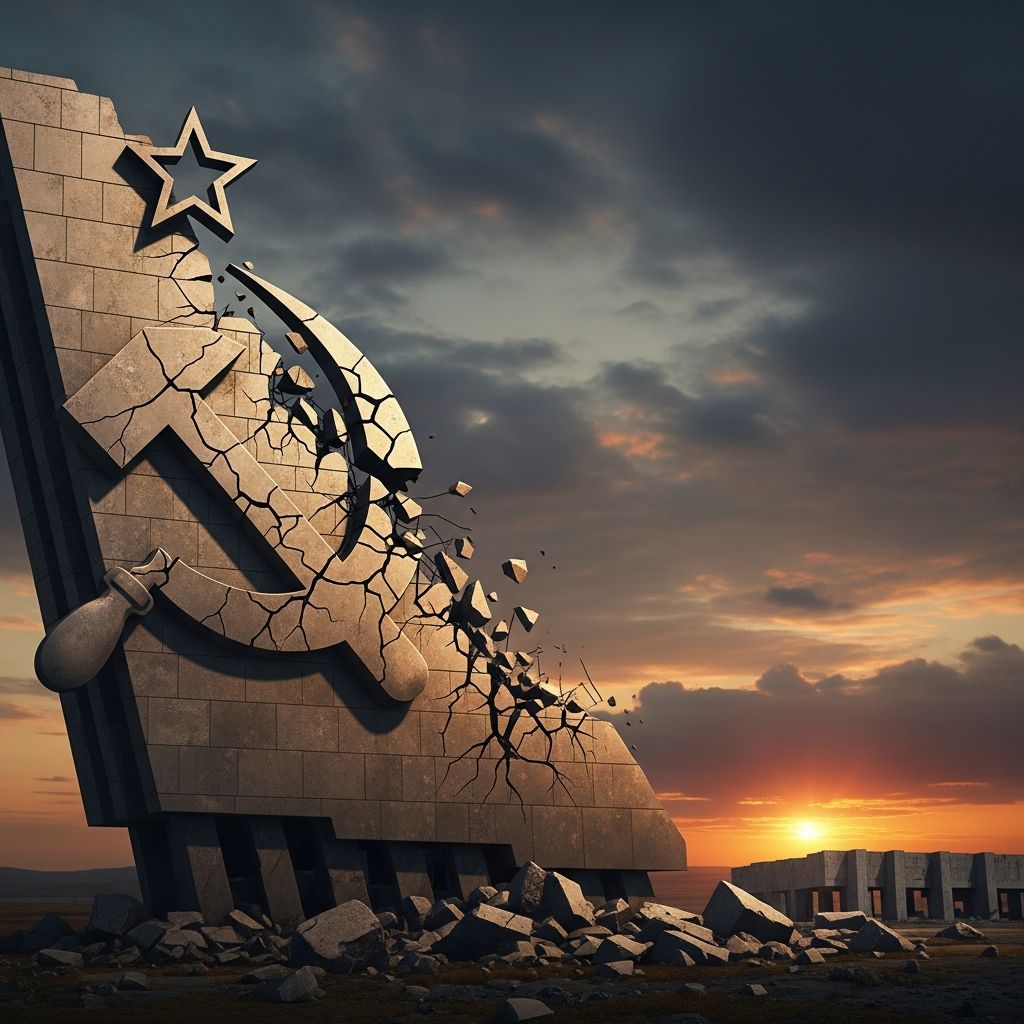
The dissolution of the Soviet Union in December 1991 marked the end of a global superpower that had dominated world affairs for over seven decades. This monumental event reshaped geopolitics, ending the Cold War and birthing 15 independent nations. Multiple intertwined factors—ranging from deep-seated economic inefficiencies to bold political experiments and external geopolitical strains—converged to dismantle the once-mighty Union of Soviet Socialist Republics (USSR).
Economic Foundations Cracking Under Pressure
At the heart of the Soviet collapse lay a chronically flawed economy. The centrally planned system, a hallmark of Soviet socialism, prioritized heavy industry and military production over consumer goods and innovation. This led to persistent shortages, low productivity, and technological lag behind the West. By the 1980s, growth rates had plummeted, with GDP per capita stagnating while Western economies surged ahead.
The oil price crash of the mid-1980s exacerbated these issues. The USSR relied heavily on petroleum exports for hard currency; when prices dropped from over $100 per barrel in 1980 to under $30 by 1986, revenues evaporated, crippling the budget. This vulnerability highlighted the economy’s overdependence on a single commodity and inability to diversify.
- Key Economic Indicators: Industrial output growth fell from 10% annually in the 1950s to under 2% by the late 1980s.
- Consumer Shortages: Long queues for basic goods like bread and meat became symbols of systemic failure.
- Inefficient Allocation: Central planners misdirected resources, favoring quantity over quality.
Gorbachev’s Bold Reforms: A Double-Edged Sword
Mikhail Gorbachev’s ascension in 1985 introduced perestroika (restructuring) and glasnost (openness), aiming to revitalize the stagnating system. Perestroika sought economic decentralization by allowing limited market mechanisms, while glasnost encouraged public discourse and reduced censorship. Initially popular, these policies unleashed forces the leadership could not control.
Perestroika’s half-measures created chaos: price controls persisted alongside nascent markets, fostering black markets and inflation. Glasnost, meanwhile, exposed decades of corruption, repression, and failures like the Afghan war, eroding faith in the Communist Party.
| Reform | Intended Goal | Actual Outcome |
|---|---|---|
| Perestroika | Boost efficiency via market elements | Inflation, shortages worsened |
| Glasnost | Promote transparency | Unleashed criticism, nationalism |
Military Overstretch and the Afghan Quagmire
The Soviet military, bloated by Cold War demands, consumed up to 25% of GDP—far exceeding NATO levels. The 1979 invasion of Afghanistan turned into a decade-long debacle, costing 15,000 Soviet lives and billions, mirroring the U.S. experience in Vietnam. Returning veterans, dubbed ‘Afgantsy,’ brought disillusionment home, fueling anti-war protests.
Arms reduction talks under Reagan further strained resources. The U.S. Strategic Defense Initiative (SDI) pressured Moscow to match technological advances it couldn’t afford, accelerating economic drain.
The Chernobyl Catastrophe: A Turning Point
On April 26, 1986, the Chernobyl nuclear reactor exploded, releasing massive radiation across Europe. The initial cover-up and bungled response shattered public trust. Gorbachev later called it “the real cause” of the USSR’s fall, as it exposed systemic incompetence and secrecy.
- Human Toll: Thousands suffered acute radiation sickness; long-term cancers affected millions.
- Economic Cost: Cleanup exceeded $200 billion in today’s terms.
- Political Fallout: Glasnost amplified criticism, linking the disaster to broader regime flaws.
Rise of Nationalism and Ethnic Tensions
The USSR comprised 15 republics with over 100 ethnic groups. Russification policies bred resentment, especially in the Baltics, Caucasus, and Central Asia. Glasnost ignited independence movements: Lithuania declared sovereignty in 1990, followed by others. The 1991 August Coup by hardliners failed spectacularly, hastening dissolution.
By late 1991, leaders of Russia, Ukraine, and Belarus signed the Belavezha Accords, formally ending the USSR.
External Pressures: Reagan’s Role and Global Shifts
U.S. President Ronald Reagan’s aggressive stance—labeling the USSR an “evil empire”—ramped up defense spending, forcing Soviet countermeasures. Sanctions and oil market manipulations via allies like Saudi Arabia compounded woes.
The fall of Eastern European satellites in 1989, from Poland to Romania, signaled the empire’s unraveling, as the Brezhnev Doctrine of intervention was abandoned.
Timeline of Critical Events
| Year | Event | Impact |
|---|---|---|
| 1979 | Afghan Invasion | Begins costly war |
| 1985 | Gorbachev Takes Power | Initiates reforms |
| 1986 | Chernobyl Disaster & Oil Crash | Exposes weaknesses |
| 1989 | Eastern Europe Revolutions | Satellites break free |
| 1990 | Baltic Independence Declarations | Nationalism surges |
| 1991 | August Coup & Belavezha Accords | USSR dissolves |
Legacy and Lessons from the Collapse
The USSR’s fall demonstrated the perils of rigid central planning, imperial overreach, and suppressed dissent. Russia inherited nuclear arsenal and UN seat, but grappled with oligarchic capitalism and authoritarian revival under Putin. New states faced turmoil but embraced democracy and markets variably.
Globally, it ended bipolarity, ushering U.S. unipolarity—though challenged today. Lessons endure: economic diversification matters, reforms must be holistic, and nationalism can fracture multi-ethnic states.
Frequently Asked Questions (FAQs)
Was Gorbachev’s perestroika the main cause of the collapse?
No, it accelerated existing problems by exposing flaws without sufficient structural change, but deep economic issues predated it.
How did the arms race contribute?
It diverted resources from civilian economy, consuming 20-25% of GDP and bankrupting the state amid falling oil revenues.
What role did Chernobyl play?
It symbolized systemic failure, eroding trust through cover-up and mismanagement, as Gorbachev himself acknowledged.
Did nationalism alone dissolve the USSR?
No, it was a catalyst; economic crisis and reforms provided the spark for republics to secede.
Could the Soviet Union have survived?
Possibly with gradual reforms and less military spending, but ideological rigidity made adaptation unlikely.
References
- Dissolution of the Soviet Union — Wikipedia Contributors. 2023-10-01. https://en.wikipedia.org/wiki/Dissolution_of_the_Soviet_Union
- The Causes and Origins of the Collapse of the Former Soviet Union — Ohio State University Knowledge Bank (Bandelin). 2010-01-01. https://kb.osu.edu/bitstreams/3f75c6aa-698a-5f0b-a5fc-253c0403bd6a/download
- Why Did the Soviet Union Collapse? — Encyclopædia Britannica (Michael Ray). 2023-08-15. https://www.britannica.com/story/why-did-the-soviet-union-collapse
- Why did the Soviet Union Collapse? — YouTube (Oversimplified). 2019-12-14. https://www.youtube.com/watch?v=w60uvrj8PtQ
- Exploring 5 Reasons for the Collapse of the Soviet Union — Exploros. 2022-05-20. https://www.exploros.com/summary/Exploring-5-Reasons-for-the-Collapse-of-the-Soviet-Union

Medha Deb is an editor with a master's degree in Applied Linguistics from the University of Hyderabad. She believes that her qualification has helped her develop a deep understanding of language and its application in various contexts. Medha specializes in the areas of beauty, health, sports, and wellness and is committed to ensuring that the content on the website is…