
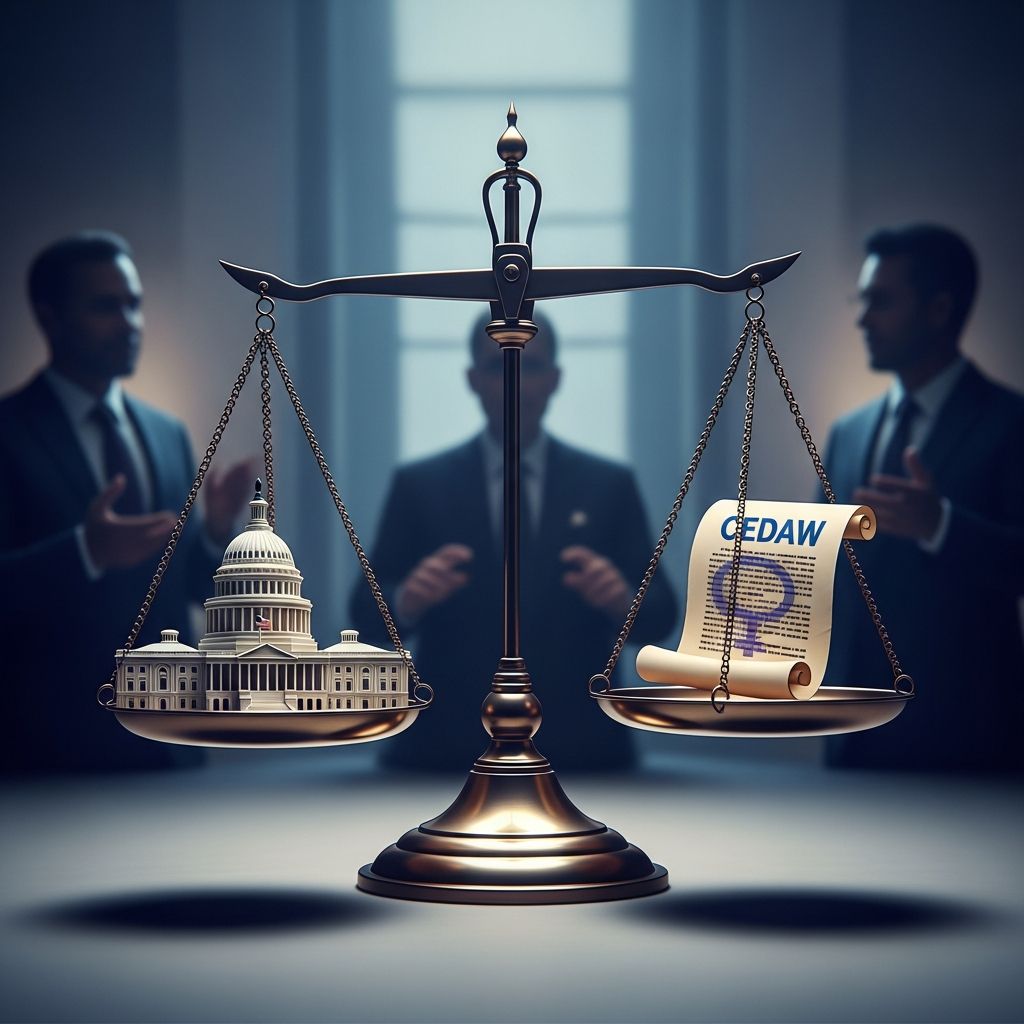
The Global Women’s Rights Treaty That America Has Yet to Embrace
On July 17, 1980, President Jimmy Carter signed the Convention on the Elimination of All Forms of Discrimination Against Women (CEDAW), marking what many believed would be a straightforward step toward international cooperation on gender equality. Nearly half a century later, the United States remains one of only a handful of nations refusing to ratify this transformative document. Of the 194 United Nations member states, 187 have formally committed to CEDAW, leaving the United States in the company of countries like Iran, Sudan, Somalia, Palau, and Tonga—a distinction that undermines America’s historical leadership on human rights and democratic values.
The absence of U.S. ratification represents a significant paradox. While the nation prides itself on championing individual liberties and democratic principles, it has failed to formally endorse a treaty that addresses fundamental discrimination against women. This contradiction has prompted decades of advocacy from civil rights organizations, policymakers, and international observers who view ratification as both a moral imperative and a practical necessity for advancing gender equality at home and abroad.
Understanding CEDAW: A Framework for Global Gender Justice
CEDAW emerged from the United Nations General Assembly in 1979 as a comprehensive international agreement designed to combat systemic discrimination against women across all spheres of society. The treaty provides a detailed framework for national governments to implement policies and legislation that ensure equal rights, opportunities, and dignity for women in education, employment, politics, family law, and public life.
The convention obligates signatory nations to adopt “appropriate measures” to eliminate discriminatory practices, though each country retains flexibility in determining how best to implement these obligations within its own legal and cultural context. Ratifying countries commit to submitting progress reports one year after ratification and then every four years thereafter, allowing international monitoring bodies to assess implementation efforts and identify gaps in compliance.
The treaty represents more than aspirational language; it functions as a living document that has guided substantial policy reforms across diverse nations. From establishing paid parental leave to addressing violence against women and ensuring equal access to financial credit, CEDAW has catalyzed concrete improvements in women’s lives worldwide. The treaty’s widespread adoption demonstrates that its provisions can be integrated into vastly different legal systems and cultural contexts, contradicting arguments that American exceptionalism requires exemption from such international commitments.
The Paradox of American Non-Ratification
The U.S. position on CEDAW reflects a broader tension in American foreign policy. During the 1970s, before CEDAW’s adoption, the United States emerged as a leading advocate for women’s rights internationally. Both Republican and Democratic parties championed ambitious policies including the Equal Rights Amendment to the Constitution, publicly funded childcare, and equal pay legislation. This bipartisan consensus on advancing women’s equality seemed poised to extend into international cooperation.
The trajectory shifted dramatically following the treaty’s signing. Despite Carter’s endorsement, the Senate Foreign Relations Committee never advanced CEDAW beyond the committee stage, where it has languished since 1980. This four-decade stalemate contrasts sharply with the swift ratification processes in most other democracies and highlights the emergence of political obstacles that transformed women’s rights from a shared national priority into a deeply polarized issue.
The disconnect between Carter’s signature and the Senate’s inaction exposes a fundamental misunderstanding of how treaty ratification functions in the American system. The president possesses the power to negotiate and sign international agreements, but the Constitution requires “advice and consent” of the Senate before ratification becomes binding. This requirement necessitates a two-thirds supermajority—67 senators out of 100—a demanding threshold that has repeatedly proved insurmountable for CEDAW advocates despite occasional Democratic control of the Senate.
Constitutional Requirements and Legislative Gridlock
The Senate’s two-thirds ratification requirement creates a structural impediment to CEDAW approval. Unlike legislation requiring only a simple majority, treaty ratification demands extraordinary consensus that reflects the framers’ intention to reserve major international commitments for matters commanding broad agreement. This constitutional design, while promoting stability in foreign relations, has become a significant barrier to gender equality advocacy when applied to CEDAW.
The Foreign Relations Committee has held hearings on CEDAW in 1988, 1990, 1994, 2002, and 2010, demonstrating periodic Democratic efforts to advance the treaty. Notably, the committee recommended ratification twice—in 1994 during the Clinton Administration and again in 2002 under President Bush, despite his conservative stance on many women’s issues. These moments of bipartisan agreement proved insufficient to overcome continued Republican opposition and the fundamental challenge of mobilizing 67 Senate votes.
The legislative gridlock reflects not merely partisan disagreement but ideological conflict over the nature of women’s rights and governmental responsibility. Opponents argue, despite evidence suggesting otherwise, that ratification would somehow undermine American sovereignty or impose foreign legal frameworks contradicting the U.S. Constitution. This argument mischaracterizes how international treaties function within American law, ignoring that the Constitution explicitly remains the supreme law of the land and that treaty ratification requires supporting domestic legislation to implement specific provisions.
Opposition Rooted in “Family Values” Politics
Republican opposition to CEDAW ratification intensified during the 1980s and has persisted through subsequent decades, driven primarily by concerns about perceived threats to traditional family structures and gender roles. Conservative groups have mobilized against the treaty, characterizing it as a threat to parental rights, religious freedom, and American cultural values. This framing transformed CEDAW from a nonpartisan human rights issue into a flashpoint in broader culture war debates.
The “family values” critique of CEDAW misrepresents the treaty’s actual provisions and intent. The convention addresses systemic discrimination in employment, education, political participation, and access to justice—not family relationships per se, though it does call for ending practices like child marriage and forced spouse selections. Yet opponents have successfully portrayed ratification as a vehicle for imposing controversial social policies, thereby mobilizing constituencies concerned about preserving traditional institutions.
This opposition strategy proved remarkably effective at preventing ratification despite lacking strong factual foundation. By framing CEDAW as an existential threat to American family autonomy and values, opponents succeeded in maintaining sufficient Senate opposition to prevent the supermajority needed for ratification. The strategy exemplifies how culture war rhetoric can override substantive policy debate, ultimately freezing the status quo regardless of treaty merits.
Debunking Arguments Against U.S. Ratification
Opponents of CEDAW ratification have advanced several arguments that deserve scrutiny. The most prominent contend that ratification would compromise American constitutional authority or impose obligations inconsistent with existing U.S. law. This concern fundamentally misunderstands treaty mechanics. International agreements ratified by the United States remain subordinate to constitutional provisions; nothing in CEDAW supersedes constitutional protections or American legal frameworks.
Additionally, ratified treaties require implementing legislation to become operative domestic law. The treaty itself does not automatically alter American statutes or legal doctrines. Previous administrations advocating CEDAW ratification explicitly clarified that the U.S. Constitution remains supreme and that appropriate reservations and understandings would accompany ratification, ensuring consistency with American law.
Another argument suggests that non-ratification is preferable because it preserves ongoing conversation about gender inequality in America. This reasoning treats non-engagement as a form of resistance to complacency—as if refusing formal commitment somehow maintains necessary vigilance. The logic inverts itself: formal ratification, coupled with mandatory progress reporting and international scrutiny, would actually increase accountability for addressing gender discrimination rather than reducing it.
Comparative Analysis: America’s Unique Position
The United States occupies a singular position among developed democracies regarding CEDAW. No other established industrial nation with comparable wealth, democratic institutions, and stated commitment to human rights has declined ratification. This distinction reflects neither American exceptionalism in a positive sense nor careful policy deliberation, but rather political dysfunction and ideological polarization that prevents ratification despite compelling practical and moral arguments.
| Region/Country Type | Ratification Status | Examples |
|---|---|---|
| European Union Nations | Ratified | All 27 member states |
| Developed Asian Democracies | Ratified | Japan, South Korea, Australia |
| Latin American Nations | Ratified | All major democracies |
| Sub-Saharan Africa | Ratified | Most nations including South Sudan |
| United States | Not Ratified | Only industrialized democracy refusing |
This comparative analysis reveals that concerns about CEDAW implementation or constitutional compatibility do not prevent ratification across diverse legal systems. Nations with complex federal structures, strong religious constituencies, and varying approaches to governance have successfully integrated CEDAW commitments into their legal frameworks, suggesting that American objections reflect political choice rather than genuine legal or practical impossibility.
Grassroots Mobilization and Sub-National Implementation
Despite federal inaction, advocacy organizations have pursued alternative strategies to advance CEDAW principles within the United States. A coalition of nearly 200 American organizations has mobilized around the “Cities for CEDAW” campaign, encouraging local jurisdictions to adopt resolutions and policies reflecting CEDAW principles and human rights standards. This grassroots approach has generated momentum at the municipal level, with numerous cities and counties formally endorsing CEDAW-aligned policies since 1995.
This sub-national movement demonstrates that CEDAW implementation need not await federal ratification. Local governments have implemented measures addressing workplace discrimination, domestic violence prevention, educational equity, and political representation that embody CEDAW principles. While formal ratification would provide greater institutional authority and international accountability, the proliferation of local CEDAW initiatives proves that American communities recognize the treaty’s relevance and value.
The “Cities for CEDAW” approach also suggests a pathway forward for advancing gender equality despite continued Senate obstruction. By building a base of local support and demonstrating the treaty’s compatibility with American law and values, advocates have established momentum that could eventually overcome federal resistance. This strategy transforms non-ratification from a permanent barrier into a temporary setback, suggesting that ratification remains achievable through sustained effort and political change.
The Role of Political Momentum and Historical Context
The #MeToo movement and broader social justice mobilizations have rekindled attention to systemic gender discrimination and violence against women. These contemporary movements highlight ongoing problems that CEDAW was designed to address—issues that remain inadequately resolved in American law and practice despite decades of activism. The intersection of gender justice advocacy with racial justice movements has created political space to revisit CEDAW ratification with fresh urgency.
Secretary of State Madeleine Albright declared in 2003 that ratification was “long past time,” articulating frustration with decades of inaction. Her statement reflected recognition that American non-ratification increasingly appeared indefensible—a choice to exclude the nation from a global consensus that cutting across ideological, religious, and cultural boundaries. This assessment gains force from the reality that ratifying countries include both conservative and progressive democracies, religious and secular societies, and nations with vastly different approaches to governance.
Current political dynamics suggest potential openings for renewed ratification efforts. Demographic shifts, evolving attitudes toward gender equality among younger voters, and international pressure stemming from American criticism of gender discrimination in other nations all create incentives for reconsideration. If political conditions shift to expand Democratic Senate representation or foster bipartisan consensus on human rights, CEDAW ratification could finally advance beyond decades of stalemate.
International Implications of Non-Ratification
American non-ratification carries consequences beyond domestic policy. When the United States criticizes gender discrimination in other nations—as it regularly does through diplomatic channels and human rights reporting—the criticism carries diminished moral authority given federal refusal to ratify the international treaty establishing gender equality as a binding commitment. Authoritarian and semi-authoritarian regimes cite American non-ratification as justification for their own resistance, undermining Washington’s credibility on human rights advocacy.
This dynamic has particularly acute implications for American efforts to promote democratic governance and human rights in developing nations. Technical assistance, educational exchange, and diplomatic pressure on gender equality issues appear inconsistent when emanating from a nation unwilling to make formal international commitment to the very principles it advocates abroad. Non-ratification thus weakens not only American moral standing but also the practical effectiveness of American human rights diplomacy.
Frequently Asked Questions About CEDAW and U.S. Ratification
Why has the United States not ratified CEDAW despite signing it in 1980?
The Senate Foreign Relations Committee has blocked CEDAW from advancing beyond the committee stage for over four decades. Republican opposition rooted in concerns about traditional family values, combined with the constitutional requirement of a two-thirds supermajority for treaty ratification, has prevented the 67 Senate votes necessary for approval. The committee has held numerous hearings but has not successfully mobilized sufficient bipartisan support.
Would CEDAW ratification override the U.S. Constitution?
No. The U.S. Constitution explicitly remains the supreme law of the land. International treaties must comply with constitutional provisions and cannot alter them. Ratifying CEDAW would require supporting domestic legislation to implement specific provisions, similar to how other ratified treaties function within American law. Previous administrations have clarified that appropriate reservations would accompany ratification to ensure compatibility with existing law.
How many countries have ratified CEDAW?
As of recent counts, 187 of 194 UN member nations have ratified CEDAW, making it one of the most widely adopted international human rights treaties. The United States is the only established industrial democracy among the handful of nations that have not ratified, placing it alongside countries including Iran, Sudan, Somalia, Palau, and Tonga.
What would CEDAW ratification require of the United States?
Ratification would commit the U.S. government to implementing “appropriate measures” to eliminate gender discrimination across employment, education, politics, and public life. The nation would submit progress reports beginning one year after ratification and then every four years, allowing international monitoring of implementation. However, each country retains flexibility in determining how best to achieve CEDAW objectives within its legal and cultural context.
Can CEDAW ratification happen despite Senate gridlock?
Yes, but it requires political conditions that expand Democratic Senate representation or generate bipartisan consensus on human rights. Contemporary social justice movements focused on gender equality may create renewed momentum for ratification. The “Cities for CEDAW” campaign demonstrates ongoing grassroots commitment to CEDAW principles even absent federal ratification.
References
- Why Ratifying the Convention on the Elimination of Discrimination Against Women (CEDAW) is Good for America’s Domestic Policy — Georgetown Institute for Women, Peace and Security. 2021-02-18. https://giwps.georgetown.edu/2021/02/18/why-ratifying-the-convention-on-the-elimination-of-discrimination-against-women-cedaw-is-good-for-americas-domestic-policy/
- CEDAW and the USA: When Belief in Exceptionalism Becomes Exemptionalism — Heinrich Böll Foundation. 2019-12-10. https://www.boell.de/en/2019/12/10/cedaw-and-usa-when-belief-exceptionalism-becomes-exemptionalism
- The Convention on the Elimination of All Forms of Discrimination Against Women (CEDAW) — American Civil Liberties Union. 2010-04-29. https://www.aclu.org/sites/default/files/field_document/CEDAW_factsheet_20100429.pdf
- Cities for CEDAW | UNA-USA — United Nations Association of the United States of America. 2021-06. https://unausa.org/wp-content/uploads/2021/06/UNAWomenCEDAWToolkit.pdf
- Ratification Status for CEDAW – UN Treaty Body Database — United Nations Office of the High Commissioner for Human Rights. Accessed 2026-04-05. https://tbinternet.ohchr.org/_layouts/15/TreatyBodyExternal/Treaty.aspx?Treaty=CEDAW&Lang=en

Medha Deb is an editor with a master's degree in Applied Linguistics from the University of Hyderabad. She believes that her qualification has helped her develop a deep understanding of language and its application in various contexts. Medha specializes in the areas of beauty, health, sports, and wellness and is committed to ensuring that the content on the website is…