
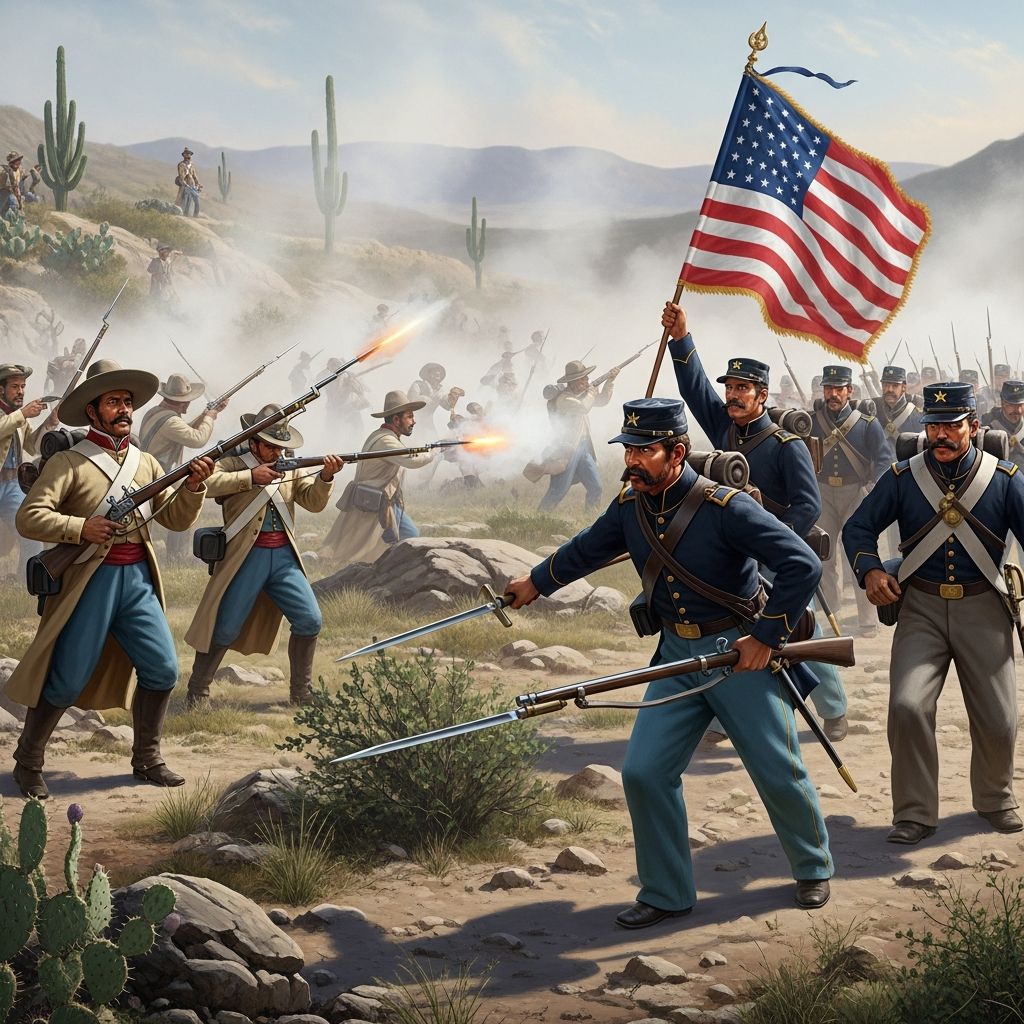
The Mexican-American War (1846-1848) marked a defining moment in North American history, resulting in massive territorial expansion for the United States. Fueled by disputes over Texas annexation and border claims, the conflict pitted a rising U.S. power against a fractured Mexico. America’s win was not accidental but stemmed from superior military organization, innovative strategies, abundant resources, and effective diplomacy. This article examines these elements in depth, drawing on historical analyses to explain why the U.S. prevailed decisively.
Historical Context and Spark of Conflict
The war’s roots trace back to Texas’s independence from Mexico in 1836, which Mexico never fully acknowledged. When the U.S. annexed Texas in 1845, adopting its claim to the Rio Grande as the border, tensions erupted. Mexico insisted the boundary was the Nueces River, 100-150 miles northeast. President James K. Polk, driven by Manifest Destiny—the belief in America’s divine right to expand westward—sent troops into the disputed zone, provoking skirmishes that Polk used to justify war declaration on May 13, 1846.
Mexico’s internal chaos, marked by political instability and frequent coups, weakened its war readiness. In contrast, the U.S. benefited from a unified federal structure and growing industrial base, setting the stage for dominance.
Superior Military Leadership and Talent
One cornerstone of U.S. success was exceptional leadership. Generals like Zachary Taylor and Winfield Scott, both seasoned veterans, orchestrated brilliant campaigns. Taylor’s victories at Palo Alto and Resaca de la Palma in May 1846 stunned Mexican forces, establishing early momentum. Scott’s audacious amphibious landing at Veracruz in 1847, followed by the inland march to Mexico City, exemplified strategic genius, overcoming rugged terrain and fierce resistance at Cerro Gordo and Chapultepec.
Future Civil War luminaries such as Robert E. Lee, Ulysses S. Grant, and George McClellan gained invaluable experience, honing skills that later defined American military prowess. Mexico, however, suffered from leadership fractures; President Antonio López de Santa Anna’s return from exile failed to unify or inspire, plagued by poor decisions and desertions.
Logistical and Technological Edges
U.S. logistical superiority proved decisive. With a robust network of rivers, roads, and soon railroads, the U.S. Army efficiently supplied troops across vast distances. Naval dominance allowed Scott’s Veracruz expedition, bypassing Mexico’s stronger northern defenses. Rifled muskets and artillery outclassed Mexico’s outdated equipment, enabling U.S. forces to inflict heavy casualties while minimizing their own.
Mexico’s supply lines crumbled under guerrilla attacks, corruption, and geography. Soldiers often went hungry, leading to low morale and high desertion rates—up to 20% in some units. The U.S. maintained volunteer enthusiasm through pay, provisions, and patriotic fervor.
| Aspect | United States | Mexico |
|---|---|---|
| Troops Mobilized | ~73,000 (regulars + volunteers) | ~25,000-40,000 |
| Naval Power | Strong fleet (blockades, transport) | Limited, no blue-water navy |
| Industrial Output | High (rifles, cannons) | Low, import-dependent |
| Budget Allocation | $10M+ war funding | Financially strained |
This table highlights disparities that amplified U.S. advantages throughout the war.
Strategic Innovations and Bold Maneuvers
U.S. strategies combined conventional battles with unconventional approaches. In the north, Taylor’s defensive posture lured Mexicans into open fights where American firepower prevailed. Scott’s southern campaign mirrored Cortés’s 1519 conquest, using mobility and alliances with local dissidents to divide Mexican resistance.
Expeditions in California and New Mexico succeeded with minimal forces; the Mormon Battalion and naval seizures secured the Pacific coast without major battles, fulfilling Manifest Destiny goals. Mexico’s defensive strategy faltered, unable to coordinate across theaters or counter amphibious threats effectively.
- Northern Campaign: Taylor’s 6,000 troops repelled 15,000 Mexicans at Buena Vista (1847).
- Central Campaign: Scott captured Mexico City after 16 months.
- Western Campaign: Bloodless conquests added 500,000+ square miles.
These maneuvers showcased adaptability, contrasting Mexico’s rigid, centralized command.
Political Will and National Morale
Domestic support bolstered U.S. efforts. Polk’s administration framed the war as defensive, rallying public opinion despite Whig opposition like Abraham Lincoln’s ‘Spot Resolutions.’ Volunteers flocked, viewing it as expansionist glory. Mexico’s populace, war-weary from internal strife, offered lukewarm support; Santa Anna’s regime faced revolts, diluting focus.
Economically, the U.S. thrived on wartime production, while Mexico’s economy collapsed under blockades and loans, exacerbating instability.
The Path to Treaty and Territorial Gains
By September 1847, with Mexico City occupied, negotiations ensued. Nicholas Trist, defying recall orders, secured the Treaty of Guadalupe Hidalgo (February 2, 1848). Mexico ceded Texas (with Rio Grande border), California, Nevada, Utah, and parts of Arizona, New Mexico, Colorado, and Wyoming—for $15 million.
This acquisition, the Mexican Cession, doubled U.S. size, enabling Gold Rush settlement and Pacific reach. For Mexico, it meant humiliation, loss of half its territory, and spurred reforms.
Long-Term Impacts and Controversies
The war intensified U.S. sectionalism; new lands reignited slavery debates, culminating in the Compromise of 1850 and Civil War. It honed U.S. military doctrine for future conflicts and solidified Manifest Destiny.
Critics decry it as aggressive imperialism, with Polk provoking war deliberately. Yet, it undeniably propelled America toward continental superpower status.
Frequently Asked Questions (FAQs)
What sparked the Mexican-American War?
The disputed Texas border—Rio Grande vs. Nueces River—after U.S. annexation in 1845, leading to clashes in 1846.
Who were the key U.S. generals?
Zachary Taylor (northern victories) and Winfield Scott (Mexico City capture), with rising stars like Grant and Lee.
What did the U.S. gain territorially?
Over 500,000 square miles via the Mexican Cession, including California and the Southwest, per Treaty of Guadalupe Hidalgo.
Why did Mexico lose despite home advantage?
Internal divisions, poor logistics, inferior leadership, and U.S. naval/military superiority overwhelmed them.
Did the war influence the U.S. Civil War?
Yes, territorial gains fueled slavery expansion debates, deepening North-South rifts.
References
- Mexican–American War — Wikipedia. 2023-10-01. https://en.wikipedia.org/wiki/Mexican%E2%80%93American_War
- The Mexican-American War — U.S. National Park Service. 2024-01-15. https://www.nps.gov/places/the-mexican-american-war.htm
- The Causes and Reasons for the Mexican-American War — Exploros. 2022-05-20. https://www.exploros.com/summary/causes-reasons-for-mexican-american-war
- Mexican-American War — Encyclopædia Britannica. 2024-03-10. https://www.britannica.com/summary/Causes-and-Effects-of-the-Mexican-American-War
- Mexican-American War — Vermont National Guard. 2023-07-12. https://vt.public.ng.mil/Museum/History/Wars/Mexican-American/
- Causes of the Mexican-American War — Society for Historians of American Foreign Relations (SHAFR). 2018-09-01. https://www.shafr.org/assets/docs/Teaching/Assignments/causes_of_the_mexican-american_war_assignment_watts.pdf

Medha Deb is an editor with a master's degree in Applied Linguistics from the University of Hyderabad. She believes that her qualification has helped her develop a deep understanding of language and its application in various contexts. Medha specializes in the areas of beauty, health, sports, and wellness and is committed to ensuring that the content on the website is…