
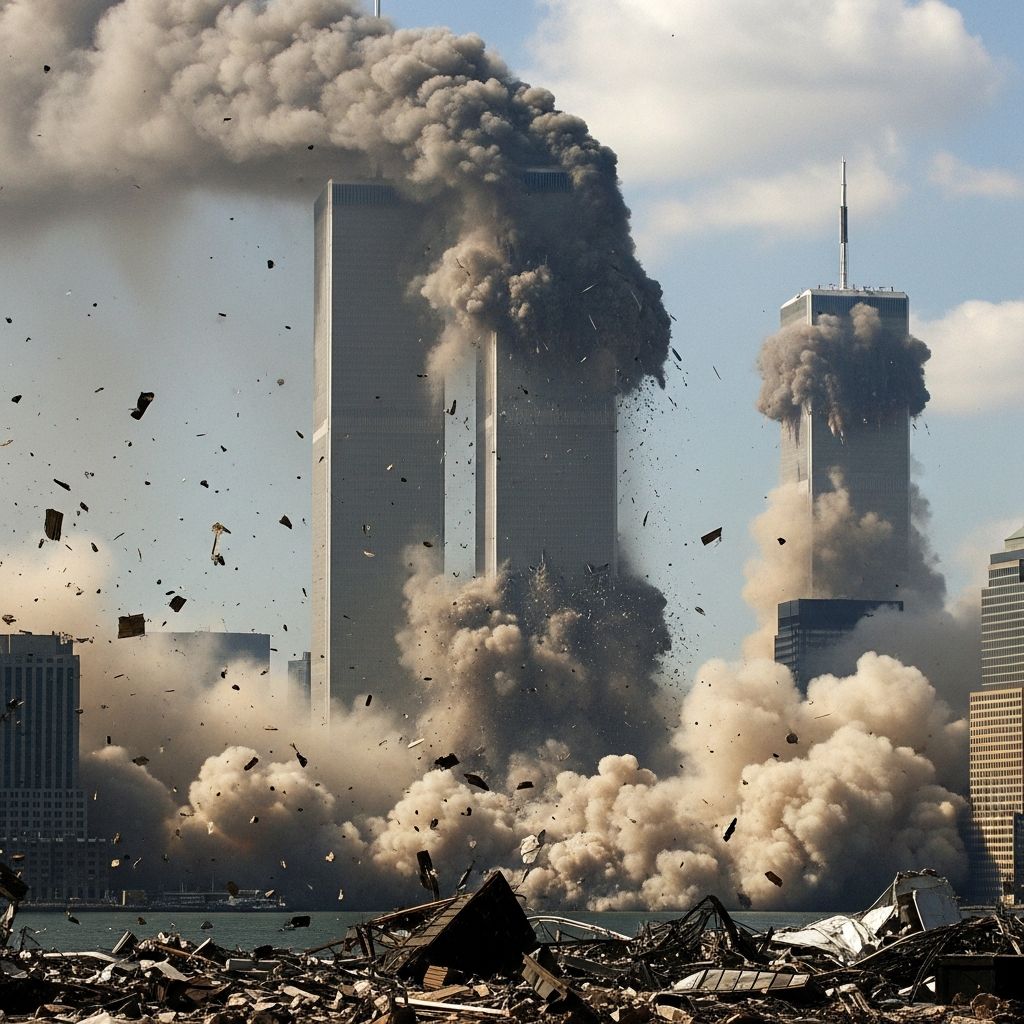
The events of September 11, 2001, marked a tragic turning point in modern history, where the iconic Twin Towers of the World Trade Center (WTC 1 and WTC 2) and later Building 7 succumbed to unprecedented structural failures. This article delves into the multifaceted causes, drawing from authoritative investigations to explain the sequence of events, the role of aircraft impacts, intense fires, and the resulting progressive collapses. Understanding these failures has profoundly influenced global building codes and safety standards.
Overview of the Catastrophic Events
On that fateful morning, hijacked commercial airliners struck the North Tower (WTC 1) at 8:46 a.m. and the South Tower (WTC 2) at 9:03 a.m. WTC 1 stood for 102 minutes before collapsing at 10:28 a.m., while WTC 2, despite being hit second, fell first at 9:59 a.m. after just 56 minutes. Later, at 5:20 p.m., the 47-story WTC 7 collapsed following hours of uncontrolled fires fueled by debris from the towers.
These buildings, engineered as marvels of the 1960s and 1970s, featured innovative tube-frame designs with lightweight floor trusses spanning between a central core and perimeter columns. While resilient to the initial impacts, the combination of physical damage and subsequent fires proved overwhelming.
Design Innovations and Vulnerabilities Exposed
The Twin Towers utilized a perimeter tube structure for lateral load resistance, allowing vast open floor spaces. Floor systems consisted of trusses connecting the core to the exterior, coated with spray-on fireproofing insulation. This design prioritized occupant safety and wind resistance, capable of withstanding hurricanes up to 140 mph, but operated at only about 20% capacity on the calm day of the attacks.
Key vulnerabilities included the reliance on fireproofing, which could be dislodged by impact, and the long-span trusses susceptible to sagging under heat. WTC 7, a more conventional steel-framed structure built in 1987, depended on critical interior columns for stability.
- Twin Towers Features: Perimeter columns, core columns, lightweight steel trusses with fireproofing.
- WTC 7 Features: Steel girders and beams connected to key columns, diesel fuel tanks adding fire load.
- Common Weakness: Fire-induced thermal expansion and weakening of steel connections.
Aircraft Impacts: Initial Structural Assault
American Airlines Flight 11, a Boeing 767, slammed into WTC 1 between floors 93 and 99 at approximately 440 mph, severing 35-36 exterior columns and damaging core columns across 6-8 floors. United Airlines Flight 175 hit WTC 2 between floors 77 and 85 at similar speeds, causing more extensive core damage due to the lower impact zone, which bore greater overhead weight.
The kinetic energy from these impacts—equivalent to small earthquakes—did not topple the towers sideways, as their mass (over 500,000 tons each) resisted lateral forces. Instead, debris severed supports, ruptured fuel lines, and dislodged fireproofing from trusses, exposing steel to direct heat.
| Building | Impact Floors | Damage Extent | Stand Time |
|---|---|---|---|
| WTC 1 (North) | 93-99 | 35 exterior, multiple core columns | 102 minutes |
| WTC 2 (South) | 77-85 | Severe core damage, higher load | 56 minutes |
The Fire’s Devastating Role
Each plane carried about 10,000 gallons of jet fuel, igniting multifloor infernos reaching temperatures over 1,000°C. Unlike typical office fires, the fuel spread rapidly across floors, weakening unprotected steel trusses. These sagged, pulling inward on perimeter columns and initiating instability.
In WTC 1, fires burned uncontrolled for nearly two hours, as damaged sprinklers failed without water supply. WTC 2’s lower impact amplified stresses, hastening failure. Fires stripped insulation, causing steel to lose 50-90% strength at 600-800°C.
For WTC 7, debris from WTC 1 ignited fires on at least 10 floors. Uncontrolled for seven hours, heat expanded girders, failing connections to Column 79, triggering global collapse.
Progressive Collapse Mechanism
Collapse initiated when weakened upper floors pancaked onto those below, overwhelming supports with dynamic loads 10-100 times design capacity. In WTC 2, the top 30 floors dropped, gaining momentum and shredding perimeter columns floor-by-floor in seconds.
WTC 1 followed similarly, with sagging floors on the opposite side pulling columns inward. The chain reaction—upper mass crushing successive levels—explains the near-free-fall speed, pulverizing concrete and ejecting debris.
WTC 7’s failure began internally: Column 79 buckled, leading to floor collapses and exterior buckling, resulting in a symmetric implosion.
Scientific Investigations and Findings
The National Institute of Standards and Technology (NIST) led a multi-year probe, reconstructing impacts and fires using videos, debris analysis, and simulations. Their reports confirmed fires as the primary collapse trigger post-impact, not explosives or other theories.
MIT engineer Thomas Eagar emphasized fire’s role over impact alone, noting uniform weakening unlike gradual fires. Peer-reviewed studies and ASCE panels corroborated these, though some engineers called for further research into details.
Lessons for Modern Skyscraper Design
Post-9/11 reforms include enhanced fireproofing adhesion, redundant structural paths, and improved evacuation. New codes mandate better sprinkler reliability and column protection. Buildings like One World Trade Center incorporate concrete cores and impact-resistant facades.
- Fire Resistance: Thicker, intumescent coatings; non-combustible materials.
- Structural Redundancy: Multiple load paths to prevent progressive failure.
- Evacuation: Wider stairs, refuge areas, and emergency communication.
Frequently Asked Questions (FAQs)
What caused the Twin Towers to collapse straight down instead of toppling over?
The immense mass and gravity directed failure downward; lateral forces from impacts were insufficient to tip structures weighing half a million tons.
Could the fires alone have brought down the buildings?
No, impacts dislodged insulation and damaged supports, enabling fires to weaken unprotected steel critically.
Why did WTC 7 collapse without being hit by a plane?
Debris-started fires burned uncontrolled, causing thermal expansion and failure of a key column, leading to progressive collapse.
How long did NIST’s investigation take?
Three years for WTC 7 alone, involving extensive modeling and testing.
Have building codes changed since 9/11?
Yes, with stricter fire safety, redundancy, and analysis requirements worldwide.
Broader Implications and Ongoing Research
The collapses reshaped urban engineering, emphasizing resilience against extreme events. While NIST reports provide consensus, debates persist on details like exact temperatures and debris ejection, spurring advanced simulations today. These tragedies underscore steel’s fire vulnerability without protection, informing designs for sustainable, safer high-rises.
Word count: 1678 (excluding metadata and references).
References
- Why the building (WTC7) fell — ASM International. 2008. https://www.asminternational.org/news/videos/-/journal_content/56/10192/2033672/VIDEO/
- The Collapse of World Trade Center | The Complete Physics — YouTube (Video Transcript). 2023. https://www.youtube.com/watch?v=1NkBfLBov5Q
- 9/11 – How and Why the Towers Fell — YouTube (Video Transcript). 2023. https://www.youtube.com/watch?v=Gs2onv3umdY
- Why the Towers Fell | The Collapse: An Engineer’s Perspective — MIT (T. Eagar). 2001. https://eagar.mit.edu/publications/Eagar185supplement1.pdf
- Reconstruction of the collapses of the New York World Trade Center buildings – 2000s — NIST. 2023 (updated). https://www.nist.gov/fire/history/reconstruction-collapses-new-york-world-trade-center-buildings-2000s
- Engineers Push New Study of Twin Towers’ Collapse — Science Magazine. 2001-10-08. https://www.science.org/content/article/engineers-push-new-study-twin-towers-collapse

Medha Deb is an editor with a master's degree in Applied Linguistics from the University of Hyderabad. She believes that her qualification has helped her develop a deep understanding of language and its application in various contexts. Medha specializes in the areas of beauty, health, sports, and wellness and is committed to ensuring that the content on the website is…