
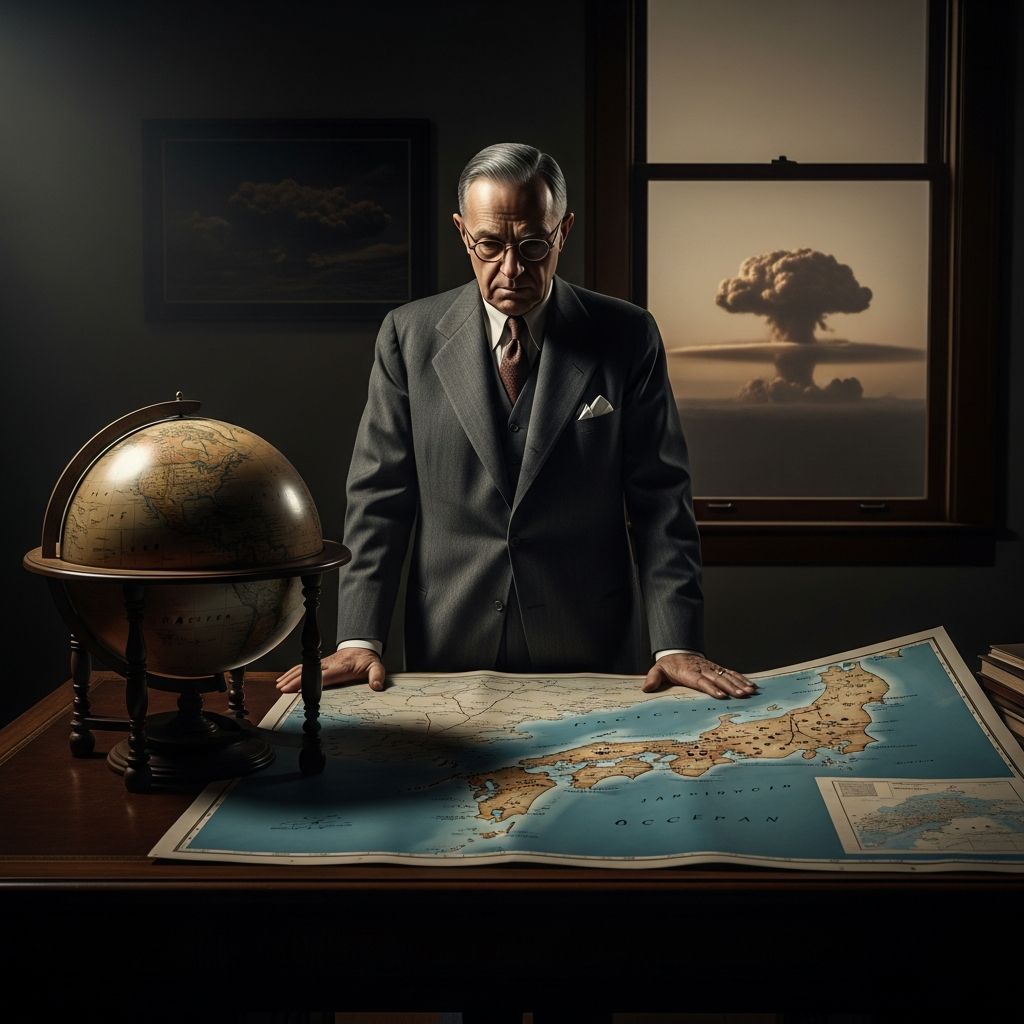
The Strategic Calculus of Nuclear Deployment in 1945
When President Harry Truman assumed office following Franklin D. Roosevelt’s death on April 12, 1945, he inherited an ongoing Pacific War that showed no signs of imminent conclusion. Within weeks, Truman learned of the Manhattan Project, a classified scientific initiative that had developed the world’s first atomic weapons. This revelation presented him with an unprecedented decision: whether to authorize the use of these devastating new weapons against Japan. The choice would ultimately reshape modern warfare and leave historians debating its justification for generations to come.
The Invasion Alternative and Casualty Projections
Military planners had developed Operation Downfall, a comprehensive strategy to invade the Japanese Home Islands directly. This invasion faced formidable obstacles that deeply concerned American leadership. The Japanese military had demonstrated unwavering commitment to fighting to the last soldier, exemplified by the horrific casualty rates in previous Pacific campaigns. General of the Army George C. Marshall acknowledged the uncertainty surrounding potential losses, stating during a June 18 White House meeting that estimates of American casualties from invasion varied so widely that providing specific numbers would be unreliable.
The earlier battles of Iwo Jima and Okinawa had established a grim pattern. Japanese soldiers rarely surrendered, instead choosing mass suicide rather than capitulation. Military strategists feared that a mainland invasion could result in hundreds of thousands of American deaths. Additionally, Japanese civilians had been extensively trained in basic combat techniques and encouraged by their government to view surrender as dishonorable. Women and children had been instructed to resist invading forces by any means available. This fanaticism suggested that an invasion would impose catastrophic human costs on both sides.
Soviet Entry and Geopolitical Complications
A second critical factor influencing Truman’s decision involved the Soviet Union’s role in the conflict. American leadership held mixed views about Soviet participation in the war against Japan. While some believed that Soviet entry would expedite Japanese surrender, others worried about the long-term consequences of Soviet territorial expansion in Asia. General Marshall reported that Soviet entry might prove “the decisive action levering them into capitulation,” suggesting that Moscow’s involvement could make invasion unnecessary.
However, Truman and Secretary of State James Byrnes increasingly saw the situation differently. They recognized that Soviet military involvement in Manchuria and potential moves into Korea would fundamentally alter the postwar geopolitical landscape. Rather than allowing the Soviets to play a decisive role in Japan’s defeat, some advisors believed that demonstrating American nuclear capability would strengthen the nation’s negotiating position in the postwar world and potentially limit Soviet influence in East Asia.
The Manhattan Project’s Completion and Political Momentum
The successful test of the atomic device in New Mexico in July 1945 marked a turning point in Truman’s deliberations. The weapon’s extraordinary destructive power exceeded expectations. Military planners immediately began identifying potential targets, with emphasis on cities that had been previously spared from conventional bombing to accurately measure the atomic weapon’s effects. Hiroshima emerged as the primary target, followed by Nagasaki as a backup option.
Once the weapon’s viability was confirmed, considerable momentum built toward its operational use. The military leadership saw the bomb as a means to achieve Japanese surrender without requiring an invasion. MacArthur, despite later claims otherwise, neither objected to nor advocated against the bombs’ use. When informed of their imminent deployment, he responded with technical observations about atomic warfare’s future rather than expressing reservations about the decision itself.
The Potsdam Conference and Communication Strategy
In late July 1945, Truman, British Prime Minister Winston Churchill, and Chinese leader Chiang Kai-shek gathered at Potsdam to finalize surrender terms for Japan. On July 26, they issued the Potsdam Declaration, demanding Japan’s unconditional surrender and threatening “prompt and utter destruction” if Japan refused. Notably, the declaration made no specific reference to atomic weapons, though the threat of “utter destruction” could reasonably be interpreted as an implicit warning.
Truman authorized use of the atomic bombs on July 25, one day before the Potsdam Declaration’s issuance. This timing suggests that military preparation had already advanced beyond the point of reconsideration. The declaration itself provided Japan with an opportunity to avoid atomic bombardment by surrendering, yet Japanese leadership rejected these terms. Japan’s official response, issued through the media on July 28, dismissed the ultimatum through a policy of “mokusatsu,” often translated as ignoring or treating with contempt.
Internal Advisory Debates and Scientific Dissent
Not all of Truman’s advisors unanimously supported atomic deployment. The Interim Committee, established by Secretary of War Henry Stimson to provide guidance on atomic bomb usage, revealed internal divisions. While some members advocated for a demonstration on a deserted island before international observers, others pushed for immediate operational use against military or industrial targets. The Interim Committee ultimately endorsed dropping the bomb on a military installation surrounded by workers’ homes without advance warning.
Scientists involved in developing the weapon also expressed concerns. Seven researchers from the University of Chicago’s Metallurgical Laboratory submitted a confidential June 11, 1945 report recommending that the bomb be demonstrated on an unpopulated island before an international audience. They suggested that if Japan refused to surrender following such a demonstration, the weapon could then be deployed against a pre-designated target area with sufficient warning time for civilian evacuation. This proposal was not adopted.
Contrasting Interpretations of Military Necessity
Historical interpretations of whether the atomic bombs were truly necessary remain deeply contested. Proponents of the decision emphasize that conventional invasion would have produced far greater casualties among both American troops and Japanese civilians. They argue that the bombs provided a shock effect capable of overcoming Japanese military leadership’s refusal to consider surrender despite Japan’s deteriorating military situation.
Critics counter that Japan was already seeking conditional surrender terms through Soviet intermediaries. Intelligence intercepts revealed Japanese efforts to negotiate through Moscow, and some scholars argue that clarifying whether the Emperor would be retained could have prompted surrender without nuclear weapons. Additionally, critics note that the Soviet declaration of war against Japan on August 9 fundamentally altered the strategic situation, potentially making the second bombing on Nagasaki unnecessary.
Japanese political dynamics support this analysis. When news of Hiroshima reached Foreign Minister Togo, he immediately proposed ending the war. However, the Supreme Council remained deadlocked, with military hardliners still advocating continued resistance. Only after learning of Soviet entry into the war did the council unanimously agree to accept Allied surrender terms. The British official history concluded that Soviet involvement “brought home to all members of the Supreme Council the realization that the last hope of a negotiated peace had gone.”
Target Selection and Civilian Casualties
The choice of Hiroshima and Nagasaki as targets reflected careful military planning. Both cities possessed military or industrial significance while remaining relatively intact from previous conventional bombing campaigns. This selection allowed military planners to assess the atomic weapons’ full destructive power without interference from prior damage. An estimated 70,000 to 80,000 people died instantly in Hiroshima, with total deaths reaching approximately 140,000 by the end of 1945 due to radiation sickness and injuries. Nagasaki’s bombing three days later killed approximately 35,000 to 40,000 people immediately.
The civilian death toll proved enormous and immediate, shocking even military planners who expected significant destruction. Women, children, and the elderly comprised the majority of victims, raising profound ethical questions about the decision. Critics argue that this scale of civilian casualties was disproportionate to any conceivable military advantage, particularly given the apparent imminent Japanese surrender.
The Soviet Factor in Japan’s Capitulation
The precise contributions of atomic bombing versus Soviet entry to Japan’s surrender remain historically disputed. Soviet forces invaded Manchuria on August 9, 1945, the same day as the Nagasaki bombing, demonstrating conventional military capabilities that threatened Japan’s position in Asia. Japanese military leaders had harbored faint hopes of Soviet neutrality or even potential mediation. The Soviet invasion shattered these illusions and eliminated any possibility of negotiated peace terms more favorable than unconditional surrender.
Some historians argue that the combined shock of Soviet entry and atomic bombing created an overwhelming impetus for surrender. Others suggest that Soviet entry alone would have sufficed to convince Japan’s civilian leadership to capitulate, making the atomic bombs strategically redundant though perhaps psychologically significant. Emperor Hirohito’s intervention in the Supreme Council on August 9, breaking the deadlock between military hardliners and civilian peace advocates, occurred after learning of both atomic bombing and Soviet invasion.
Long-term Implications and Missed Opportunities
Some scholars contend that Truman and Secretary of State Byrnes missed an opportunity to end the war through alternative means. A clear warning about atomic weapons, combined with clarification that the Emperor could be retained, might have prompted earlier surrender without nuclear weapons’ use. The Potsdam Declaration’s insistence on unconditional surrender and its silence regarding the Emperor’s fate may have hardened Japanese resistance among military leaders.
The decision to use atomic weapons without demonstration and without explicit warning represented a choice among available alternatives rather than an inevitable response to circumstances. Military planners possessed other options, including continued conventional bombing, naval blockade, and invasion with or without Soviet assistance. The selection of the atomic bomb reflected particular strategic preferences among Truman’s advisors rather than absolute military necessity.
Frequently Asked Questions
Q: Did Truman fully understand the destructive power of atomic weapons before authorizing their use?
A: Truman understood that atomic weapons possessed unprecedented destructive capabilities. However, the actual scale of civilian casualties and long-term radiation effects were not fully appreciated in advance. Truman wrote in his diary on July 25 that the weapon should be used “against military objectives and soldiers and sailors, not women and children.” Yet civilian death tolls far exceeded these expressed intentions.
Q: Could Japan have surrendered without atomic bombing?
A: Historical debate continues on this question. Japan’s military leadership resisted surrender despite hopeless circumstances, while civilian leaders increasingly sought peace. Soviet entry into the war dramatically shifted the situation. Whether atomic bombs were necessary or merely accelerated surrender remains contested among historians and scholars.
Q: Why was a second bomb dropped on Nagasaki?
A: Japan did not immediately surrender following Hiroshima on August 6. Military planners proceeded with the planned attack on Nagasaki on August 9 as scheduled. However, the Japanese government’s formal acceptance of surrender terms came shortly after learning of Soviet entry and the second atomic bombing.
Q: What alternatives to atomic bombing were available to end the war?
A: Alternative strategies included conventional invasion despite anticipated casualties, continuation of conventional bombing campaigns, naval blockade to starve Japan’s economy, waiting for Soviet entry into the war, and modifying surrender terms to preserve the Emperor’s role in Japanese governance.
References
- Truman and the Atomic Bomb — World War II — PBS Learning Media. Accessed April 2026. https://www.pbslearningmedia.org/resource/pres10.socst.ush.dww.atomicbomb/truman-and-the-atomic-bomb-world-war-ii-truman/
- Learning from Truman’s Decision: The Atomic Bomb and Japan’s Surrender — Association for Asian Studies. https://www.asianstudies.org/publications/eaa/archives/learning-from-trumans-decision-the-atomic-bomb-and-japans-surrender/
- Decision to Drop the Atomic Bomb — Harry S. Truman Library and Museum. https://www.trumanlibrary.gov/education/presidential-inquiries/decision-drop-atomic-bomb
- The Atomic Bombing of Hiroshima and Nagasaki — U.S. National Archives and Records Administration. https://visit.archives.gov/whats-on/explore-exhibits/atomic-bombing-hiroshima-and-nagasaki
- Why did America drop two atomic bombs on Japan? — Imperial War Museum. https://www.iwm.org.uk/history/why-did-america-drop-two-atomic-bombs-on-japan
- Potsdam and the Final Decision to Use the Bomb, July 1945 — U.S. Department of Energy Office of Scientific and Technical Information. https://www.osti.gov/opennet/manhattan-project-history/Events/1945/potsdam_decision.htm
- The Atomic Bomb: Arguments in Support Of The Decision — History on the Net. https://www.historyonthenet.com/decision-use-atomic-bomb-arguments-support

Medha Deb is an editor with a master's degree in Applied Linguistics from the University of Hyderabad. She believes that her qualification has helped her develop a deep understanding of language and its application in various contexts. Medha specializes in the areas of beauty, health, sports, and wellness and is committed to ensuring that the content on the website is…