
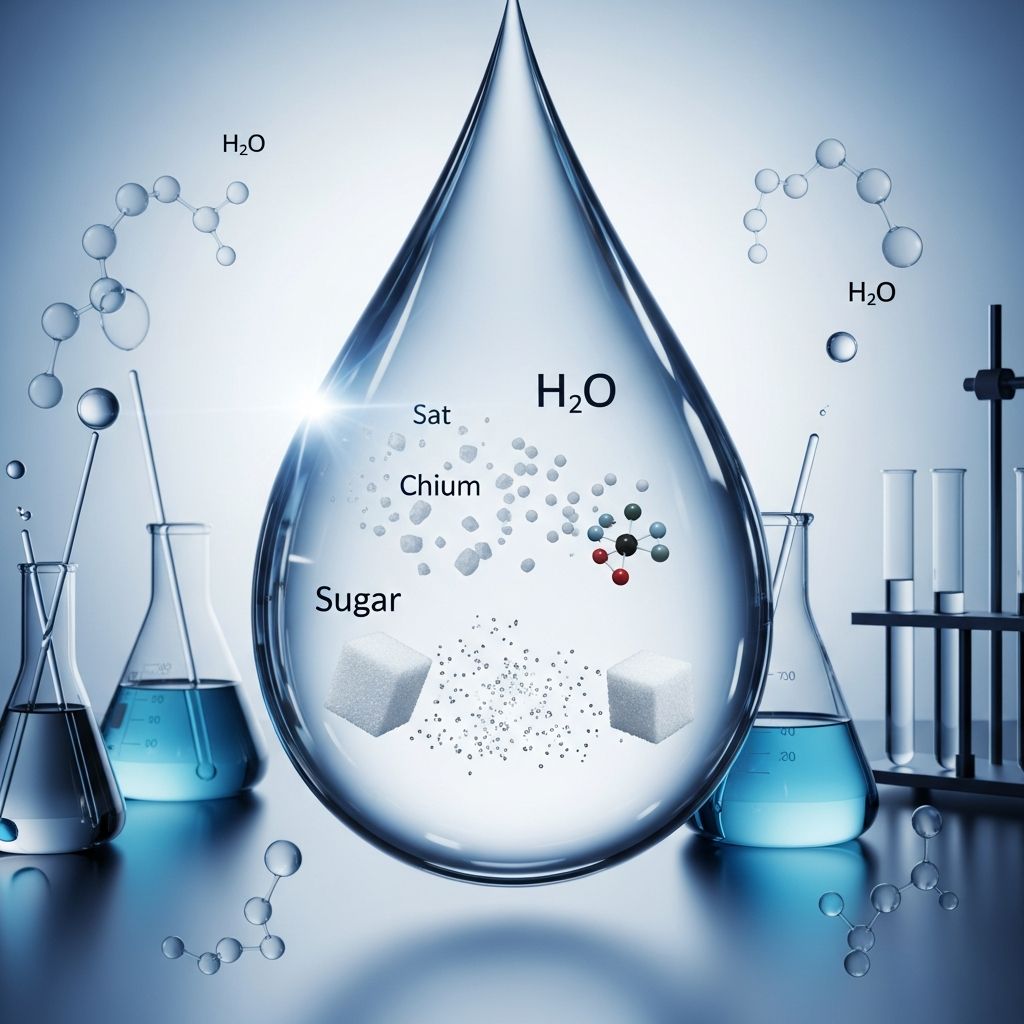
Water earns its title as the universal solvent because it dissolves more substances than any other liquid, thanks to its polar nature and hydrogen bonding capabilities. This property underpins countless chemical reactions, biological processes, and environmental cycles on Earth.
The Molecular Structure of Water
At its core, a water molecule consists of one oxygen atom bonded to two hydrogen atoms, forming a bent structure with a bond angle of about 104.5 degrees. This arrangement creates a dipole moment: oxygen, being more electronegative, pulls electron density toward itself, resulting in a partial negative charge (δ⁻), while the hydrogens carry partial positive charges (δ⁺).
This polarity is key. Unlike nonpolar molecules like oils, water’s uneven charge distribution allows it to interact strongly with other polar or charged particles. Additionally, water molecules form hydrogen bonds—electrostatic attractions between the δ⁻ oxygen of one molecule and the δ⁺ hydrogen of another. These bonds are dynamic, constantly breaking and reforming, which contributes to water’s fluidity and solvating power.
- Bond strength: Hydrogen bonds are weaker than covalent bonds but stronger than typical dipole-dipole interactions.
- Network formation: Each water molecule can form up to four hydrogen bonds, creating a tetrahedral network in liquid water.
- Impact on properties: This leads to high boiling point (100°C), surface tension, and solvent ability compared to similar-sized molecules like H₂S.
How Water Dissolves Substances
Water’s solvent action relies on ‘like dissolves like,’ but its versatility stems from handling both ionic and polar solutes effectively. For ionic compounds like sodium chloride (NaCl), water molecules surround Na⁺ ions with their oxygen ends and Cl⁻ ions with their hydrogen ends, weakening ion-ion attractions and causing dissociation into hydrated ions.
Polar covalent compounds, such as sugars or alcohols, dissolve via similar attractions: water’s partial charges align with the solute’s dipoles, aided by hydrogen bonding. Even some nonpolar gases like oxygen dissolve to a limited extent through weak dispersion forces, though sparingly.
| Solute Type | Dissolving Mechanism | Examples |
|---|---|---|
| Ionic | Ion-dipole interactions, hydration shells | NaCl, KNO₃ |
| Polar covalent | Hydrogen bonding, dipole-dipole | Glucose, ethanol |
| Nonpolar (limited) | Dispersion forces | O₂, CO₂ |
The high dielectric constant of water (about 80) further enhances its solvent prowess by screening electrostatic forces between ions, reducing their tendency to recombine.
Biological Significance of Water’s Solvent Properties
In living organisms, water’s role as a solvent is indispensable. Cells are aqueous environments where enzymes catalyze reactions, nutrients dissolve for transport via blood, and waste products are flushed out. For instance, in photosynthesis, water splits to provide electrons, and in cellular respiration, it participates in hydrolysis reactions.
Proteins, DNA, and carbohydrates rely on water for folding and function through hydrophilic interactions. Blood plasma, 90% water, carries dissolved gases (O₂, CO₂), ions, and metabolites, maintaining homeostasis. Without water’s solvency, metabolic processes would halt.
- Transport: Dissolved minerals in xylem enable plant growth.
- Digestion: Hydrolytic enzymes break down food in aqueous media.
- pH regulation: Water’s amphoteric nature (acting as acid or base) buffers solutions.
Environmental and Geological Roles
Water shapes Earth’s surface as a solvent in the rock cycle. Rainwater, slightly acidic from dissolved CO₂, weathers rocks, dissolving minerals like calcium carbonate to form caves and soil. Rivers carry suspended and dissolved loads, depositing sediments and nutrients.
Oceans dissolve vast amounts of salts, maintaining salinity levels crucial for marine life. The water cycle recycles these solutes, distributing elements globally. Ice’s lower density (due to hydrogen-bonded open structure) allows lakes to freeze from the top, insulating aquatic ecosystems.
Industrial and Everyday Applications
Industries exploit water’s solvency in pharmaceuticals (drug formulation), cleaning (detergents lower surface tension for oil removal), and cooling (heat transfer in solutions). In labs, aqueous solutions standardize reactions; ultrapure water minimizes contaminants.
Everyday, it dissolves coffee, sugar in tea, or salts in baths. However, hard water (high in Ca²⁺, Mg²⁺) forms scale in pipes, prompting softening processes.
Limitations: Not Truly Universal
Despite its nickname, water fails to dissolve nonpolar substances like hydrocarbons or oils, which clump via hydrophobic interactions. Fluorocarbons and noble gases are also insoluble. This selectivity is vital: cell membranes use lipid bilayers to separate aqueous compartments.
Some salts have solubility limits (e.g., temperature-dependent), and supersaturation can occur. pH affects solubility, as seen with metal hydroxides.
Advanced Solvent Properties
Water’s amphoterism enables self-ionization: 2H₂O ⇌ H₃O⁺ + OH⁻ (K_w = 10⁻¹⁴ at 25°C), setting the pH scale. Its high specific heat stabilizes temperatures, and cohesion/adhesion drive capillary action in plants.
Compared to other solvents:
| Solvent | Dielectric Constant | Key Strength |
|---|---|---|
| Water | 80 | Ionic/polar solutes |
| Ethanol | 24 | Organic compounds |
| Hexane | 2 | Nonpolar lipids |
Frequently Asked Questions (FAQs)
What makes water a better solvent than other liquids?
Water’s polarity, hydrogen bonding, and high dielectric constant allow it to interact with and separate a wide range of ions and molecules more effectively than alternatives.
Why doesn’t water dissolve oil?
Oil is nonpolar, lacking charges for water’s dipole to attract; instead, oil molecules stick together via van der Waals forces, repelled by water (hydrophobic effect).
How does temperature affect water’s solvent ability?
Generally, solubility of solids increases with temperature, while gases decrease, due to kinetic energy disrupting lattices or driving gases out.
Is water the only universal solvent?
No, but it’s unmatched for aqueous biology and common substances; supercritical fluids or ionic liquids serve niche industrial roles.
Why is pure water essential in labs?
Impurities introduce variables; deionized water ensures reproducible results in experiments.
Conclusion
Water’s status as the universal solvent arises from its molecular polarity and hydrogen bonding, enabling dissolution critical to life, geology, and industry. While not dissolving everything, its supremacy remains unchallenged.
References
- Water, the Universal Solvent — U.S. Geological Survey (USGS). 2023-05-15. https://www.usgs.gov/water-science-school/science/water-universal-solvent
- 4.1: Water, the Universal Solvent — Chemistry LibreTexts (Zumdahl and DeCoste). 2024-01-10. https://chem.libretexts.org/Bookshelves/General_Chemistry/Map:_Chemistry_(Zumdahl_and_Decoste)/04:_Types_of_Chemical_Reactions_and_Solution_Stoichiometry/4.01_Water_the_Universal_Solvent
- Water Properties, Polarity and Role as a Universal Solvent — Sigma-Aldrich (MilliporeSigma). 2023-11-20. https://www.sigmaaldrich.com/US/en/technical-documents/technical-article/water-purification/understanding-lab-water/water-properties-polarity-role-as-solvent
- Solvent properties of water — Khan Academy. 2024-02-28. https://www.khanacademy.org/science/biology/water-acids-and-bases/hydrogen-bonding-in-water/a/water-as-a-solvent

Medha Deb is an editor with a master's degree in Applied Linguistics from the University of Hyderabad. She believes that her qualification has helped her develop a deep understanding of language and its application in various contexts. Medha specializes in the areas of beauty, health, sports, and wellness and is committed to ensuring that the content on the website is…