
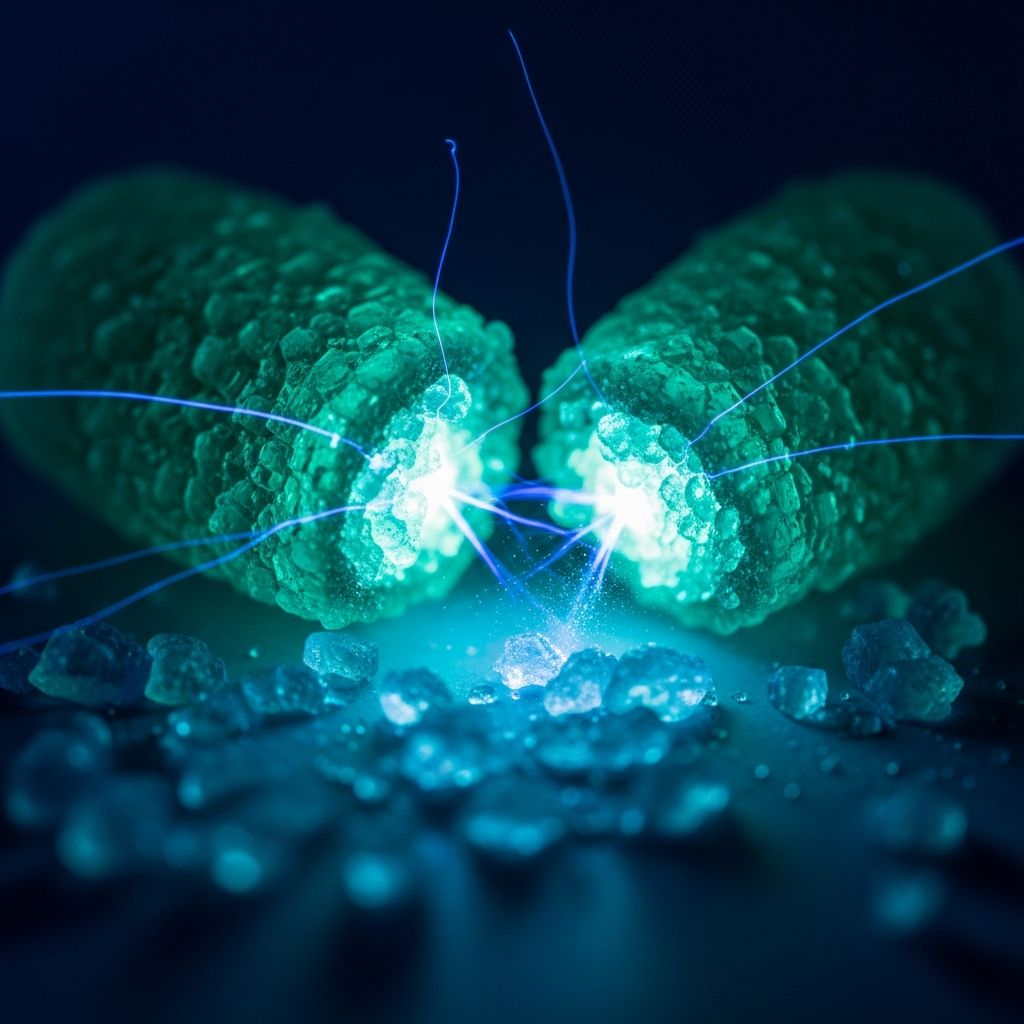
Imagine biting into a simple piece of candy and witnessing a burst of blue light in complete darkness. This isn’t magic—it’s the captivating world of triboluminescence, a phenomenon where mechanical action like crushing produces light. Wintergreen-flavored Life Savers, particularly the Wint-O-Green variety, are famous for this effect, turning an ordinary treat into a personal light show.
The Physics of Light from Friction
Triboluminescence occurs when materials, often crystalline ones, are subjected to stress such as biting, crushing, or rubbing. The term derives from Greek roots meaning ‘rubbing light,’ highlighting its frictional origins. In sugary candies, the key players are sugar crystals. When you crunch down, these crystals fracture, generating localized electric fields.
These fields strip electrons from molecules, sending them into the surrounding air, rich in nitrogen. The free electrons collide with nitrogen atoms, exciting them. As nitrogen returns to its ground state, it releases energy primarily as ultraviolet (UV) light, invisible to the human eye. This process mirrors lightning on a tiny scale, where charge separation leads to discharge.
Why Wintergreen Candies Outshine Others
Not all hard candies spark equally. Most produce faint, imperceptible light because the UV emission isn’t converted to visible wavelengths. Enter methyl salicylate, the oil of wintergreen flavoring in Wint-O-Green Life Savers. This compound is fluorescent: it absorbs UV light (short wavelength) and re-emits it as blue visible light (longer wavelength).
This fluorescence amplifies the glow dramatically, making sparks visible even without specialized equipment. Peppermint versions, lacking sufficient methyl salicylate, yield dimmer effects. The synergy of triboluminescent sugar and fluorescent flavoring creates the iconic blue flashes.
Historical Glimpses and Modern Observations
Reports of candy sparks date back decades, with camp stories and science demos popularizing the effect. High-speed photography reveals intricate spark patterns, showing streaks of light from fracturing surfaces. Slow-motion videos capture the bursts as vivid blue lightning, confirming the mechanical trigger’s role.
Scientists note that crystal asymmetry is crucial; symmetric structures rarely triboluminesce. Sugar’s imperfect lattice makes it ideal, explaining why everyday confections double as physics labs.
Hands-On Experiments to Try at Home
Replicate this phenomenon safely with minimal setup. Here’s a step-by-step guide:
- Choose a fresh roll of Wint-O-Green Life Savers—stale ones weaken the effect.
- Enter a pitch-black room; let eyes adjust for 5-10 minutes.
- Position a mirror in front; bite a candy firmly with mouth slightly open.
- Observe blue sparks dancing across teeth and tongue.
- For safety, avoid swallowing fragments; supervise children.
Alternatives include crushing candies between pliers in darkness or peeling adhesive tape, which also triboluminesces faintly. These demos illustrate physics accessibility.
| Method | Expected Glow | Best For |
|---|---|---|
| Biting in mouth with mirror | Bright blue sparks | Personal viewing |
| Crushing with tools | Visible bursts | Group demos |
| Tape peeling | Faint glow | Comparative test |
Comparing Candy Varieties: A Spark Intensity Guide
Different flavors yield varying luminescence. Wintergreen dominates due to its chemistry, but others offer subtle shows:
- Wint-O-Green: Intense blue, highly fluorescent.
- Pep-O-Mint: Weak UV emission, minimal visible light.
- Other sugars (e.g., butterscotch): Faint or none without fluorescence.
Intensity depends on crystal size, freshness, and biting force. Larger crystals fracture more dramatically, boosting electron release.
Broader Applications of Triboluminescence
Beyond candy, this effect appears in nature and technology. Crushing quartz or peeling wintergreen leaves sparks similarly. It’s studied for stress sensors, where light emission indicates material strain, useful in aviation and construction.
In forensics, triboluminescent traces aid fracture analysis. Researchers explore it for luminescent materials in displays or safety gear, converting mechanical energy to light without batteries.
Safety Considerations and Fun Facts
While harmless, excessive hard candy crunching risks dental wear. The sparks pose no health risk; methyl salicylate is FDA-approved in small amounts. Fun fact: The effect strengthens in dry air, as humidity dampens charge separation.
Global variations exist; equivalent wintergreen candies in other countries may spark similarly if formulated alike.
Frequently Asked Questions (FAQs)
Why only wintergreen Life Savers and not others?
The methyl salicylate in wintergreen fluoresces UV to blue light, unlike other flavors.
Can I see sparks in regular light?
No, darkness is essential; ambient light overwhelms the faint emission.
Is this safe for kids?
Yes, with supervision to prevent choking; use fresh candies.
Do all sugary crystals spark?
Many do faintly via triboluminescence, but visibility varies by structure and additives.
What’s the science name for friction light?
Triboluminescence, from mechanical stress-induced luminescence.
Delving Deeper: Molecular Mechanisms
At the atomic level, fracturing displaces positive and negative charges, creating piezoelectric fields in asymmetric crystals. Electrons tunnel through, exciting air molecules. Nitrogen’s emission peaks at 337 nm (UV), absorbed by methyl salicylate’s pi-electrons, which relax emitting ~450 nm blue.
Spectroscopy confirms this cascade: pure sugar yields broad UV; wintergreen adds visible peaks. Quantum models predict intensity scales with fracture surface area, aligning with observations.
Cultural Impact and Educational Value
This demo captivates audiences, bridging chemistry, physics, and optics. Museums like OMSI and Exploratorium feature it, inspiring STEM interest. Social media videos amplify reach, with millions viewing slow-motion sparks.
In classrooms, it teaches energy conservation: mechanical → electrical → photonic. Extensions include comparing salts like sucrose vs. quartz, revealing material dependencies.
Future Research Directions
Advances may yield engineered triboluminescent polymers for wearables or anti-counterfeit labels. Nanoscale crystals could enhance efficiency, potentially powering micro-LEDs via chewing. Environmental applications include monitoring glacial fractures via ice triboluminescence.
Despite simplicity, unanswered questions persist: exact electron yield per fracture? Optimal flavor matrices? These drive ongoing curiosity.
References
- Why do wintergreen candies spark in the dark? — Scienceline (New York University). 2008-05-12. https://scienceline.org/2008/05/ask-locke-lifesavers/
- Why Do Wint-O-Green Life Savers Spark in the Dark? — HowStuffWorks. Accessed 2026. https://recipes.howstuffworks.com/question505.htm
- Spark in the Dark! DIY Triboluminescence — Oregon Museum of Science and Industry (OMSI). 2022-11. https://omsi.edu/wp-content/uploads/2022/11/DIY-Design_Triboluminescense_OneSheet.pdf
- Life Saver Triboluminescence — Fluorescent Mineral Society. Accessed 2026. https://uvminerals.org/glownotes/science/life-saver-triboluminescence/
- LIFE SAVER LIGHTNING (Triboluminescence Slow Motion) — YouTube (The Slow Mo Guys). Accessed 2026. https://www.youtube.com/watch?v=tW8q_JfmcbU
- Science of Candy: Lightning in Your Mouth — Exploratorium. Accessed 2026. https://annex.exploratorium.edu/cooking/candy/activity-lightning.html

Medha Deb is an editor with a master's degree in Applied Linguistics from the University of Hyderabad. She believes that her qualification has helped her develop a deep understanding of language and its application in various contexts. Medha specializes in the areas of beauty, health, sports, and wellness and is committed to ensuring that the content on the website is…