
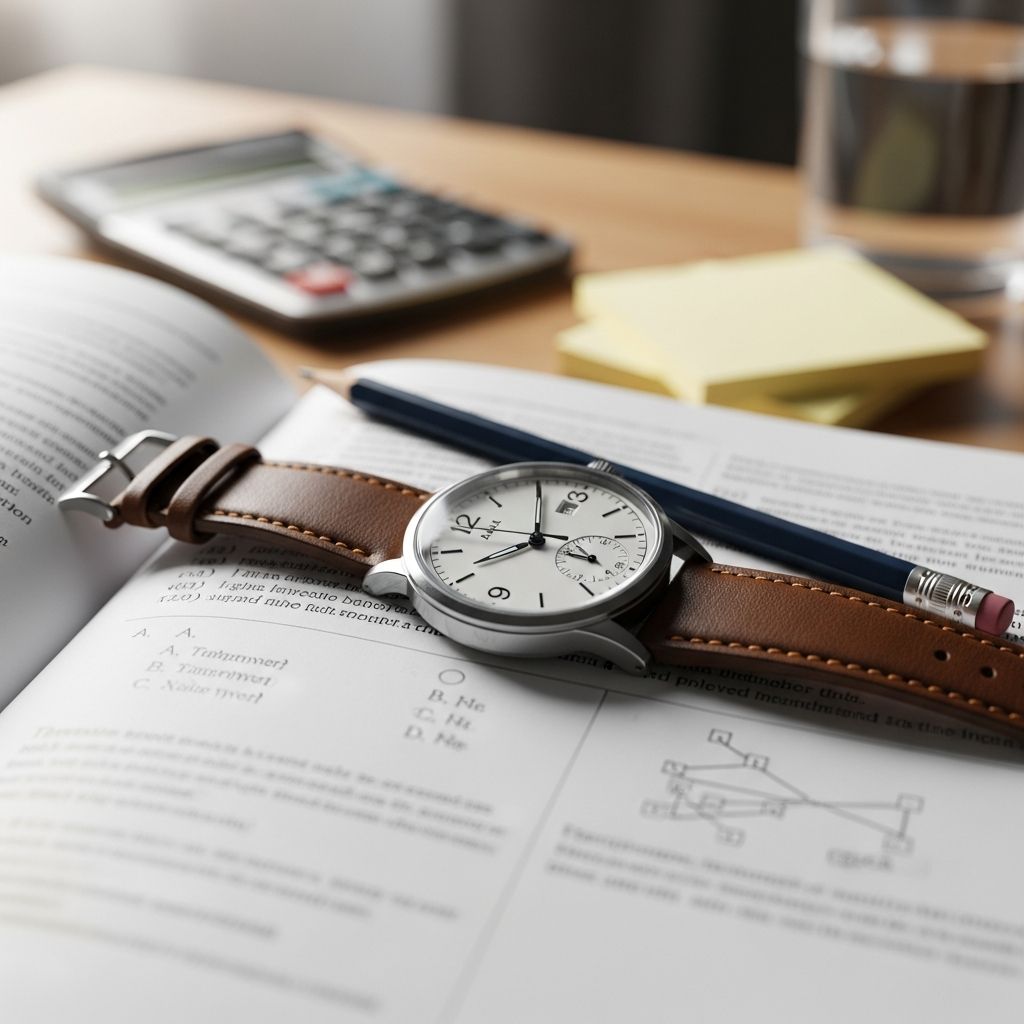
When preparing for high-stakes exams like the SAT or ACT, students focus extensively on content mastery, practice problems, and test-taking strategies. However, one surprisingly impactful element often gets overlooked: having a personal timepiece to track your progress throughout the examination. This seemingly small detail can significantly influence your performance, focus level, and ultimately your final score.
The Challenge of Relying on Room Clocks
Test administrators typically place a clock somewhere in the examination room and provide periodic announcements about remaining time. While these measures exist to help students pace themselves, they come with significant drawbacks. Many testing facilities position wall clocks in less-than-ideal locations—sometimes behind test-takers, requiring them to rotate their chairs or bodies to check the time.
When you turn away from your work to consult a wall clock, you interrupt your cognitive flow. This momentary disruption requires your brain to refocus and reorient to the problem you were solving. Research on concentration and task engagement demonstrates that such interruptions create cognitive switching costs, where your mind needs time to return to its previous level of engagement. During a high-pressure exam where every second counts, these breaks in concentration can accumulate into measurable performance losses.
The ACT and SAT both recognize this challenge. While they don’t require students to use personal timepieces, test policies explicitly allow them, acknowledging their value for student performance.
How Personal Timing Devices Preserve Mental Energy
Mental fatigue represents one of the most underestimated obstacles during long examinations. A typical SAT session lasts over three hours, while the ACT can extend beyond two and a half hours. During this extended period, your mental resources deplete gradually through sustained focus, rapid decision-making, and problem-solving.
By wearing a watch or keeping a small timing device in your line of sight, you eliminate the need to redirect your attention away from your test materials. A quick downward glance at your wrist provides immediate temporal information without breaking your physical orientation or visual connection to your work. This preservation of attention translates directly into sustained mental energy, allowing you to maintain your optimal cognitive state throughout the examination.
Additionally, knowing you have reliable personal access to time information reduces anxiety. Test anxiety often manifests as uncertainty—uncertainty about whether you’re working at an appropriate pace, whether you’ll finish in time, or whether you’ve already used more time than anticipated. A personal timepiece provides concrete, immediate answers to these anxieties, promoting a sense of control and calm.
Understanding Permitted Timepiece Options
Not all watches are created equal when it comes to standardized testing. The College Board and ACT have established clear guidelines about what constitutes an acceptable timepiece. Understanding these restrictions prevents last-minute complications on test day.
Prohibited Devices
Students cannot bring the following items into the testing room:
- Smartwatches of any brand (Apple Watch, Garmin, Android Wear, Pebble, etc.)
- Fitness trackers or health monitoring devices
- Any timepiece with computing, communication, or recording capabilities
- Watches that make noise, beep, or produce alarms
- Devices with cell phone functionality
Acceptable Timepiece Categories
The following options are permitted during examinations:
- Basic analog watches: Traditional watches with hour, minute, and second hands remain universally acceptable. They’re simple, reliable, and completely silent.
- Silent digital watches: Standard digital watches without alarm or notification functions work perfectly. Common brands like Casio offer affordable, durable options specifically popular among test-takers.
- Specialized test timing watches: Companies have developed watches specifically engineered for SAT and ACT exams, featuring preset countdown timers for each section and visual progress indicators.
- Basic stopwatch function devices: Some students prefer watches with stopwatch capabilities that count upward rather than downward, helping them track elapsed time rather than remaining time.
Selecting the Right Watch for Your Needs
Different students benefit from different timing approaches. Consider these factors when choosing your examination timepiece:
Cost Considerations
You don’t need an expensive timepiece to excel on standardized tests. Basic digital or analog watches cost between ten and thirty dollars, making them accessible to all students. The functionality difference between an expensive watch and an inexpensive one is negligible during examinations.
Display Preferences
Some students prefer countdown timers that display remaining time, while others find this psychologically stressful, interpreting the decreasing numbers as pressure. For these students, stopwatch functions that count upward may feel less anxiety-inducing. Experiment during practice tests to determine your preference.
Visual Accessibility
Consider whether you prefer a watch with large, clearly visible numbers or if standard sizing works for you. Some specialized test watches feature bright displays or high-contrast designs specifically engineered for quick readability during examinations.
The Critical Importance of Practice Integration
Obtaining an appropriate watch is only half the equation. Many students acquire a suitable timepiece but fail to practice with it before test day. This oversight eliminates much of the watch’s benefit because you’re still adjusting to using it when it matters most.
Effective preparation requires consistent practice with your chosen watch throughout your entire study period. When completing timed practice tests, use the same watch you’ll wear on examination day. This familiarization accomplishes several objectives:
- Physical habituation: You become accustomed to how the watch feels on your wrist, eliminating potential discomfort during the actual exam.
- Timing strategy development: You learn how to interpret time remaining, understanding what thirty minutes actually feels like within a particular section, how quickly a fifteen-minute interval passes, and what pace you need to maintain.
- Psychological conditioning: Your brain becomes familiar with the watch’s presence, reducing it from a novel distraction to a familiar tool.
- Technical proficiency: You learn how to quickly check your watch without losing your place, developing an efficient glance pattern that minimizes attention disruption.
If you don’t typically wear watches in daily life, begin your preparation by wearing your test watch consistently during study sessions. This extended exposure ensures that on examination day, the watch feels like a natural extension of your preparation routine rather than an unfamiliar device.
Strategic Time Management Applications
Having a reliable timepiece enables several evidence-based timing strategies that improve performance:
Sectional Pacing
For sections with multiple parts—such as the Math section’s calculator and non-calculator portions, or the Reading section’s passage-based questions—you can divide your total time and monitor whether you’re staying on pace for each subdivision. This prevents spending excessive time on early problems at the expense of later ones.
Question Difficulty Navigation
Knowing precisely how much time you’ve spent on individual problems helps you make strategic decisions about when to move forward. Rather than guessing based on vague feelings, you have concrete information about whether spending additional time on a challenging question aligns with your overall pacing strategy.
Mental Checkpoint System
You can establish personal checkpoints—for instance, determining that halfway through a section’s time allocation, you should be approximately 60% through the questions. Your watch enables precise monitoring of these checkpoints, preventing the surprise of discovering you’re behind schedule in the final minutes.
Individual Variation in Watch Utility
While most students benefit from using a personal watch during examinations, individual variation matters. Some students find timepieces psychologically beneficial, while others experience increased anxiety from constantly monitoring time. If you’re prone to time-focused anxiety or obsessive checking, you might perform better focusing on problem content rather than remaining clock-conscious.
The only way to determine whether a watch will genuinely help your performance is through extensive practice. If you find during practice tests that you’re becoming overly fixated on time or experiencing increased stress, you can make an informed decision to abstain from using a watch during the actual examination.
Practical Test Day Implementation
Beyond selecting and practicing with an appropriate watch, several practical considerations ensure it functions effectively on examination day:
- Verify silence: Check that your watch makes absolutely no sounds—no alarms, no notifications, no beeping. Test it thoroughly before test day to ensure complete silence.
- Confirm permissions: If you’re using a specialized test watch or an unfamiliar device, consider showing your proctor in advance or having documentation from the manufacturer confirming compliance with test policies.
- Arrive prepared: Wear your watch when you arrive at the testing center. Don’t wait until the last moment to put it on for the first time on test day.
- Maintain focus: While your watch enables better time awareness, avoid obsessive checking. Glance periodically, not constantly, to maintain focus on actual test content.
The Competitive Advantage of Clock Mastery
Students who effectively manage time during standardized exams consistently score higher than equally prepared peers who struggle with pacing. Your watch becomes the tool that enables this advantage—not through making you work harder, but through helping you work smarter by maintaining consistent focus and making deliberate timing decisions.
The cumulative effect of avoiding cognitive disruption, maintaining anxiety levels, and executing strategic time management creates measurable score improvements. Many students report that introducing a personal watch into their preparation routine was the single most impactful adjustment they made before attempting their examinations.
Final Recommendations for Test Success
The path to leveraging a watch effectively involves several straightforward steps: first, select an appropriate timepiece that aligns with your preferences and budget—basic digital watches from reliable manufacturers offer excellent value. Second, integrate this watch into your practice routine immediately, wearing it during every timed practice session and study period. Third, test your watch’s silence thoroughly before examination day. Finally, remember that while a watch is an excellent tool for most students, monitor during practice whether it genuinely helps your performance, adjusting your approach based on personal evidence.
The SAT and ACT represent crucial milestones in your academic journey. By implementing proven strategies like using a personal timepiece, you maximize your preparation investment and position yourself to achieve your strongest possible score. This small detail, applied consistently, compounds into significant advantages that can influence your college options and future opportunities.
References
- Why you should bring a watch to the SAT — Lemma, Inc. https://www.youtube.com/watch?v=Vilq0dCOWnk
- Testing Timers: Digital Watch Helps Students on SAT and ACT — ABC News. https://abcnews.go.com/Technology/testing-timers-digital-watch-helps-sat-act-test/story?id=17343240
- Winners Wear a Watch During the SAT and ACT — Edison Prep. https://edisonprep.com/wear-a-watch/
- The Silent Watch I use for the SAT and ACT — The College Panda. https://thecollegepanda.com/silent-watch-for-sat-and-act/
- Tip for Timing on the ACT: The ACT Watch — Summit Prep. https://summitprep.com/blog/the-act-watch/
- Two Life-Saving Tricks to Keep Time During the SAT Exam — Winward Academy. https://www.winwardacademy.com/two-life-saving-tricks-to-keep-time-during-the-sat-exam/
- Prohibited Devices — SAT Suite — College Board. https://satsuite.collegeboard.org/sat/what-to-bring-do/prohibited-devices

Medha Deb is an editor with a master's degree in Applied Linguistics from the University of Hyderabad. She believes that her qualification has helped her develop a deep understanding of language and its application in various contexts. Medha specializes in the areas of beauty, health, sports, and wellness and is committed to ensuring that the content on the website is…