
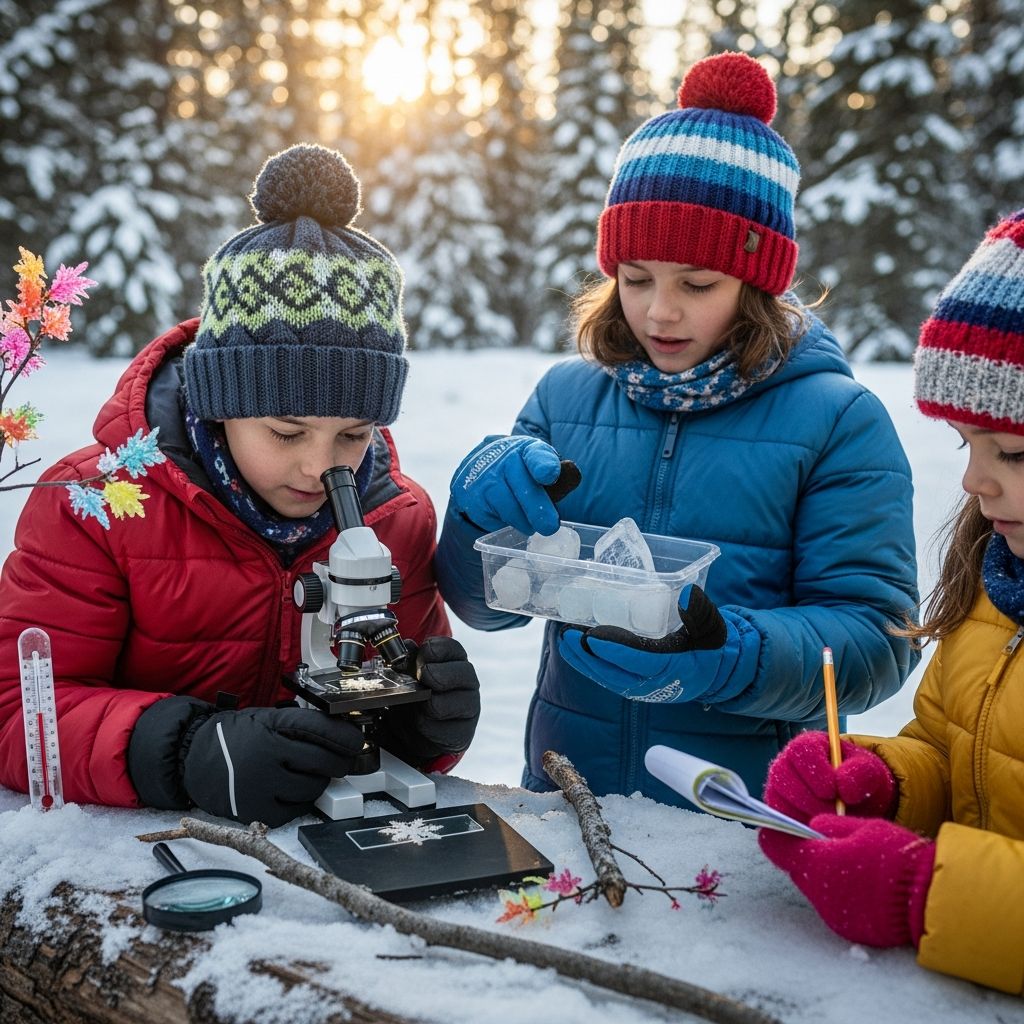
Winter offers a unique opportunity to bring the chill of the season indoors through captivating science experiments. These activities transform everyday materials into tools for discovery, helping children grasp fundamental concepts like phase changes, thermal dynamics, and biological adaptations. Designed for preschool through elementary ages, they require minimal setup and encourage observation, prediction, and critical thinking.
Exploring Ice and Snow Dynamics
Ice and snow provide perfect mediums for investigating how temperature influences matter. Children can witness dramatic transformations that illustrate scientific principles in action.
- Ice Excavation Challenge: Freeze small toys or coins in ice blocks. Provide tools like warm water, salt, or string to ‘rescue’ them. This reveals how solutes lower freezing points and accelerate melting.
- Melting Race on Surfaces: Place identical ice cubes on metal, fabric, and wood. Time their melt rates to compare heat absorption properties of different materials.
- Frozen Bubble Observation: Blow soap bubbles outdoors on cold days or in a freezer. Watch them crystallize and shatter, demonstrating gas contraction and water vapor freezing.
These experiments highlight heat transfer mechanisms, where conduction, convection, and radiation play key roles. For instance, darker surfaces absorb more radiant heat, speeding up melting—a principle rooted in physics observable even in young learners.
Chemical Reactions with a Frosty Twist
Winter themes enhance classic chemistry demos, making fizzing and color shifts feel magical. Safe household ingredients create reactions that teach about acids, bases, and gas production.
- Baking Soda Snowdrifts: Layer baking soda ‘snow’ in a tray and add vinegar ‘rain’. The effervescence mimics a snowy eruption, producing carbon dioxide gas.
- Milk Snowflake Magic: Drop food coloring into milk, then add dish soap. Swirling patterns form due to surface tension disruption, resembling dancing snowflakes.
- Hot Cocoa Phase Play: Mix marshmallows and cocoa in water at varying temperatures. Observe dissolving, suspension, and foaming to explore solubility and emulsions.
Such activities introduce non-Newtonian fluids too, like fluffy slime made with glue, activator, and glitter for a wintry effect, showing how materials behave as both solids and liquids under stress.
Growing Crystalline Wonders
Crystals form slowly, teaching patience and symmetry. Borax or salt solutions yield intricate structures mimicking real snowflakes.
| Crystal Type | Key Ingredient | Time to Form | Science Concept |
|---|---|---|---|
| Borax Stars | Borax powder | Overnight | Supersaturation |
| Salt Flakes | Table salt | 2-3 days | Evaporation |
| Sugar Threads | Granulated sugar | 1-2 days | Nucleation |
To grow them, suspend pipe cleaners or string in saturated hot solutions, cooled gradually. Crystals precipitate as water evaporates, adhering to the shape. This process mirrors natural snowflake formation via water vapor deposition.
Insulation and Heat Retention Tests
Understanding how warmth is preserved is crucial in cold weather. Experiments with everyday insulators reveal engineering principles.
- Blubber Barrier Test: Compare hand immersion in ice water bare versus coated in shortening (simulating whale blubber). Feel the difference in heat loss.
- Fabric Fortress for Ice: Wrap ice cubes in cotton, wool, plastic, and foil. Measure melt times to rank insulation efficacy.
- DIY Temperature Tracker: Craft a thermometer from a bottle, straw, and colored water. Observe liquid rise/fall with heat changes, linking to expansion/contraction.
These tie into real-world applications, like why layered clothing works better than single thick layers for trapping air pockets that hinder convection.
Animal Adaptations in the Cold
Winter survival strategies of wildlife offer life science insights. Hands-on simulations connect kids to biology.
- Hibernation Habitat Setup: Create cozy ‘dens’ with varying materials. Test how they maintain ‘body heat’ using warm water bags.
- Feather vs. Fur Debate: Compare insulation of feathers, fur scraps, and synthetics around warm objects in cold environments.
- Food Storage Simulation: Hide ‘food’ items and track accessibility in simulated snow, discussing caching behaviors.
Animals like penguins huddle for collective warmth, a concept kids can model with group hand-holding in cold water.
Weather Patterns and Density Discoveries
Replicate winter phenomena to demystify meteorology and oceanography.
- Blizzard Bottle: Layer oil over dyed water in a jar, add effervescent tablet. ‘Snow’ swirls up via rising bubbles, illustrating immiscible liquids and buoyancy.
- Iceberg Float Test: Float ice in fresh vs. saltwater. Mark waterlines to see sea level effects as it melts, debunking myths.
- Breath Cloud Maker: Exhale into cold air or over ice. Warm moist breath condenses, forming visible vapor—a mini water cycle demo.
Density gradients explain why ‘snow’ sinks then rises in the bottle, paralleling ocean currents.
Safety Guidelines for Winter Experiments
Supervise closely with sharp tools or hot liquids. Use food-safe dyes and avoid ingestion of non-edibles. Outdoors, dress warmly and check for allergies to ingredients like borax.
Frequently Asked Questions
What age group are these experiments best for?
Ideal for ages 4-10, with adaptations for younger (sensory play) or older (data graphing) kids.
Do I need snow for these activities?
No, most work indoors with artificial substitutes like shaved ice or freezer methods.
Can these be done in a classroom setting?
Yes, they scale easily for groups; prepare stations for rotation.
What if borax is unavailable for crystals?
Substitute with epsom salt or sugar; results vary but still educational.
How do I extend these for advanced learners?
Incorporate measurements, hypotheses, graphs, and variable testing for scientific method practice.
These winter science adventures foster lifelong curiosity, blending play with profound learning. Experiment freely and adapt to your group’s interests!
References
- National Weather Service: Snowflake Formation — NOAA. 2023-12-15. https://www.weather.gov/jetstream/snowflakes
- Heat Transfer Basics — U.S. Department of Energy. 2024-01-10. https://www.energy.gov/energysaver/heat-transfer
- Animal Adaptations to Cold Climates — Smithsonian National Zoo. 2023-11-20. https://nationalzoo.si.edu/animals/news/how-animals-survive-winter
- Crystal Growth Experiments — American Chemical Society. 2022-09-05. https://www.acs.org/education/resources/k-8/inquiryinaction/fifth-grade/chapter-1-investigating-matter-at-the-macroscopic-level/lesson-1-1-growing-crystals.html
- States of Matter for Elementary — NASA Glenn Research Center. 2024-02-28. https://www1.grc.nasa.gov/beginners-guide-to-aeronautics/states-of-matter/

Medha Deb is an editor with a master's degree in Applied Linguistics from the University of Hyderabad. She believes that her qualification has helped her develop a deep understanding of language and its application in various contexts. Medha specializes in the areas of beauty, health, sports, and wellness and is committed to ensuring that the content on the website is…