
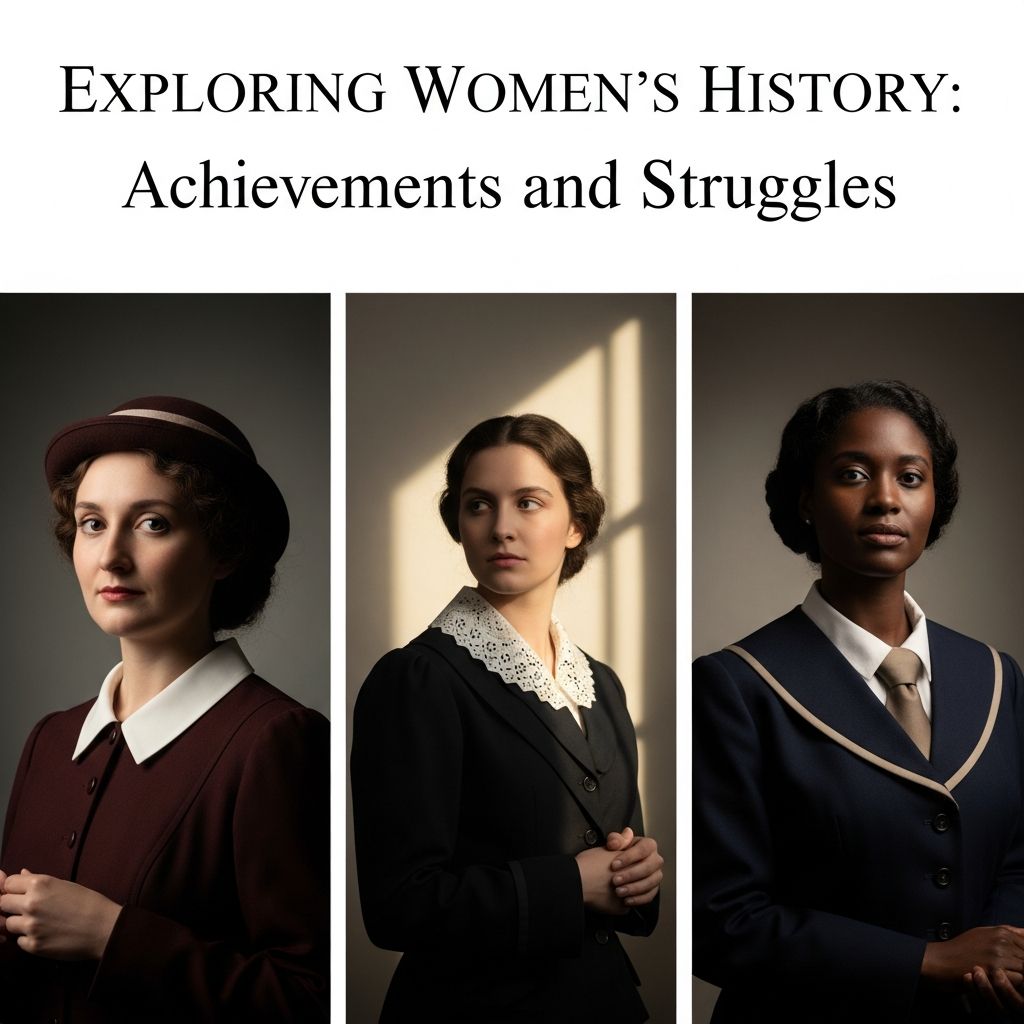
Women’s history examines the diverse contributions, challenges, and transformations women have experienced across time. It highlights how women influenced politics, society, and culture while confronting systemic barriers. This field emerged prominently in the late 20th century, driven by feminist scholars who sought to recover overlooked narratives and methodologies for studying gender dynamics.
The Foundations of Women’s Historical Study
At its core, women’s history goes beyond biographies of notable figures to analyze broader societal roles and the evolution of gender norms. Scholars focus on how historical events reshaped women’s lives, from wars and economic shifts to legal reforms. In the United States and Britain, second-wave feminists pioneered this discipline in the 1960s and 1970s, integrating social history approaches to reveal women’s agency in everyday struggles.
Early efforts emphasized personal achievements and collective movements for rights. For instance, the study includes examinations of how women navigated patriarchal structures in education, labor, and family life. This interdisciplinary approach draws from sociology, anthropology, and economics to provide a fuller picture of human progress.
Key Waves of Feminist Movements
Feminist movements represent cornerstone chapters in women’s history, marked by organized pushes for equality. These waves built upon each other, addressing legal, social, and cultural inequalities.
First-Wave Feminism: The Fight for Suffrage
The first wave, from the late 19th to early 20th century, centered on securing basic legal rights, especially voting. Activists like Emmeline Pankhurst in the UK and Alice Paul in the US mobilized masses through protests and civil disobedience. Their efforts culminated in milestones such as the 19th Amendment in the US in 1920, granting women the vote.
- 1848: Seneca Falls Convention launches the US women’s rights movement with the Declaration of Sentiments.
- 1869: Wyoming Territory becomes the first to grant women suffrage.
- 1890: Wyoming enters the Union as the first state with full women’s voting rights.
These victories were hard-won amid arrests and societal backlash, as seen when Susan B. Anthony was fined for voting in 1872.
Second-Wave Feminism: Broader Social Reforms
Emerging in the 1960s, the second wave expanded to workplace equality, reproductive rights, and challenging domestic roles. Figures like Gloria Steinem and Betty Friedan critiqued cultural expectations, leading to landmark laws. The Equal Pay Act of 1963 and Roe v. Wade in 1973 marked key legal advances.
Courts struck down barriers, such as in Weeks v. Southern Bell (1965), which opened male-dominated jobs to women, and Griswold v. Connecticut (1965), affirming contraceptive access for married couples.
Third and Fourth Waves: Intersectionality and Digital Activism
Later waves incorporated race, class, and sexuality, with third-wave feminism in the 1990s emphasizing individual empowerment. The fourth wave, fueled by social media since the 2010s, tackles issues like #MeToo and global inequalities.
Legal Milestones in the United States
American women’s legal history reveals gradual erosion of discriminatory laws rooted in English common law, which treated married women as extensions of their husbands.
| Year | Milestone | Impact |
|---|---|---|
| 1839 | Mississippi allows women property ownership with spousal permission | Begins dismantling coverture laws |
| 1879 | Belva Lockwood argues before Supreme Court | First woman admitted to practice nationally |
| 1908 | Muller v. Oregon upholds 10-hour workday limits | Protects but stereotypes women’s physicality |
| 1920 | 19th Amendment ratified | National suffrage victory |
| 1925 | Native American women gain suffrage | Extends rights to indigenous groups |
| 1965 | Griswold v. Connecticut | Legalizes contraception for married couples |
By 1900, most states had adopted married women’s property acts, granting control over earnings. The National Recovery Act of 1932, however, forced many women from jobs, highlighting setbacks.
Global Dimensions and International Women’s Day
Women’s history transcends borders, with global solidarity evident in International Women’s Day (IWD). Proposed by Clara Zetkin in 1910, the first IWD occurred on March 19, 1911, in several European countries, stemming from labor and socialist roots. Today, it addresses annual themes like violence prevention and economic justice.
UN Women notes persistent challenges, such as over 800 daily maternal deaths, mostly in developing nations. Movements worldwide echo US struggles, adapting to local contexts.
Recognizing Women’s Contributions: Women’s History Month
In the US, March is Women’s History Month, proclaimed annually by the president. It originated in 1978 as a week-long event in Santa Rosa, California, tied to IWD on March 8. By 1980, President Jimmy Carter declared National Women’s History Week, evolving into a full month via congressional resolution in 1987.
The National Women’s History Alliance preserves this legacy through education and timelines. Sites like the National Archives offer primary sources—letters, photos—illuminating women’s stories. The National Park Service highlights both ordinary and extraordinary women. Smithsonian resources combat historical erasure in curricula.
Challenges Women Faced Throughout History
Despite progress, women endured profound obstacles. Enslaved Black women like Celia in 1855 lacked self-defense rights against rape. Protective labor laws, while beneficial, reinforced stereotypes of frailty. Indigenous and minority women often gained rights last, as with Native American suffrage in 1925.
Reproductive control battles persisted; Margaret Sanger’s 1916 clinic led to arrests under anti-contraception laws. Economic policies like the 1932 job limits disproportionately affected women.
Influential Women Who Shaped History
- Susan B. Anthony: Arrested for voting in 1872, symbolizing defiance.
- Victoria Woodhull: First woman presidential candidate in 1870.
- Genevieve Rose Cline: Appointed first female federal judge in 1928.
- Margaret Sanger: Advocated birth control amid persecution.
- Clara Zetkin: Founded IWD concept.
These trailblazers paved paths for future generations.
The Impact of Women’s History on Modern Society
Studying women’s history fosters empathy and informs policy. It reveals how gender intersects with race and class, promoting inclusive narratives. Educational initiatives during Women’s History Month engage youth, ensuring forgotten stories endure. Globally, it fuels advocacy against ongoing disparities in pay, representation, and health.
Primary sources from archives enrich understanding, from jury integrations in 1701 Albany to modern timelines. This field continues evolving, incorporating digital tools and diverse voices.
Frequently Asked Questions (FAQs)
What defines women’s history as a field?
Women’s history studies women’s roles in events, rights growth, achievements, and historical impacts on them, using specialized methods to uncover biased records.
When did the first feminist wave occur?
The first wave spanned late 19th to early 20th centuries, focusing on suffrage and legal rights.
How did Women’s History Month start?
It began as a 1978 local week in California, becoming national in 1980 and a month in 1987.
What is International Women’s Day’s origin?
Clara Zetkin proposed it in 1910; first celebrated 1911 in Europe.
Have all US women always had voting rights?
No; states revoked rights post-1777, with full national suffrage in 1920, later for some groups.
References
- Women’s history – Wikipedia — Wikipedia contributors. 2026. https://en.wikipedia.org/wiki/Women%27s_history
- Women’s History Overview — LiveYourDream.org. 2026.
 Written byMedha Deb
Medha Deb is an editor with a master's degree in Applied Linguistics from the University of Hyderabad. She believes that her qualification has helped her develop a deep understanding of language and its application in various contexts. Medha specializes in the areas of beauty, health, sports, and wellness and is committed to ensuring that the content on the website is…