
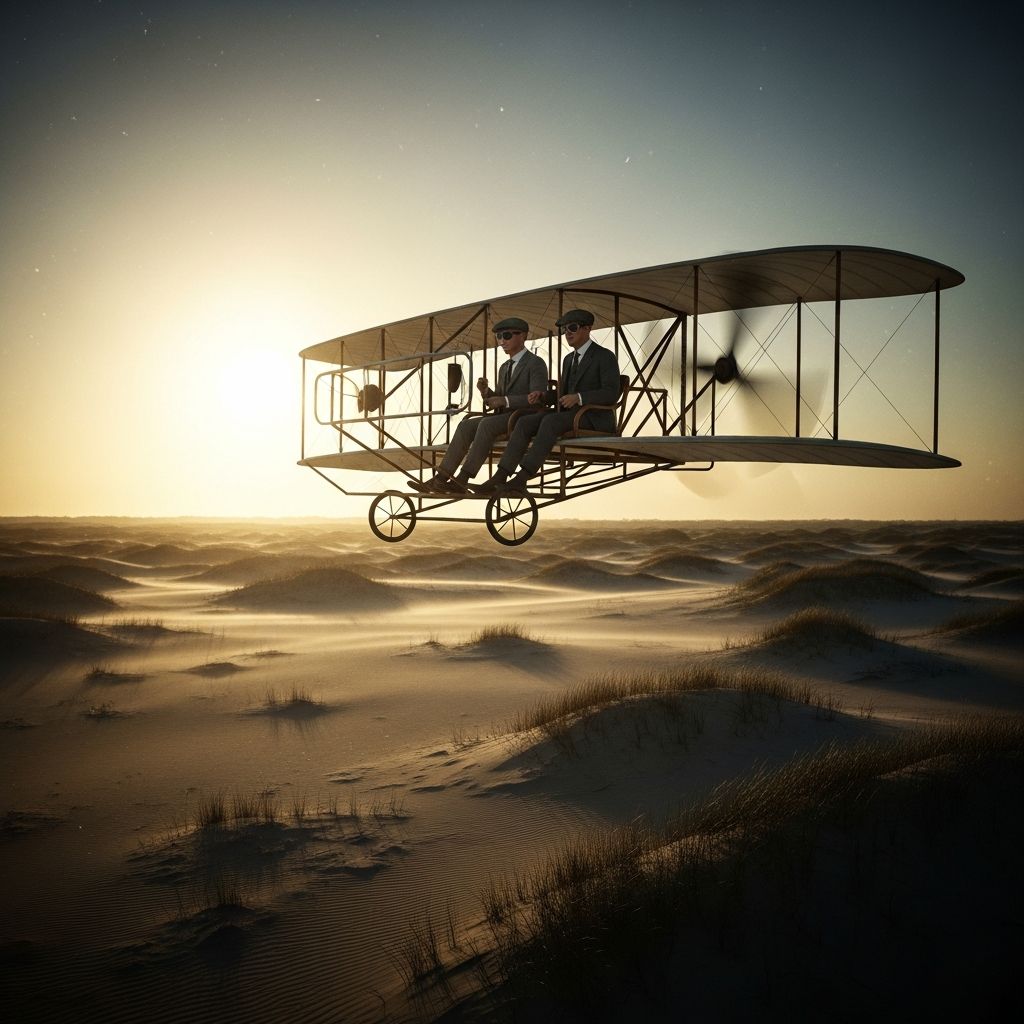
The Wright brothers, Wilbur and Orville, transformed human transportation by achieving the first controlled, powered flight in a heavier-than-air craft. On December 17, 1903, at Kill Devil Hills near Kitty Hawk, North Carolina, their invention, the Wright Flyer, took to the skies, marking the dawn of modern aviation.
Early Lives and Shared Ambitions
Born in the Midwest, Wilbur (1867-1912) and Orville (1871-1948) grew up in a family that valued education and curiosity. Their father, a bishop, encouraged intellectual pursuits. The brothers launched a printing business as teenagers and later opened a bicycle shop in Dayton, Ohio, in 1892. This venture honed their mechanical skills, which proved essential for their aviation experiments.
Bicycles influenced their thinking about flight. The need for balance and control in cycling paralleled the challenges of steering aircraft. By the late 1890s, inspired by pioneers like Otto Lilienthal and news of potential flights, they began studying aerodynamics seriously.
Scientific Foundations: Wind Tunnels and Data
Unlike others relying on guesswork, the Wrights built a wind tunnel in 1901 to test airfoil shapes. This device allowed precise measurements of lift and drag, generating data for wing designs superior to existing tables.
They conducted thousands of calculations, refining theories on camber and aspect ratios. This rigorous approach set them apart, enabling efficient propellers they designed from scratch—another innovation, as no suitable ones existed.
Glider Experiments on the Outer Banks
In 1900, the brothers chose Kitty Hawk for its steady winds, soft sands, and isolation. Advised by Octave Chanute, they arrived with their first glider, a biplane with a 17-foot wingspan.
Initial tests involved kiting the glider with ballast, then piloted glides. By 1901, challenges arose: their 1901 glider underperformed due to inaccurate lift data. Undeterred, they iterated, achieving controlled turns in 1902 with over 1,000 glides from Big Kill Devil Hill, mastering three-axis control via wing warping, rudders, and elevators.
| Year | Glider Key Features | Achievements |
|---|---|---|
| 1900 | 17-ft span, no tail | Basic lift tests, short glides |
| 1901 | Improved wings | Identified data flaws, longer glides |
| 1902 | Fixed tail, wing warping | 1,000+ glides, full control |
This table summarizes their progressive glider developments, building confidence for powered attempts.
The Dawn of Powered Flight: December 17, 1903
After crafting a lightweight 12-horsepower engine and propellers in Dayton, they shipped the 605-pound Flyer to Kitty Hawk. Delays from propeller issues pushed tests to December.
On December 14, Wilbur won a coin toss but stalled on launch. Orville flew first on the 17th at 10:35 a.m., covering 120 feet in 12 seconds against 27 mph winds, photographed by witness John Daniels.
They alternated four flights: Wilbur 175 feet, Orville 200 feet, Wilbur 852 feet in 59 seconds. Gusts wrecked the Flyer afterward, but success was undeniable—sustained, controlled powered flight.
- First Flight: Orville, 120 ft, 12 sec, 6.8 mph ground speed.
- Second: Wilbur, 175 ft, ~12 sec.
- Third: Orville, 200 ft, ~15 sec.
- Fourth: Wilbur, 852 ft, 59 sec, ~10 ft altitude.
Overcoming Skepticism and Advancing Aviation
Initial secrecy stemmed from patent fears, but demonstrations followed. In 1904, Flyer II circled a field; Flyer III in 1905 flew 24 miles, proving practicality.
European flights in 1908, like Wilbur’s Le Mans shows, gained acclaim. They sold planes to the U.S. Army in 1908 and founded the Wright Company.
Legacy: Shaping the Skies
Their three-axis control remains aviation’s standard. Today, the Wright Brothers National Memorial preserves the site. Aviation evolved from their 12-second hop to global air travel.
Hands-On Learning: Aviation Activities for All Ages
Bring history alive with these original activities inspired by the Wrights’ methods.
Build a Straw Glider
Materials: Straws, tape, paper strips, scissors.
- Form a fuselage with 4-5 straws taped lengthwise.
- Add straw wings and tail (triangle stabilizers).
- Test glides, adjust wing angles for lift.
Discuss: How does wing shape affect flight? Mimics 1900 glider tests.
Wind Tunnel in a Box
Materials: Shoebox, fan, clay airfoils.
- Cut slots for fan and view.
- Shape clay wings (flat vs. curved).
- Blow air, observe lift via thread lift.
Replicates Wrights’ data collection for better designs.
Paper Airplane Challenges
Fold variations (dart, glider), measure distance/time outdoors. Chart results in a table:
| Design | Distance (ft) | Time (sec) |
|---|---|---|
| Dart | 25 | 3 |
| Glider | 35 | 5 |
Explore control by adding flaps.
Propeller Physics Demo
Use rubber band-powered propellers from kits or DIY: Twist band on popsicle stick frame, launch. Measure spin efficiency. Links to Wrights’ chain-driven opposites.
Kitty Hawk Simulator
Mark a ‘rail’ outdoors, use toy plane or styrofoam model. Simulate launches with string pull, note wind effects. Role-play coin toss!
Common Questions About the Wright Brothers
Who flew first on December 17, 1903?
Orville, after Wilbur’s failed attempt days earlier. Coin toss decided the order.
Why Kitty Hawk?
Strong, steady winds (15-25 mph average), soft dunes for safe landings, remote location.
Were there prior flight claims?
Others achieved hops, but Wrights first for controlled, sustained powered flight in heavier-than-air craft.
How did they control the Flyer?
Wing warping for roll, vertical rudder for yaw, horizontal elevator for pitch—true three-axis control.
What’s left of the original Flyer?
Reconstructed at Smithsonian’s Air and Space Museum; site has replicas.
Modern Relevance: Aviation Milestones Post-Wrights
From 1903’s 852 feet to 2024’s hypersonic jets, their innovations underpin it all. Drones, spaceflight trace back here. Educational programs worldwide use their story to inspire STEM.
References
- Wright brothers – Wikipedia — Wikipedia. 2023-12-01. https://en.wikipedia.org/wiki/Wright_brothers
- 120 Years Ago: The First Powered Flight at Kitty Hawk — NASA. 2023-12-17. https://www.nasa.gov/history/120-years-ago-the-first-powered-flight-at-kitty-hawk/
- 10 Facts About the Wright Brothers — History Hit. 2023-12-17. https://www.historyhit.com/facts-about-the-wright-brothers/
- 1903-The First Flight — National Park Service (.gov). 2024-01-15. https://www.nps.gov/wrbr/learn/historyculture/thefirstflight.htm
- The Wright Brothers Made History at Kitty Hawk — Smithsonian National Air and Space Museum (.gov). 2022-06-23. https://airandspace.si.edu/stories/editorial/wright-brothers-made-history-kitty-hawk
- 10 Things You May Not Know About The Wright Brothers — Visit Naha. 2023-11-01. https://visitnaha.com/10thingsyoudidntknowwrightbrothers/

Medha Deb is an editor with a master's degree in Applied Linguistics from the University of Hyderabad. She believes that her qualification has helped her develop a deep understanding of language and its application in various contexts. Medha specializes in the areas of beauty, health, sports, and wellness and is committed to ensuring that the content on the website is…