
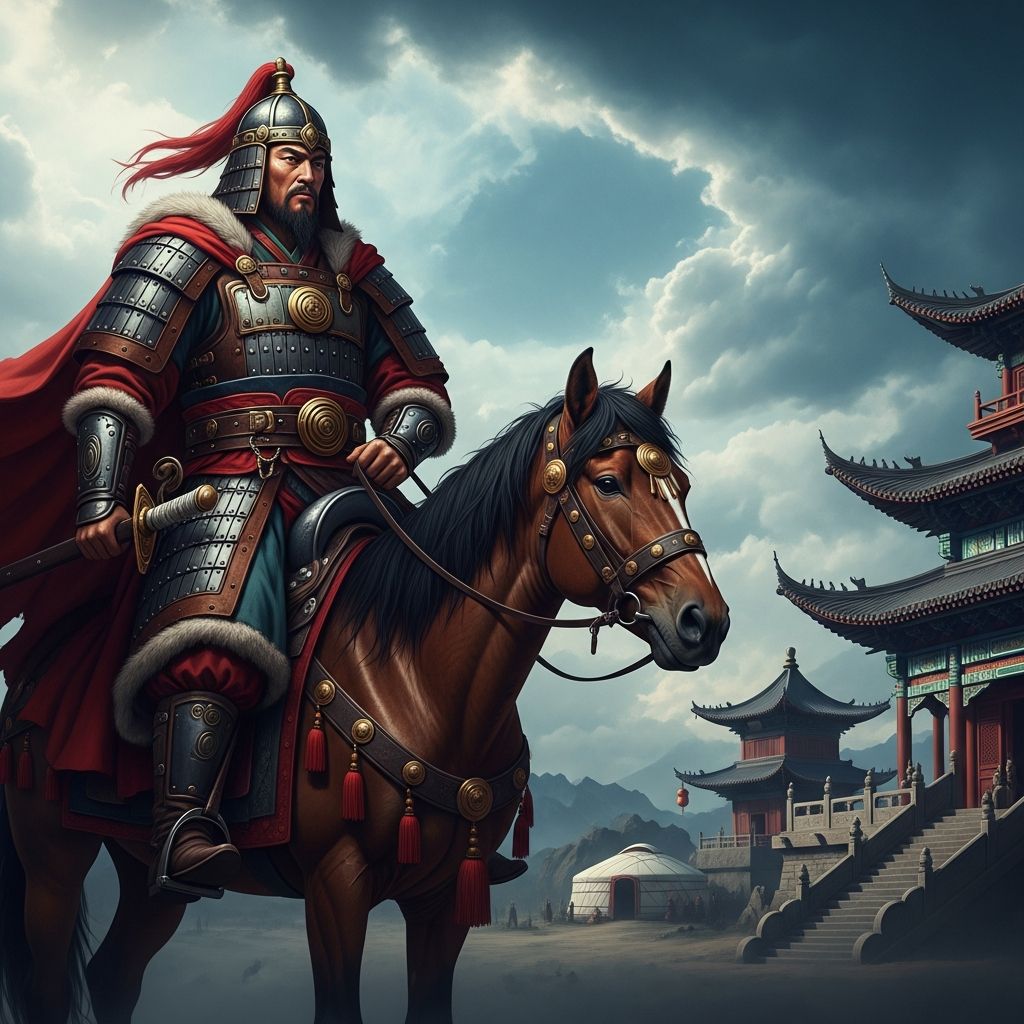
The Yuan Dynasty represents a pivotal chapter in Chinese history, spanning from 1271 to 1368, when Mongol leaders under Kublai Khan established the first foreign dynasty to rule all of China. This era unified the nation after centuries of division, introduced innovative administrative systems, and opened China to global trade networks, while also imposing a rigid ethnic hierarchy that sowed seeds of discontent.
Origins of Mongol Ascendancy in China
The foundations of the Yuan Dynasty trace back to the early 13th century with the unification of Mongol tribes under Genghis Khan. His successors expanded the Mongol Empire across Asia, conquering northern China by the 1230s. The Jin Dynasty fell in 1234, leaving the Southern Song in control of the south. Kublai Khan, Genghis’s grandson, ascended as Great Khan in 1260 following his brother Möngke’s death during a campaign against the Song.
Kublai consolidated power by defeating rival Mongol factions and launching decisive offensives southward. By 1276, Mongol forces captured the Song capital at Hangzhou without major resistance, and the last Song emperor surrendered. Full unification came in 1279 at the Battle of Yamen, where the remnants of Song loyalists were decisively defeated. This marked the end of over three centuries of division since the Tang Dynasty’s fall.
Founding and Proclamation of the Yuan
In 1271, even before complete conquest, Kublai proclaimed the Yuan Dynasty, adopting the Chinese reign title ‘Shizu’ and naming his rule ‘Yuan,’ meaning ‘origin’ or ‘central pivot,’ symbolizing Mongol primacy. He established Dadu (modern Beijing) as the capital in 1272, shifting the political center northward and away from traditional southern strongholds.
This formal adoption of dynastic nomenclature was strategic: it legitimized Mongol rule in Chinese eyes while maintaining imperial separation from other Mongol khanates like the Golden Horde and Ilkhanate. Kublai’s realm encompassed modern China, Mongolia, Korea, and parts of Siberia, but internal divisions isolated it from broader Mongol unity.
Administrative Innovations and Social Structure
The Yuan government blended Mongol military hierarchy with Chinese bureaucracy. Kublai retained the Confucian civil service exam sporadically but favored Mongols and Central Asians (Semu) in key posts, creating a four-tier system:
- Mongols: Ruled as nobility with privileges like tax exemptions.
- Semu ( assorted peoples): Included Uighurs, Persians, and Tibetans in finance and trade roles.
- Han: Northern Chinese, treated as second-class subjects.
- Nanren: Southern Chinese (former Song), lowest tier with heaviest taxes.
This structure ensured Mongol control but alienated the Han majority. Kublai promoted paper money (chao) backed by silver, standardized weights, and built extensive canals and roads to integrate the economy. Postal systems (yam) facilitated rapid communication across the vast empire.
Economic Flourishing and Global Connections
Under Yuan rule, China experienced economic revival through promoted international trade along the Silk Road and maritime routes. Kublai welcomed Venetian merchant Marco Polo, whose accounts popularized ‘Cathay’ in Europe. Ports like Quanzhou bustled with Arab, Persian, and Indian traders exchanging porcelain, silk, and tea for spices and horses.
Agricultural policies included irrigation projects and crop introductions like sorghum from the steppes. Urbanization grew in Dadu, a planned city with grand palaces. Despite famines in later years, early decades saw prosperity, with tax revenues funding monumental constructions.
| Key Economic Policies | Impact |
|---|---|
| Paper currency issuance | Streamlined trade but led to inflation |
| Silk Road revival | Increased cultural exchanges |
| Grand Canal extensions | Boosted grain transport to north |
| Maritime expeditions | Explored Southeast Asia |
Cultural and Artistic Renaissance
Despite foreign rule, the Yuan era nurtured artistic heights. Drama flourished with zaju plays blending music, poetry, and acting; masters like Wang Shifu penned enduring works. Blue-and-white porcelain emerged, fusing Persian motifs with Chinese techniques, becoming a global export.
Buddhism, especially Tibetan variants, gained imperial patronage; Kublai invited lamas to court. Daoist and Confucian scholars adapted to Mongol patronage, producing philosophical texts. Painting evolved with literati styles emphasizing personal expression over imperial commissions.
Literary giants like Ma Zhiyuan captured the era’s melancholy in verses reflecting social upheavals. This cultural synthesis influenced subsequent Ming arts profoundly.
Military Prowess and Failed Expeditions
The Yuan military relied on elite cavalry, siege engineers from Persia, and conscripted Chinese navies. Conquests included Korea (annexed 1270) and Vietnam (temporarily subdued). However, ambitious campaigns against Japan in 1274 and 1281 failed due to typhoons—’kamikaze’—and logistical strains.
- 1274: First Japan invasion repelled by storms.
- 1281: Larger fleet destroyed, costing thousands of lives.
- Southeast Asia raids yielded tribute but no lasting control.
These defeats drained treasuries and exposed vulnerabilities, contributing to internal decay.
Decline and Path to Collapse
Kublai’s death in 1294 ushered in weak successors. Emperors like Temür Khan maintained stability briefly, but by the 1340s, disasters struck: Yellow River floods, droughts, and plagues decimated populations. Corruption and factionalism eroded central authority.
Heavy taxes and discrimination fueled the Red Turban Rebellion (1351), led by Han Chinese groups blending religious fervor with anti-Mongol sentiment. Rebel leader Zhu Yuanzhang founded the Ming Dynasty, capturing Dadu in 1368. Emperor Toghun Temür fled to Mongolia, where the ‘Northern Yuan’ persisted until 1635.
Legacy of the Yuan in Chinese History
The Yuan reunited China, accelerating globalization through Pax Mongolica. It preserved Song innovations while introducing Islamic astronomy and Persian medicine. Socially, it entrenched ethnic divisions influencing Qing policies later. Artistically, Yuan styles bridged Song refinement and Ming vibrancy.
Though brief, the dynasty’s administrative models endured, proving steppe nomads could govern sedentary empires effectively—until overreach undid them. Modern scholarship views it as a cosmopolitan bridge era.
Frequently Asked Questions (FAQs)
What was the significance of Kublai Khan in the Yuan Dynasty?
Kublai Khan founded the Yuan in 1271, unified China by 1279, and promoted trade and culture, establishing Beijing as capital.
How long did the Yuan Dynasty last?
From 1271 to 1368 in China proper, with Northern Yuan remnants until the 17th century.
Why did the Yuan Dynasty fall?
Natural disasters, rebellions like the Red Turbans, corruption, and weak rulers led to Ming conquest in 1368.
What was unique about Yuan social structure?
It ranked Mongols highest, followed by Central Asians, northern Han, and southern Han, limiting Chinese advancement.
Did Marco Polo really visit during Yuan rule?
Yes, around 1275-1292, serving Kublai and describing prosperous China in his travels.
References
- Yuan Dynasty – World History Encyclopedia — World History Encyclopedia. 2019-10-02. https://www.worldhistory.org/Yuan_Dynasty/
- Yuan dynasty – Wikipedia — Wikipedia. 2024-01-15. https://en.wikipedia.org/wiki/Yuan_dynasty
- Yuan Dynasty, Mongol China History, Facts & Achievements — China Highlights. 2023-11-20. https://www.chinahighlights.com/travelguide/china-history/the-yuan-dynasty.htm
- The Yuan Dynasty – HIST-1500: World History — University of Utah Pressbooks. 2022-08-10. https://uen.pressbooks.pub/worldhistory1/chapter/the-yuan-dynasty/
- The Yuan Dynasty – History Guild — History Guild. 2021-05-12. https://historyguild.org/the-yuan-dynasty/
- Yuan Dynasty | History | Research Starters — EBSCO. 2023-06-01. https://www.ebsco.com/research-starters/history/yuan-dynasty
- Yuan dynasty | History, Achievements, Art, & Facts — Britannica. 2024-03-28. https://www.britannica.com/topic/Yuan-dynasty

- Integrated M.A. in Applied Linguistics, University of Hyderabad
- 5+ years in editorial, instructional, SEO, and research-based writing
Sneha is a relationships and lifestyle writer with a strong foundation in applied linguistics and certified training in relationship coaching. She brings over five years of writing experience to theskillvault, crafting thoughtful, research-driven content that empowers readers to build healthier relationships, boost emotional well-being, and embrace holistic living. Her writing and insights reflect the belief that beauty, happiness, and wellness…