
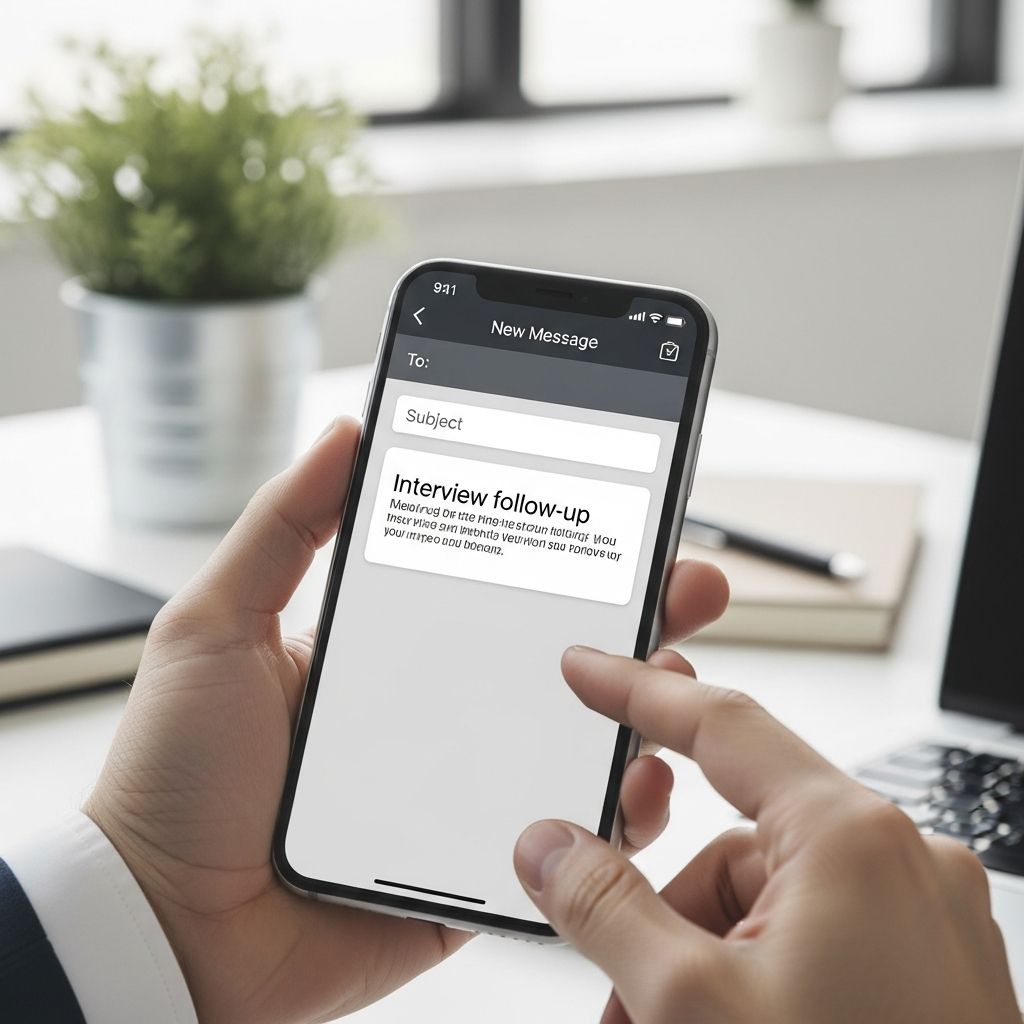
Waiting for news after a promising job interview can be stressful. You replay every answer in your head while refreshing your inbox far more often than you would like to admit. A thoughtful, well-timed follow-up can ease some of that anxiety and remind the hiring team why you are a strong candidate—without appearing impatient or pushy.
This guide walks through when to follow up, what to say at each stage, and how to stay professional even if you never get a clear answer.
Why Following Up Matters More Than You Think
Post-interview follow-up is not just polite; it is part of how employers evaluate your professionalism, communication skills, and genuine interest in the role. Hiring processes can be lengthy and complex—managers juggle multiple candidates, busy schedules, and shifting priorities—so a respectful nudge is often appreciated.
- Reinforces your interest: A measured follow-up shows you are still enthusiastic about the role, not just sending out dozens of generic applications.
- Shows professionalism: Employers notice candidates who communicate clearly, respect timelines, and follow basic business etiquette.
- Clarifies expectations: Asking about next steps or timelines can clear up confusion and reduce your stress.
- Keeps you top of mind: A short, relevant message can help the hiring manager remember your strengths when decisions are made.
Setting Expectations Before You Leave the Interview
The smartest follow-up strategy starts before you walk out of the interview room. Clarifying next steps helps you decide when and how to reach out later.
- Ask: “What is your timeline for next steps?”
- Confirm: “Who is the best person to contact if I have any additional questions?”
- Note any dates mentioned, such as: “We hope to decide within two weeks.”
These details guide your follow-up schedule and prevent you from emailing too early.
Ideal Timing: When to Follow Up After an Interview
The timing of each message sends a signal. You want to be prompt, but not impatient. Career experts generally recommend a staged approach: a quick thank-you, a check-in after the stated timeline, and a final closure message if needed.
| Stage | When to Send | Goal |
|---|---|---|
| Thank-you email | Within 24 hours of the interview | Express appreciation and briefly reinforce fit |
| First status check | After the decision timeline or about 1 week later | Confirm status and restate interest |
| Second follow-up (optional) | 7–10 days after the first check, if no reply | Politely ask if there are any updates |
| Final closure message | 2–3 weeks after your last email, if still no response | Close the loop while keeping the relationship positive |
Step 1: Send a Strong Thank-You Email
Your first message after any interview should be a brief thank-you. Many employers now expect this as standard professionalism, and it can influence how they perceive your candidacy.
Core elements of a post-interview thank-you
- Sent within 24 hours: This shows eagerness and respect for the interviewer’s time.
- Personalized greeting: Address each interviewer by name; avoid generic salutations.
- Specific reference: Mention one or two topics you discussed to show you were engaged.
- Reinforced value: Briefly connect your skills to a key need they mentioned.
- Professional closing: End with thanks and an invitation to contact you with questions.
Sample thank-you email (customize, do not copy)
Subject line ideas:
- “Thank you for our conversation about the [Role Title] role”
- “Appreciated the chance to meet with you today”
Email body example:
Hi [Name],
Thank you for taking the time to speak with me about the [Role Title] position. I especially enjoyed our discussion about [brief reference to a project, initiative, or challenge].
Our conversation reinforced my excitement about the opportunity to contribute in [specific way you can add value]. My background in [relevant experience] seems well aligned with the priorities you described.
Please let me know if I can provide any additional information. I appreciate your time and look forward to hearing about next steps.
Best regards,
[Your Name]
Step 2: Follow Up When the Timeline Has Passed
If the hiring team gave you a timeline and it has come and gone without an update, it is reasonable to send a status check. This is especially common in lengthy or competitive searches and is not considered pushy if done politely.
When to send a status check
- If they said “about two weeks”, follow up a few days after the two-week mark.
- If they did not share a timeline, a one-week wait after the interview is usually appropriate.
What your first follow-up should include
- A polite greeting and context: Remind them who you are and when you spoke.
- Confirmation of continued interest: Make it clear you still want the role.
- A simple question: Ask whether there are any updates or an anticipated timeframe.
- Gratitude: Thank them for their time and consideration.
Sample first follow-up email
Subject line ideas:
- “Checking in regarding the [Role Title] position”
- “Follow-up on our [date] interview”
Email body example:
Hi [Name],
I hope you are doing well. I wanted to follow up on my interview for the [Role Title] position on [date]. I remain very interested in the opportunity to contribute to [team, project, or department name].
If you are able to share any updates on the hiring process or an expected timeline for next steps, I would appreciate it. Thank you again for your time and consideration.
Best regards,
[Your Name]
Step 3: Handling Long Silence and No Response
Silence does not always mean rejection. Hiring can be delayed by shifting budgets, vacations, restructurings, or additional approvals. At the same time, you do not want to chase indefinitely. A second follow-up—spaced appropriately—is often the right middle ground.
When a second follow-up makes sense
- It has been 7–10 business days since your first follow-up.
- You have not received any reply, even an acknowledgment.
- You are still genuinely interested in the role.
How to write a second follow-up without sounding demanding
- Keep it even shorter than the first status check.
- Reiterate interest once, briefly.
- Recognize that their process may be taking longer than expected.
- Make it easy to respond with a quick update (even a brief one).
Sample second follow-up email:
Hi [Name],
I wanted to quickly touch base regarding the [Role Title] position. I know hiring processes can take time, and I appreciate everything that goes into them.
I remain very interested in the role and would be grateful for any update you are able to share when convenient.
Thank you again,
[Your Name]
Step 4: Sending a Final Closure Message
If you have followed up twice with no response, it is reasonable to assume the process is either significantly delayed or moving forward without you. Sending a final, gracious message lets you close this chapter while preserving the relationship for future opportunities.
Goals of a final follow-up
- Signal that you are moving ahead with your search while staying respectful.
- Leave a positive impression that may help with future roles.
- Optionally ask to stay in touch or be considered later.
Sample final email:
Hi [Name],
I wanted to follow up one last time regarding the [Role Title] position. Since I have not heard back, I am assuming the process is either on hold or moving in a different direction.
I truly appreciated the chance to learn more about [company/team]. If opportunities arise in the future that align with my background in [your field or specialty], I would be glad to be considered.
Thank you again for your time and for the insights you shared during our conversations.
Best regards,
[Your Name]
Common Mistakes to Avoid in Post-Interview Follow-Up
Even strong candidates can weaken their chances by following up in ways that seem impatient or careless. A few simple rules help protect your professional image.
- Following up too soon: Emailing a day after they told you the process would take three weeks can come across as ignoring what they said.
- Multiple emails in quick succession: Sending repeated messages every couple of days risks making you look anxious or demanding.
- Overly long messages: Keep emails short and easy to skim; hiring managers move quickly.
- Emotional or frustrated tone: Avoid expressing anger, disappointment, or sarcasm, even if you feel ignored.
- Spelling and grammar errors: Typos in a follow-up can undermine your perceived attention to detail.
- Using generic templates without personalization: Always reference specifics from your interview or the job description.
Balancing Follow-Up With an Ongoing Job Search
While you wait for updates, continuing your search protects your momentum and mindset. Labor market data show that hiring timelines can be unpredictable, and candidates often move through several processes at once.
- Keep applying to other roles rather than pausing for one opportunity.
- Track each interview’s date, timeline, and follow-up schedule in a spreadsheet or notes app.
- Send thoughtful follow-ups, then mentally “file” that application and refocus on other leads.
- If you receive another offer, you can update the first employer and ask if they are able to share their decision timing.
Advanced Tips: When You Have New Information to Share
Sometimes, something positive changes after your interview: you complete a major project, earn a certification, or publish work relevant to the role. In that case, you can incorporate an update into one of your follow-ups.
- Share only updates that directly strengthen your fit (not every minor change).
- Keep the update to one or two sentences linked to the job’s priorities.
- Frame it as additional context, not as pressure to respond immediately.
Example line you might add: “Since we spoke, I completed [relevant accomplishment], which further deepened my experience in [skill area important to the role].”
FAQs About Following Up After an Interview
How many times is it acceptable to follow up?
In most situations, one thank-you email and one or two status checks are enough. Beyond that, a final closure message is optional, but repeatedly following up after that rarely changes the outcome and can hurt your professional image.
Will following up hurt my chances?
A short, polite follow-up sent at a reasonable time is unlikely to hurt your chances and often helps by demonstrating professionalism and continued interest. Problems arise when messages are frequent, emotional, or ignore the timeline the employer already shared.
What if they told me not to follow up?
Occasionally, an employer may clearly state that they will reach out if interested and that follow-ups are not necessary. In that case, you can still send a thank-you within 24 hours, but it is wise to respect their preference afterward and focus your energy on other applications.
Should I call instead of emailing?
Email is usually preferred because it is less intrusive and gives the recruiter or manager time to respond when convenient. Phone calls can be appropriate if you already have an established relationship or if the recruiter has encouraged you to call, but unplanned calls may feel disruptive.
What if I get another offer while I am waiting?
If you receive an offer from another employer, you can send a concise update to the first organization. Thank them again for your interview, let them know you have another offer with a decision deadline, and ask—without pressure—whether they expect to make a decision before that date. This allows them to accelerate if they are very interested while keeping your communication transparent.
References
- Optimal Timing for Post-Interview Follow-Ups — TopInterview. 2023-06-15. https://topinterview.com/interview-advice/when-to-follow-up-after-your-interview
- Mastering Post-Interview Etiquette: How to Follow Up Professionally — Insurance Recruiting Solutions. 2023-04-10. https://www.insurancerecruitingsolutions.com/articles/mastering-post-interview-etiquette-how-to-follow-up-professionally
- From Interview to Offer: Writing a Winning Follow-Up Email — Herzing University. 2022-05-20. https://www.herzing.edu/blog/interview-offer-writing-winning-follow-email
- 4 Things You Need to Do After Every Job Interview (and 1 Big Don’t) — TopResume. 2022-03-08. https://topresume.com/career-advice/post-job-interview-follow-up-etiquette
- Post Interview Etiquette: How Many Times to Follow Up? — Spiceworks Community. 2019-10-01. https://community.spiceworks.com/t/post-interview-etiquette-how-many-times-to-follow-up/439788

Medha Deb is an editor with a master's degree in Applied Linguistics from the University of Hyderabad. She believes that her qualification has helped her develop a deep understanding of language and its application in various contexts. Medha specializes in the areas of beauty, health, sports, and wellness and is committed to ensuring that the content on the website is…