
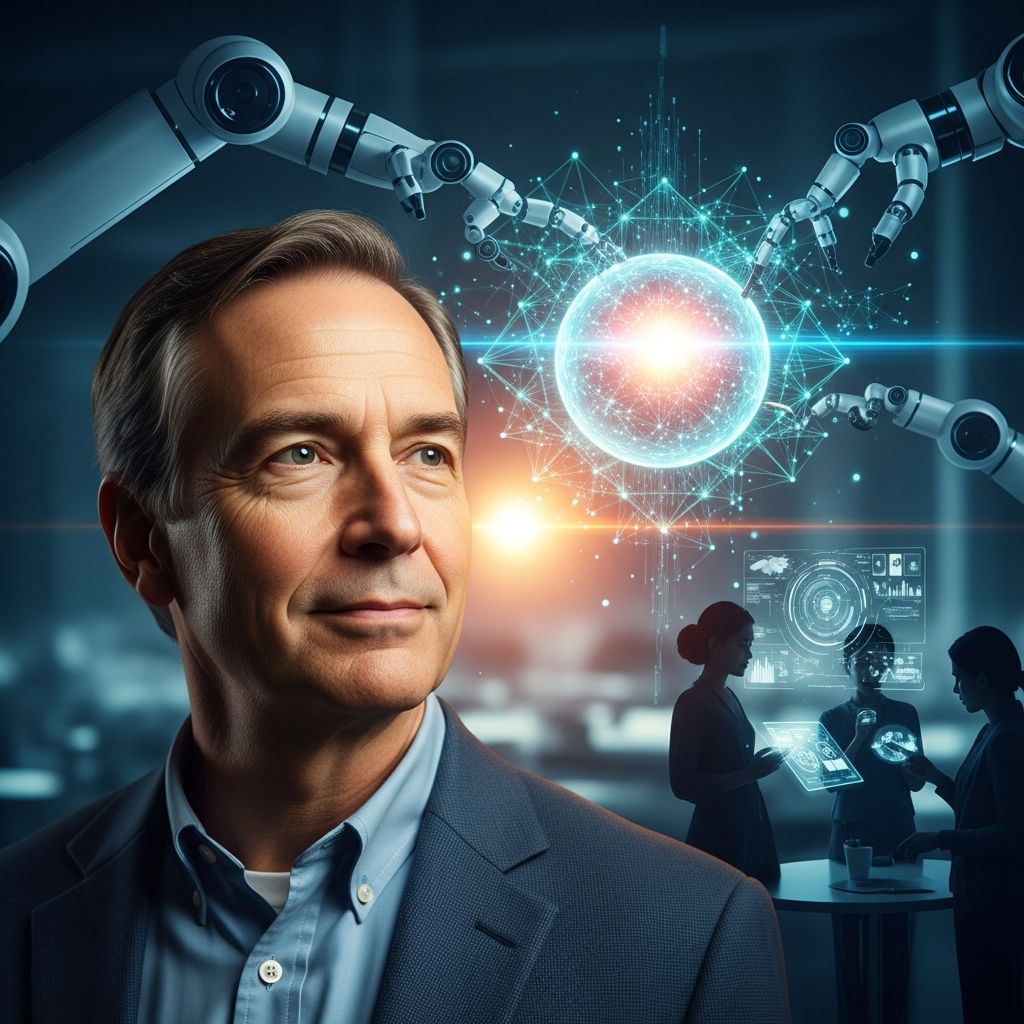
Roboticist and artist Ken Goldberg has spent decades at the intersection of engineering, art, and society, challenging simple stories about artificial intelligence and automation. His work on robot manipulation, cloud robotics, and human–machine collaboration offers a more nuanced vision than headlines about machines taking all our jobs.
This article distills key themes inspired by his public talks and research: why uncertainty is fundamental in robotics, how cloud-connected robots learn, and what the future of work might look like when humans and machines collaborate at scale.
Who Is Ken Goldberg?
Ken Goldberg is a distinguished professor of Industrial Engineering and Operations Research at the University of California, Berkeley, with joint appointments in Electrical Engineering and Computer Sciences, Art Practice, and the School of Information. He is also affiliated with Radiation Oncology at UCSF, reflecting his contributions to medical robotics.
- Academic roles: William S. Floyd Jr. Distinguished Chair in Engineering at UC Berkeley and Chair of the Berkeley AI Research (BAIR) steering committee.
- Research leadership: Director of UC Berkeley’s Automation Sciences Lab (AUTOLAB), focusing on robot grasping, manipulation, and learning for industry, homes, agriculture, and surgery.
- Recognition: IEEE Fellow, multiple National Science Foundation awards, and best paper awards at major robotics conferences.
- Creative work: Exhibited as an artist in leading museums and biennials, exploring how humans perceive robots and networks.
This mix of engineering and art shapes his approach: instead of portraying AI as a purely technical force, he asks how it changes how we see ourselves and how we work together.
Robots, Uncertainty, and the Real World
Early industrial robots thrived in tightly controlled environments—fixed parts, rigid fixtures, and predictable motions. Goldberg’s research addresses what happens when robots leave that carefully staged world and enter the messy complexity of warehouses, homes, clinics, and farms.
Why Uncertainty Matters
In practice, robots face several kinds of uncertainty:
- Perception noise: Sensors like cameras and depth sensors can be occluded, miscalibrated, or affected by lighting and reflections.
- Object variability: Real objects differ in shape, friction, flexibility, and surface texture, often in ways not captured by CAD models.
- Action outcomes: Grasping, pushing, or cutting an object rarely yields perfectly repeatable results, especially for deformable or cluttered items.
Goldberg’s work pioneered geometric algorithms and learning-based methods that explicitly account for these uncertainties rather than assuming ideal conditions. His early research on orienting arbitrary polygonal parts provided provable guarantees about what robots can do with limited sensing and actuation.
From Toy Problems to Tangled Cables and Crumpled Laundry
Recent projects from his lab illustrate how deep learning and careful engineering can tackle tasks that once seemed intractable:
- Cable untangling: Learning strategies for robots to autonomously untangle long, flexible cables—useful for manufacturing, logistics, and home electronics.
- Plant pruning: Automating selective pruning in polyculture agriculture, where plants grow in mixed arrangements rather than uniform rows.
- Speedfolding: Learning efficient bimanual folding of garments, enabling robots to handle deformable objects like clothing at near-human speed.
These examples show that real-world robotics is less about perfect control and more about robust performance under uncertainty, using a combination of models, data, and clever simplifications.
Cloud Robotics and Shared Learning
Goldberg has been a leading voice in cloud robotics, the idea that robots should not be isolated devices but networked systems that share data, models, and experience via the internet.
From Single Robots to Collective Intelligence
Traditional robots are programmed and improved individually. Cloud robotics reverses this logic: when one robot learns to grasp a tricky object or navigate a new layout, that knowledge can instantly be shared with thousands of others.
In practice, cloud robotics can provide:
- Shared datasets: Large libraries of sensor data, object models, and motion trajectories collected across many sites.
- Central training: Cloud-based servers that train deep learning models for perception and control, then deploy them to fleets of robots.
- Continuous updates: Robots periodically upload logs and receive improved policies, enabling rapid iteration.
As Chief Scientist of a robotics startup and president of the Robot Learning Foundation, Goldberg has emphasized how shared datasets and benchmarks can accelerate progress across research groups and companies.
Benefits and Risks of Networked Robots
Networked robots introduce new possibilities and new vulnerabilities:
- Advantages
- Faster learning from diverse environments and edge cases.
- Lower per-robot computational requirements as heavy training runs in the cloud.
- More consistent performance across locations and deployments.
- Concerns
- Cybersecurity: compromising a shared model or control channel could affect many robots.
- Data privacy: sensitive industrial or medical data must be carefully managed.
- Robustness: systems must remain functional during network outages or model rollbacks.
Goldberg and other researchers at BAIR and similar institutions are developing safeguards and architectures that balance the benefits of shared learning with the realities of security and regulation.
Robots at Work: Industry, Medicine, and Agriculture
Goldberg’s group and collaborators deploy robots in a range of domains where physical tasks, safety, and efficiency are paramount.
| Domain | Example Robotic Tasks | Human–Robot Relationship |
|---|---|---|
| Warehousing & logistics | Picking diverse items, packing orders, sorting parcels | Robots handle repetitive picks; humans handle exceptions and system oversight |
| Manufacturing | Part feeding, assembly, cable management | Robots execute precise, high-volume actions; engineers refine processes |
| Healthcare & surgery | Assisting surgeons in minimally invasive procedures, precise positioning | Robots serve as tools; clinicians retain diagnosis and high-level decisions |
| Agriculture | Pruning, harvesting, monitoring crops | Robots perform repetitive field tasks; farmers set strategy and adapt to seasons |
Across these domains, Goldberg emphasizes that robots rarely replace entire jobs; instead, they automate subsets of tasks, creating new needs for oversight, maintenance, exception handling, and process design.
Automation Anxiety vs. Multiplicity
Public debate about robotics often swings between panic and hype: either robots will steal all jobs or they will usher in effortless abundance. Goldberg argues that both extremes miss a more interesting possibility he calls multiplicity.
The Long History of Automation Anxiety
Concerns about machines displacing workers predate digital computers by centuries. Economic research shows that while automation can displace specific tasks, it also tends to create new tasks and roles over time, though the transition can be painful for certain groups and regions.
Contemporary studies by organizations such as the OECD and World Bank suggest that:
- A minority of jobs are at high risk of full automation, but a large share of roles will see significant task change rather than total replacement.
- Jobs involving manual, routine tasks are more exposed, while those involving social, creative, and complex problem-solving skills are more resilient.
Goldberg’s framing aligns with this research: he urges moving away from yes/no questions about whether jobs “disappear” and toward detailed analysis of which tasks are transformed and how humans can specialize in complementary skills.
Multiplicity: Many Humans, Many Machines
Multiplicity is Goldberg’s term for configurations where diverse groups of people work with diverse groups of machines to solve problems. Rather than a single superintelligent AI replacing everyone, multiplicity imagines networks of specialized models and robots collaborating with teams of humans.
Key features of multiplicity include:
- Complementarity: Machines excel at pattern recognition, rapid calculation, and repetitive precision; humans excel at context, values, negotiation, and creativity.
- Diversity: Different robot designs and AI models are suited to different tasks; different people bring varied expertise and perspectives.
- Iteration: Systems improve through continuous feedback loops where human users correct and refine automated outputs.
In this view, productivity growth comes from orchestrating these mixed teams effectively—structuring workflows so both humans and machines do what they are best at.
Human Skills in a Robotic Age
If multiplicity is the future, which skills become more valuable? Goldberg’s career, which spans engineering, art, and public communication, highlights several enduring human advantages.
- Systems thinking: Understanding how technical, social, and economic elements fit together, rather than focusing on isolated tools.
- Interdisciplinary fluency: Combining insights from robotics, design, ethics, and policy to make responsible deployment decisions.
- Communication and collaboration: Explaining complex systems, resolving conflicts, and coordinating across teams.
- Ethical judgment: Evaluating not only what is possible, but what is acceptable and beneficial for different stakeholders.
- Creative problem framing: Asking the right questions, defining meaningful goals, and designing experiments to test new ideas.
Educational institutions and policymakers can play a major role by helping workers develop these complementary skills, particularly in regions where automation pressure is high.
Art, Perception, and the Stories We Tell about Robots
Goldberg’s artistic work, from early internet-connected robots to interactive visualizations of public opinion, explores how people perceive distance, control, and presence in networked systems.
Robots as Mirrors
Robots often become screens onto which we project our hopes and fears. Gold-bberg argues that science-fiction narratives about killer robots or godlike superintelligences can obscure the real, present-day questions:
- How do we allocate decision-making between humans and algorithms in medicine, finance, or justice?
- Who owns and governs the data that robots and AI systems rely on?
- How do we design interfaces that make automation transparent and contestable rather than opaque?
By combining exhibitions, online installations, and public talks, he encourages audiences to think critically about these themes rather than accepting simplified myths.
Frequently Asked Questions (FAQs)
Q: Will robots and AI eliminate most human jobs?
A: Research by major economic organizations suggests that while many tasks within jobs will be automated, relatively few occupations are likely to disappear entirely; instead, job content will shift, creating demand for new skills and roles that complement automation.
Q: What makes Ken Goldberg’s approach to robotics distinctive?
A: Goldberg’s work stands out for its focus on uncertainty, real-world manipulation, and cloud-connected learning, as well as his unusual combination of roles as an engineer, artist, and public intellectual, which leads him to emphasize human values and collaboration alongside technical performance.
Q: What is cloud robotics, in simple terms?
A: Cloud robotics is the idea that robots tap into shared data and computational resources over networks so that when one robot learns something useful—like how to grasp a new object—the resulting models can be updated and distributed to other robots, accelerating learning across the entire fleet.
Q: How does multiplicity differ from the idea of a “singularity”?
A: The “singularity” narrative imagines a single, superintelligent AI surpassing humans and potentially displacing them; multiplicity instead envisions many humans and many machines working together, each contributing different strengths, and emphasizes collaboration, diversity, and shared decision-making over replacement.
Q: Which fields are likely to see the biggest impact from Goldberg-style robotics?
A: Domains that involve large numbers of physical, repetitive, or precision tasks—such as warehousing, manufacturing, agriculture, and minimally invasive surgery—are particularly aligned with Goldberg’s research on grasping, manipulation, and learning under uncertainty.
References
- Ken Goldberg — Wikipedia. 2024-05-01. https://en.wikipedia.org/wiki/Ken_Goldberg
- Ken Goldberg Wins Multiple Best Paper Awards — UC Berkeley News. 2022-11-10. https://vcresearch.berkeley.edu/news/ken-goldberg-wins-multiple-best-paper-awards
- Ken Goldberg Robotics Speaker — Aurum Speakers Bureau. 2023-03-15. https://www.aurumbureau.com/speaker/ken-goldberg/
- Ken Goldberg – AI for Good — International Telecommunication Union. 2023-09-20. https://aiforgood.itu.int/speaker/ken-goldberg/
- Ken Goldberg – UC Berkeley IEOR Department — University of California, Berkeley. 2023-02-01. https://ieor.berkeley.edu/people/ken-goldberg/
- An Interview with Ken Goldberg — The Bridge, National Academy of Engineering. 2020-03-01. https://www.nae.edu/255789/An-Interview-with-Ken-Goldberg-Engineering-Professor-and-Artist-UC-Berkeley

- Integrated M.A. in Applied Linguistics, University of Hyderabad
- 5+ years in editorial, instructional, SEO, and research-based writing
Sneha is a relationships and lifestyle writer with a strong foundation in applied linguistics and certified training in relationship coaching. She brings over five years of writing experience to theskillvault, crafting thoughtful, research-driven content that empowers readers to build healthier relationships, boost emotional well-being, and embrace holistic living. Her writing and insights reflect the belief that beauty, happiness, and wellness…