
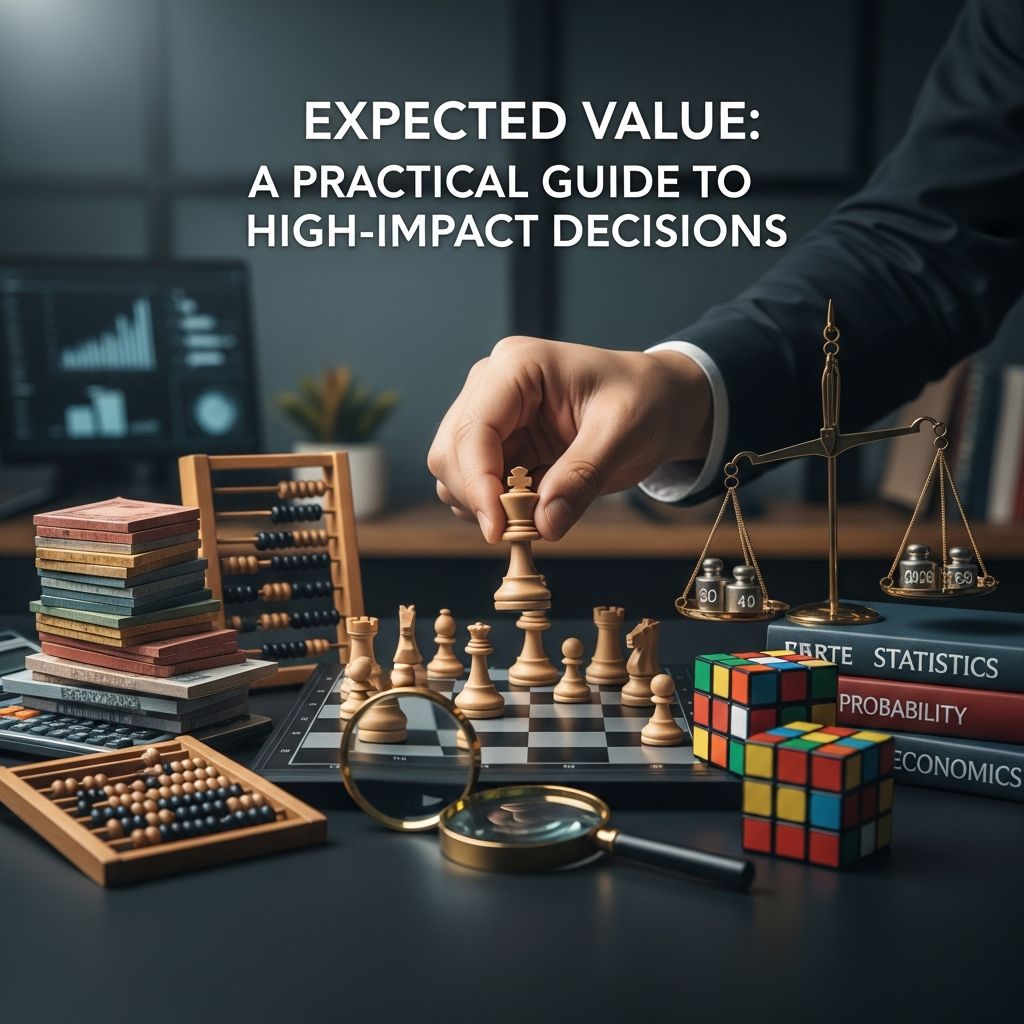
Many of the most important choices in life are gambles. You rarely know for sure how a new job, a donation, or a risky project will turn out. Expected value is a simple but powerful way to compare these uncertain options and choose the ones that are best in the long run.
What Expected Value Really Means
In probability and decision science, expected value is the probability-weighted average of all possible outcomes of an uncertain choice. If you could repeat the same decision many times under similar conditions, the expected value is the average result you would obtain over the long run.
Mathematically, for a decision with outcomes \(x_1, x_2, …, x_n\) and corresponding probabilities \(p_1, p_2, …, p_n\) that sum to 1, the expected value (EV) is:
EV = p1 × x1 + p2 × x2 + … + pn × xn
- Outcomes capture what you care about (money, time, lives saved, happiness, or any metric).
- Probabilities reflect how likely each outcome is.
- Expected value condenses these into a single comparable number.
Expected value does not predict what will happen on any single attempt. It tells you what to expect on average if you repeatedly face similar situations.
Why Expected Value Beats Intuition Alone
People are not naturally good at thinking about risk and probability. Research in behavioral economics shows that we:
- Overweight vivid worst cases and underweight quiet, likely outcomes.
- Fear losses more than we value equivalent gains (loss aversion).
- Rely on stories and anecdotes instead of base rates and statistics.
Expected value helps counter these biases by forcing you to:
- List all significant plausible outcomes.
- Assign explicit probabilities to each.
- Combine them using a transparent formula instead of gut feeling.
Used consistently, this approach leads to better resource allocation in domains such as public policy, finance, and operations, where decisions must weigh uncertain trade-offs.
How to Calculate Expected Value Step by Step
You can apply expected value with a simple four-step process.
1. Define the decision and metric
Start by clarifying:
- What choice are you evaluating? (Example: which project to fund.)
- What outcome measure matters? (Profit, cost, social impact, quality-adjusted life years, etc.)
2. List possible outcomes
Identify the main scenarios that might occur if you choose this option:
- Best-case, typical, and worst-case results.
- Other realistic scenarios that differ in cost, scale, or probability.
Do not try to enumerate every tiny possibility; focus on outcomes that meaningfully change your decision.
3. Estimate probabilities
For each outcome, estimate how likely it is. You can use:
- Historical data or benchmarks (e.g., failure rates, demand levels).
- Expert judgment or structured forecasting techniques.
- Reference classes: how similar projects turned out.
Ensure that probabilities across all outcomes for a given option sum to 1 (or 100%).
4. Multiply and sum
For each outcome:
- Multiply the outcome value by its probability.
- Add the results across all outcomes.
The resulting number is the expected value for that option. You can then repeat this process for other options and compare the EVs to guide your choice.
Comparing Options: Expected Value in Action
Expected value is useful whenever you have several ways forward and each has multiple possible results. A classic use case is choosing between projects or policies under uncertainty.
| Aspect | Option A | Option B |
|---|---|---|
| Number of outcomes considered | Several profit scenarios | Several profit scenarios |
| Estimated probabilities | Data-based (e.g., 40% / 60%) | Data-based (e.g., 30% / 70%) |
| Expected value result | Higher EV (e.g., $1.1M) | Lower EV (e.g., $1.04M) |
| Decision rule (for gains) | Choose the option with the higher expected value. | |
In many business and policy settings, analysts use expected value as a decision criterion: for profit-seeking decisions, the option with the highest EV is favored; for cost minimization, the option with the lowest EV is preferred.
Using Expected Value Beyond Money
Although EV is often introduced with monetary examples, it is a general tool. You can use it with any measure that can be quantified, such as:
- Health outcomes: life expectancy or quality-adjusted life years in health policy analysis.
- Environmental impact: expected carbon emissions avoided by different interventions.
- Social impact: expected number of people helped by a program.
- Career impact: expected long-term contribution of different career paths.
In these cases, expected value becomes a structured way to compare the long-run impact of paths that differ in scale, risk, and likelihood of success.
Expected Value and Career Choices
Career decisions combine uncertainty, long time horizons, and the potential for large differences in impact. Expected value thinking can support better career planning by:
- Highlighting high-upside paths that are risky but could have very large positive effects if they succeed.
- Distinguishing between low-risk, low-impact roles and higher-risk, higher-impact opportunities.
- Encouraging a portfolio mindset, where early career moves build skills and information that raise the expected value of later choices.
For example, someone deciding between a safe job and a more uncertain, potentially high-impact role can model each path:
- Estimate different career trajectories (e.g., remaining in the same field, transitioning to leadership, or moving into a highly impactful sector).
- Assign probabilities to each trajectory based on base rates and personal indicators.
- Quantify the expected contribution in terms of people helped, research output, or other relevant metrics.
While these estimates will be rough, the exercise can reveal when a riskier path has a substantially higher expected value than safer alternatives, even if most specific outcomes are modest.
Expected Value vs. Risk Attitudes
Expected value is not the only legitimate decision criterion. People differ in how they feel about risk:
- Risk-neutral individuals focus mostly on expected value and are comfortable with variability.
- Risk-averse individuals prefer more certain outcomes, even with slightly lower expected value.
- Risk-seeking individuals may favor options with lower EV but very large upside in rare cases.
In formal decision analysis, risk aversion is often captured with expected utility rather than expected monetary value. Utility functions can be concave (risk-averse) or convex (risk-seeking), reflecting how additional gains or losses feel to you.
Even if you care about risk, expected value remains a crucial input:
- It tells you what you give up when choosing safety over upside.
- It allows transparent trade-offs between risk and reward.
- It supports robust policy analysis, where social planners may aggregate expected utilities across individuals.
Common Pitfalls When Using Expected Value
Expected value is powerful but can be misused. Some frequent issues include:
- Overconfident probabilities: assigning precise numbers where evidence is weak. Use ranges or sensitivity analysis instead.
- Ignoring tail risks: omitting low-probability, high-impact outcomes that materially change the EV.
- Unit confusion: mixing different metrics (e.g., dollars and hours) without converting them into a common scale.
- Single-shot decisions: treating one-off, irreversible choices exactly like repeatable gambles, even when personal risk constraints matter.
To make EV more reliable:
- Use historical data and external benchmarks whenever possible.
- Check how EV changes if key assumptions shift.
- Combine EV with qualitative judgment about ethics, dignity, and non-quantifiable values.
Advanced Uses: Forecasting and Dynamic Decisions
In many real-world settings, probabilities and payoffs evolve over time as you learn and conditions change. Organizations increasingly use forecasted expected value to plan across multiple periods.
Key ideas include:
- Dynamic probabilities: updating beliefs based on new data (e.g., Bayesian updating).
- Scenario analysis: modelling how future market or policy changes affect probabilities and payoffs.
- Real options: recognizing that you can expand, pause, or abandon a project later depending on what you learn.
Modern analytics platforms integrate live data streams to keep expected value calculations up to date, helping teams revise decisions as conditions shift.
When Expected Value Is Most Useful
Expected value thinking is especially valuable when:
- Outcomes differ greatly in scale (e.g., small chance of very high payoff).
- Decisions are repeatable or part of a series (investments, hiring, experimentation).
- You can estimate probabilities at least roughly from data or expert input.
- Resources are scarce and must be allocated across competing projects.
It is less decisive when probabilities are almost entirely unknown, when qualitative values dominate, or when catastrophic downside risk cannot be tolerated regardless of expected value.
Practical Checklist for Expected-Value Decisions
To apply expected value in your own decisions, you can use this quick checklist:
- Have I clearly defined the decision and chosen a metric?
- Have I listed the main plausible outcomes?
- Have I estimated probabilities using data or reasonable analogies?
- Have I computed the probability-weighted average outcome?
- Have I compared EVs across options, checking sensitivity to key assumptions?
- Have I considered my risk tolerance and ethical constraints?
Answering these questions transparently often improves decisions even before you finalize the numbers.
Frequently Asked Questions (FAQs)
Q: Is expected value the same as the average result?
A: Expected value is a theoretical long-run average based on probabilities. In many independent repetitions under similar conditions, the observed average tends to approach the expected value, but any single outcome may differ greatly.
Q: What if I cannot estimate probabilities precisely?
A: Precision is not always necessary. Use ranges, approximate probabilities, or scenario analysis, and test how your decision changes when assumptions shift. The structure of the calculation can still reveal which options are robustly better.
Q: How is expected value used in public policy?
A: Policy analysts often calculate expected values of costs and benefits for different policy options, including health outcomes, economic effects, and environmental changes, to guide resource allocation and risk management.
Q: Does expected value ignore fairness or ethics?
A: Expected value only summarizes outcomes on a chosen metric; it does not capture all moral or distributional concerns. Many decisions require combining EV analysis with ethical principles, legal constraints, and stakeholder input.
Q: When should expected utility replace expected monetary value?
A: When risk attitudes matter strongly—for example, for individuals facing large stakes relative to their wealth—analysts often model choices using expected utility instead of raw monetary values, allowing concave utility functions to represent risk aversion.
References
- 10.3 Expected Value – Data Analytics for Public Policy and Management — K.E. Henrickson & K. M. Reynolds, Oregon State University. 2021-01-01. https://pressbooks.pub/decisions/chapter/7-1-expected-value/
- How Expected Value Can Help You Make Good Decisions (Part 1) — Quick and Dirty Tips. 2019-04-09. https://www.quickanddirtytips.com/qdtarchive/how-expected-value-can-help-you-make-good-decisions-part-1/
- Expected Value — Corporate Finance Institute. 2023-05-01. https://corporatefinanceinstitute.com/resources/data-science/expected-value/
- How to Calculate (and Forecast) Expected Value — Workday, Inc. 2023-06-15. https://blog.workday.com/en-gb/how-to-calculate-and-forecast-expected-value.html
- Expected Value: Why Probabilities Can Help Us Make Better Career Decisions — Probably Good. 2022-07-20. https://probablygood.org/core-concepts/expected-value/

- Integrated M.A. in Applied Linguistics, University of Hyderabad
- 5+ years in editorial, instructional, SEO, and research-based writing
Sneha is a relationships and lifestyle writer with a strong foundation in applied linguistics and certified training in relationship coaching. She brings over five years of writing experience to theskillvault, crafting thoughtful, research-driven content that empowers readers to build healthier relationships, boost emotional well-being, and embrace holistic living. Her writing and insights reflect the belief that beauty, happiness, and wellness…