
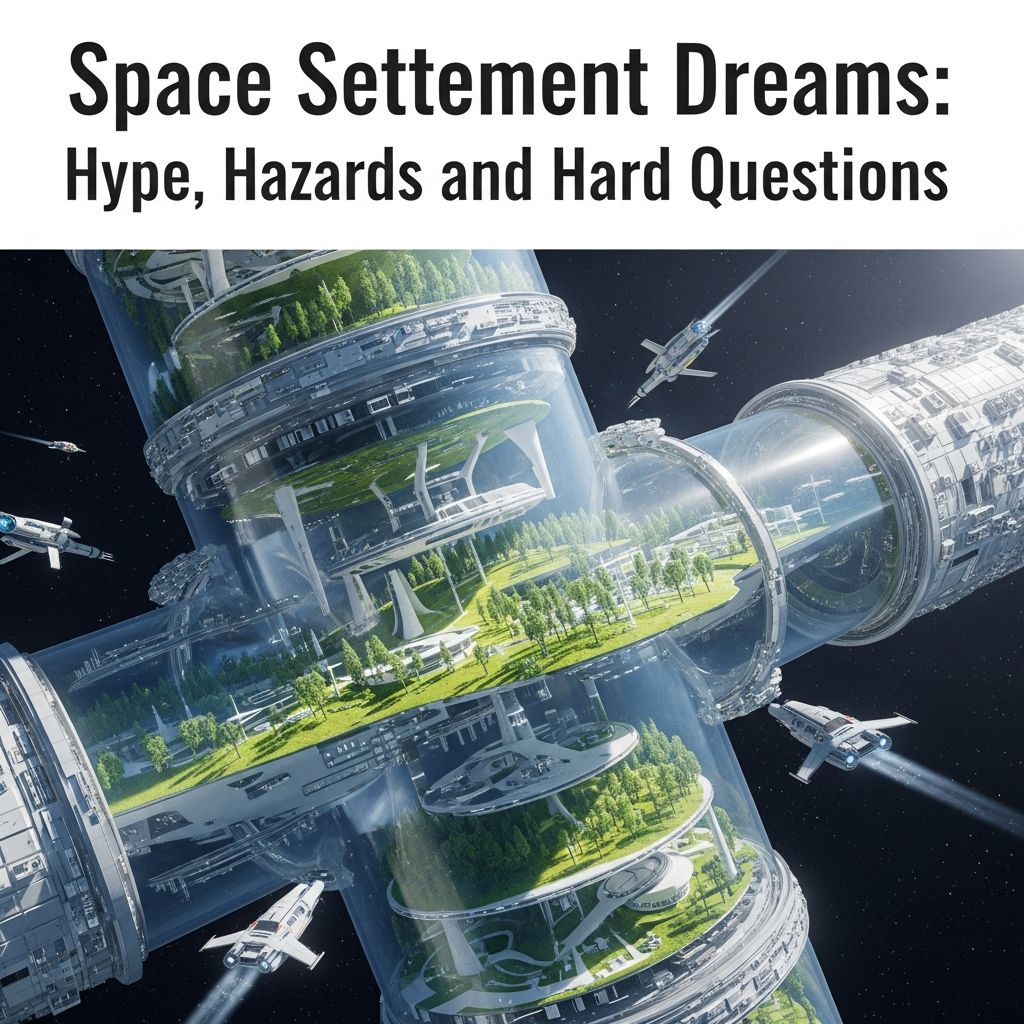
For decades, visions of bustling cities on Mars, lunar mining towns, and spinning space habitats have captured the public imagination. Reusable rockets and falling launch costs have made those dreams feel closer than ever. Yet when scientists, lawyers, and economists scrutinize the details, a sobering picture emerges: we are far less prepared for permanent off-world living than popular narratives suggest.
This article offers a reality check. Drawing on contemporary research in biology, engineering, economics, and international law, it explores why ambitious space settlement timelines are likely premature, what we still do not know, and how better priorities could make humanity safer in the long term.
From Excited Space Fan to Structured Skeptic
Many people who take a deep dive into the literature on space settlement undergo a similar journey: they start optimistic and end cautious. The basic arc often looks like this:
- Phase 1 – Inspiration: Childhood exposure to science fiction, Apollo footage, or Mars colony concept art fuels enthusiasm for humanity as a multiplanetary species.
- Phase 2 – Technological Optimism: News about cheap launch, mega-rockets, and private spaceflight strengthens the sense that colonizing Mars is imminent.
- Phase 3 – Research and Doubt: Reading deeply in space medicine, life support engineering, and space law reveals unresolved questions that are rarely mentioned in popular coverage.
- Phase 4 – Cautious Realism: The goal of inhabiting space remains appealing, but timelines stretch, priorities shift, and the emphasis moves from “How soon can we settle?” to “What would it take to do this safely and ethically?”
This shift is not anti-space. It is pro-evidence. It asks for the same rigor for off-world cities that we expect when certifying aircraft, medicines, or nuclear reactors.
Why Falling Launch Costs Changed the Conversation
One reason renewed enthusiasm for settlements feels plausible is that launch costs have indeed fallen sharply. Reusable first stages, improved manufacturing, and competition have driven the price per kilogram to low Earth orbit down by an order of magnitude compared with early shuttle-era benchmarks.
Lower launch price matters for several reasons:
- It enables large satellite constellations and deep-space probes that were previously uneconomical.
- It makes experiments in orbit more accessible to universities and smaller nations.
- It lends credibility to visions that once sounded purely speculative, such as large crewed missions to Mars.
However, cheap access to orbit is necessary but not sufficient for permanent communities in space. Launch is just one line item in an enormous bill that includes shielding, habitats, food, medical care, and decades of logistics.
Technical vs. Biological vs. Social Challenges
Space settlement is often portrayed as a primarily engineering problem: build bigger rockets, better habitats, and robust life-support systems, and the rest will follow. In reality, the difficulty spans at least three intertwined domains:
| Domain | Core Challenge | Settlement-Relevant Unknowns |
|---|---|---|
| Technical | Keeping people alive in harsh environments | Reliability of closed-loop life support, in-situ resource utilization, long-duration systems maintenance |
| Biological | Understanding human health off Earth | Long-term impacts of partial gravity, radiation on children, reproductive health, multigenerational viability |
| Social & Legal | Preventing conflict and exploitation | Governance structures, property rights, labor conditions, environmental protection of celestial bodies |
Critically, many of the hardest problems lie in the biological and social columns, where data are thinnest and solutions may be far slower to develop.
Human Biology: We Have Not Tested the Life We’re Promising
Space agencies have learned a great deal about human physiology in low Earth orbit, but most research focuses on short-to-medium missions involving healthy adults. There is minimal data on the kinds of lives often imagined in popular depictions of Mars or lunar settlements.
Radiation and Partial Gravity
Two major biological unknowns stand out:
- Chronic radiation exposure: Outside Earth’s protective magnetosphere, astronauts face a mix of galactic cosmic rays and solar particle events. Even in orbit, NASA notes elevated risks of cancer, cataracts, cardiovascular disease, and possible cognitive effects from radiation exposure.
- Partial gravity environments: While microgravity’s harms to bone density, muscles, and vision are well documented, we know little about long-term health in intermediate gravity (for example, Mars at about 0.38 g, the Moon at about 0.16 g).
These gaps become more alarming when we consider children. We have almost no direct data on conception, pregnancy, fetal development, or childhood growth in non-Earth gravity or high-radiation environments. Ethical constraints make such research slow and fraught, yet any genuine settlement would hinge on safe reproduction and healthy development.
Life Support and Medical Care
Closed-loop life support systems that recycle air and water are improving, but they are not yet at the reliability level needed for independent, permanent cities. NASA’s current systems on the International Space Station are highly sophisticated, but they are backed by frequent resupply, extensive spare parts, and real-time support from Earth.
A true settlement would need to handle:
- Industrial-scale food production and nutrient recycling.
- Long-term maintenance of complex equipment without rapid Earth resupply.
- Surgery, emergency medicine, chronic disease management, and childbirth with limited external help.
Every untested assumption about health care and life support multiplies the risk of catastrophic failure in an isolated environment.
Economics: Will Space Settlements Pay for Themselves?
Space settlement is often justified with economic narratives: asteroid mining will flood markets with valuable metals; space-based solar power will deliver clean energy; Mars will become a new frontier for wealth. These stories are compelling but currently speculative.
Asteroid Mining and Resources
Asteroid mining is technically conceivable and is an active area of exploration. NASA and other agencies study near-Earth asteroids for resource potential, and small missions have demonstrated rendezvous and sample-return capabilities. Yet turning those resources into profit faces serious obstacles:
- High up-front capital costs for prospecting, mining, processing, and transport.
- Uncertain demand: large new supplies could depress prices for some metals.
- Competition with terrestrial mining that continues to innovate and cut costs.
Until there is a clear, robust business case, it is risky to assume large, self-sustaining settlements can be financed by off-world extraction alone.
Space-Based Solar Power
Space-based solar power (SBSP) proposes putting large solar arrays in orbit and beaming energy down to Earth. Supporters argue that constant sunlight above the atmosphere could offer high-capacity, baseload power. Government and industry studies have suggested that SBSP is technically plausible but faces immense engineering and economic challenges, including launch costs, construction of very large structures in space, and safety concerns about power-beaming systems.
Compared with rapidly falling prices for terrestrial solar and energy storage, SBSP currently appears economically marginal at best. Treating it as a primary economic driver for off-world cities therefore seems premature.
Law and Governance: Who Owns the Moon?
While lawyers and diplomats have been thinking about space for decades, the legal regime was not designed for dense, permanent cities on other worlds. Two key features shape current debates:
- Outer Space Treaty (1967): This foundational treaty, to which major spacefaring nations are parties, prohibits national sovereignty over celestial bodies and frames space as the “province of all humankind.”
- Resource use ambiguity: The treaty disallows national appropriation but is less explicit about commercial extraction. Some countries have passed domestic laws granting companies rights over resources they mine, arguing this is consistent with international law.
For small-scale scientific activities, these frameworks have functioned reasonably well. For self-governing settlements with permanent residents, the gaps become pressing:
- How are property rights assigned in a way that does not trigger conflict?
- What protections exist against exploitative labor practices in isolated company towns?
- How are environmental impacts on lunar or Martian landscapes regulated?
- Which courts or institutions adjudicate disputes between settlers, corporations, and Earth-based states?
Creating fair and stable governance systems takes years or decades even on Earth. Attempting to improvise them under survival pressure on Mars could be disastrous.
Ethical Trade-offs and Opportunity Costs
Even if long-term space settlement is technically possible, it raises hard questions about priorities. Humanity currently faces pressing global problems—climate change, pandemic risk, nuclear weapons, biodiversity loss—that pose near-term existential threats.
Key ethical questions include:
- Risk allocation: Is it acceptable to expose early settlers and especially their children to poorly understood health risks for the sake of long-term species survival?
- Equity: Who gets access to off-world opportunities? Will initial settlements mostly serve wealthy individuals and corporations?
- Opportunity cost: How much funding, engineering talent, and political capital are diverted from solving urgent Earth-bound risks in order to pursue speculative colonies?
Proponents often argue that becoming multiplanetary is itself a form of existential risk reduction. This might eventually be true, but if rushed, early settlements could fail catastrophically, damage international cooperation, and undermine support for later, better-prepared efforts.
A More Responsible Roadmap for Space Settlement
Instead of racing to plant flags and declare Martian cities, a more responsible approach would prioritize learning, risk reduction, and governance. A plausible high-level roadmap might emphasize:
1. Deepening Biological and Medical Research
- Extend and diversify long-duration missions in low Earth orbit to better understand bone, muscle, cardiovascular, and neurological changes over many years.
- Develop safe partial-gravity research (for example, via rotating habitats or lunar surface stays) focused explicitly on long-term health outcomes.
- Create international ethical frameworks for any studies involving reproduction or child development in altered gravity or radiation environments.
2. Building Robust, Testable Infrastructure on and Near Earth
- Invest in closed-loop life support testbeds on Earth to approach truly autonomous operation over multi-year periods.
- Construct analog habitats in extreme terrestrial environments (Antarctica, deserts, undersea) to study group dynamics, governance, and logistics under stress.
- Use cislunar space—Earth–Moon orbit and the lunar surface—as a proving ground for systems and protocols before attempting Mars-scale settlements.
3. Developing Governance Before We Desperately Need It
- Convene international working groups to clarify rights and responsibilities around resource use and environmental stewardship beyond Earth.
- Design template legal frameworks for off-world communities, including labor rights, dispute resolution, and emergency powers.
- Encourage transparency and data sharing among states and companies to avoid a regulatory race to the bottom.
4. Linking Space Policy to Global Risk Reduction
- Align major space investments with goals that also benefit Earth, such as climate monitoring, disaster prediction, and planetary defense against asteroids.
- Ensure that long-term settlement research includes explicit analysis of trade-offs with terrestrial risk mitigation.
- Prioritize projects whose spin-offs clearly improve resilience for both Earth-bound and future spacefaring populations.
Frequently Asked Questions (FAQs)
Q: Does this mean space settlement is impossible?
No. Current evidence suggests that permanent, large-scale settlements are far more uncertain and technically demanding than popular timelines assume, not that they are impossible in principle. The key message is to slow down, gather data, and solve foundational problems first.
Q: Isn’t becoming multiplanetary essential for preventing human extinction?
Multiple independent populations could eventually reduce some existential risks, such as planetary-scale natural disasters. However, many of the most acute threats today—nuclear war, engineered pandemics, climate destabilization—are best addressed through improved governance and technology on Earth. Premature, fragile colonies may add risk rather than reduce it.
Q: If launch is getting cheaper, won’t economics eventually take care of themselves?
Lower launch costs help, but they do not automatically make habitats, radiation shielding, healthcare, or local industry affordable. Most of the mass and complexity of a functioning city still must be built, maintained, and resupplied, often under harsher conditions than any terrestrial site.
Q: Could private companies handle settlements without extensive international law?
In theory, corporations could establish outposts under their national legal frameworks. In practice, history suggests that high-stakes, lightly regulated frontier ventures can produce conflict, exploitation, and environmental damage. Clear, widely accepted rules are likely to reduce long-term risk for both settlers and investors.
Q: What is the most valuable thing we can do for future space settlers right now?
The highest-value work is probably in careful foundational research: understanding long-term human biology in space-like conditions, developing trustworthy life support, and building fair governance structures. These steps will make any eventual settlement safer, more equitable, and more likely to endure.
References
- NASA’s Journey to Mars: Pioneering Next Steps in Space Exploration — NASA. 2015-10-01. https://www.nasa.gov/sites/default/files/atoms/files/journey-to-mars-next-steps-20151008_508.pdf
- Commercial Crew Program: About the Program — NASA. 2020-11-02. https://www.nasa.gov/commercialcrew
- Human Health and Performance Risks of Space Exploration Missions — NASA Human Research Program. 2016-04-01. https://humanresearchroadmap.nasa.gov
- Treaty on Principles Governing the Activities of States in the Exploration and Use of Outer Space, including the Moon and Other Celestial Bodies — United Nations Office for Outer Space Affairs. 1967-10-10. https://www.unoosa.org/oosa/en/ourwork/spacelaw/treaties/outerspacetreaty.html
- Life Support Baseline Values and Assumptions Document — NASA. 2010-04-01. https://ntrs.nasa.gov/citations/20100024116
- Near-Earth Object Survey and Deflection Analysis of Alternatives Report to Congress — NASA. 2007-12-31. https://www.nasa.gov/sites/default/files/atoms/files/neo_report_march07.pdf
- Space-Based Solar Power — U.S. Department of Energy, Office of Energy Efficiency and Renewable Energy. 2021-08-10. https://www.energy.gov/eere/solar/articles/space-based-solar-power
- Global Catastrophic Risks Survey: 2021 Report — Future of Humanity Institute, University of Oxford. 2021-03-01. https://www.fhi.ox.ac.uk/reports

- Integrated M.A. in Applied Linguistics, University of Hyderabad
- 5+ years in editorial, instructional, SEO, and research-based writing
Sneha is a relationships and lifestyle writer with a strong foundation in applied linguistics and certified training in relationship coaching. She brings over five years of writing experience to theskillvault, crafting thoughtful, research-driven content that empowers readers to build healthier relationships, boost emotional well-being, and embrace holistic living. Her writing and insights reflect the belief that beauty, happiness, and wellness…