
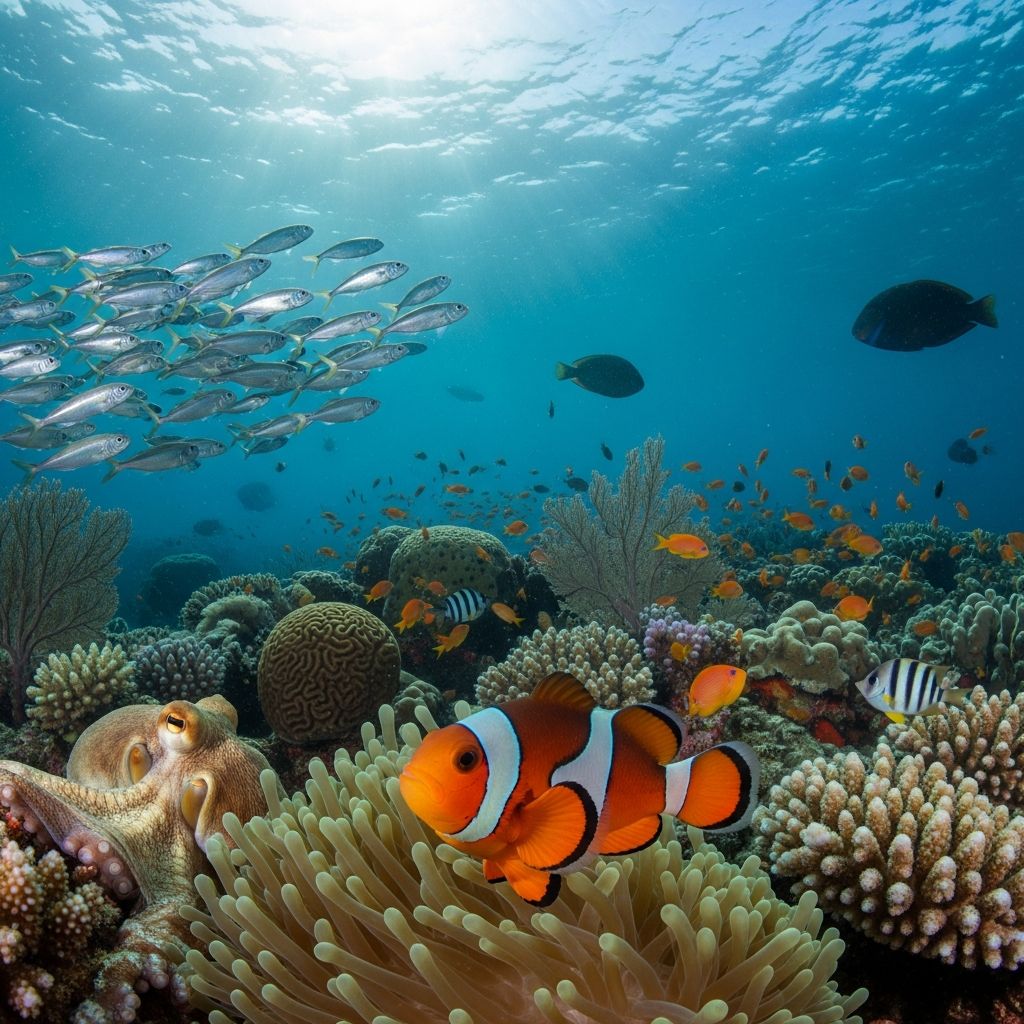
Fish make up the vast majority of vertebrate animals on Earth, yet for a long time they were treated as little more than instinctive swimmers and silent food sources. Emerging scientific research paints a very different picture: many fish can solve complex problems, recognise individual humans, navigate with mental maps, and show signs of emotions such as fear, anxiety, or even optimism. This new understanding forces us to rethink both their mental lives and our moral responsibilities toward them.
From Simple Reflexes to Sophisticated Minds
For much of the 20th century, the dominant view in science was that fish were cognitively simple: their behaviour was assumed to be driven by reflexes, not by flexible learning or conscious experiences. This assumption was partly based on brain anatomy — fish lack a neocortex, the structure traditionally associated with higher cognition in mammals — and partly on cultural attitudes that treated fish as emotionally blank animals.
Over the past two decades, however, carefully designed experiments have revealed that many fish:
- Adapt their behaviour based on experience, not just hard-wired instincts.
- Learn from both rewards and punishments and retain this information for weeks or months.
- Use attention and memory in ways comparable to some birds and mammals.
These findings support a broader shift in comparative cognition: similar abilities can evolve in very different brain architectures, meaning that lacking a neocortex does not prevent complex mental processes.
Extraordinary Senses in an Alien Medium
Life underwater exposes animals to a very different physical world than life on land. Water filters light, transmits sound faster, and carries dissolved chemicals. Fish have consequently evolved a range of specialised senses that, from a human point of view, can seem almost superhuman.
Vision and precision targeting
Many fish rely heavily on vision to locate prey and recognise other individuals. Some species can correct for visual distortions caused by refraction at the water–air interface, allowing them to accurately strike insects above the surface. This requires:
- Estimating the position and movement of fast, small targets.
- Adjusting for changes in angle, distance, and water conditions.
- Predicting where the prey will be in the near future rather than where it currently appears.
Studies in visual perception show that this type of correction involves internal models of how light and geometry behave — a surprisingly abstract kind of “underwater physics” encoded in neural circuits.
Beyond eyesight: lateral line, sound, and electroreception
In addition to vision, fish integrate several specialised sensory systems:
- Lateral line system: a row of mechanoreceptors along the body that detects water movement and vibrations, crucial for schooling and obstacle avoidance.
- Hearing and pressure detection: inner ears and pressure-sensitive organs allow fish to sense low-frequency sounds and pressure changes over long distances.
- Electroreception (in some species): the ability to detect electric fields produced by other animals or generated by the fish itself, which aids in navigation, hunting, and communication.
Because these sensory channels operate in parallel, fish perceive a rich, multi-dimensional environment that is difficult for humans to imagine and easy to underestimate.
Memory, Maps, and Problem-Solving
Contrary to the common myth that goldfish have three-second memories, numerous experiments demonstrate long-lasting and flexible forms of memory in fish. Researchers have shown, for example, that:
- Goldfish can learn to avoid zones of an aquarium where they previously received mild electric shocks and retain this avoidance for extended periods.
- The strength of the negative stimulus influences both how fast they learn and how long they remember, which matches standard principles of learning in mammals.
Cognitive maps and spatial reasoning
Some fish species also appear to form internal representations of their physical surroundings — cognitive maps. Field observations and experiments on intertidal fish and reef dwellers suggest they:
- Memorise the layout of pools, rocks, and safe zones when the tide is high.
- Use this stored map to navigate accurately when conditions change, such as when the tide recedes.
- Rely on distant landmarks and spatial cues similarly to birds and mammals that navigate large territories.
These abilities indicate that fish are not just reacting to immediate stimuli but can recall and use information that is no longer present — a key feature of advanced cognition.
Tool use and strategic behaviour
Experimental and field work has documented cases where fish use their environment in flexible ways, such as:
- Using rocks or hard surfaces to crack open shells and other tough prey items.
- Employing water jets to dislodge prey from crevices or to manipulate objects.
While tool use is less common in fish than in some birds or primates, its presence at all demonstrates the surprising range of strategies that can evolve in aquatic environments.
Fish and the Question of Pain
One of the most ethically significant questions in animal research is whether fish can feel pain in a conscious, affective sense, as opposed to mere reflexive responses. For years, sceptics argued that fish brains were too simple and lacked the necessary structures to support subjective experiences.
However, a growing body of evidence from neurobiology and behaviour points in the opposite direction:
- Fish have nociceptors — specialised sensory receptors that detect potentially damaging stimuli such as high heat or chemical irritation — similar to those found in mammals.
- Painful stimulation leads to changes in brain activity in regions involved in processing sensory and emotional information.
- Fish exposed to noxious stimuli display long-lasting, specific behavioural changes that go beyond simple reflexes, such as altered feeding, attention, and exploration patterns.
For example, studies on goldfish show that they quickly learn to avoid areas where they receive mild electric shocks and that they later weigh the trade-off between pain and hunger when food is only available in the aversive zone. This kind of cost–benefit evaluation closely resembles how mammals behave in parallel situations, suggesting that fish experiences are more than purely mechanical reactions.
Emotions, Mood, and Judgement Bias
Beyond pain, researchers have begun to investigate whether fish experience richer emotional states such as fear, anxiety, or optimism. One innovative method is the judgement bias test, widely used in animal welfare science. In this paradigm, animals are trained to associate one cue with a positive outcome (for example, food) and another cue with a negative one (such as a mild stressor). Then they are presented with an ambiguous cue between the two extremes.
Studies on species like sea bream show that:
- Fish in enriched or positive conditions tend to interpret ambiguous cues as more likely to lead to rewards — an “optimistic” bias.
- Fish under chronic stress or exposed to negative conditions more often interpret ambiguous cues as predicting negative outcomes — a “pessimistic” bias.
These shifts in behaviour are accompanied by changes in brain activity and physiological markers such as stress hormones, paralleling what is observed in mammals. Together, such results suggest that fish may possess internal states analogous to moods that influence how they evaluate future events.
Social Worlds: Friends, Foes, and Personalities
Fish are frequently imagined as anonymous members of huge, undifferentiated schools. In reality, many species form intricate social structures with repeating relationships, stable preferences, and even recognisable individual differences in temperament.
Social networks and individual recognition
Research on wild populations of small fish such as guppies shows that they form structured social networks rather than mixing randomly.
- Certain individuals act as connectors between separate clusters of fish, moving frequently between groups.
- Some fish maintain many social links, whereas others are more solitary or peripheral.
- Patterns of association remain stable over time, suggesting genuine social preferences rather than chance encounters.
Laboratory experiments complement these findings by showing that some fish can recognise individual conspecifics and even discriminate between familiar and unfamiliar humans based on facial features. This implies sophisticated visual processing and memory over significant time spans.
Personality and pair bonds
Personality — consistent differences in behaviour across time and situations — has been documented in many fish species. Individuals differ reliably in traits such as boldness, aggression, or sociability, and these differences influence:
- Who they associate with in social groups.
- How they respond to predators or new environments.
- Which strategies they use to find food or mates.
In some species, males and females form long-term pair bonds that resemble those seen in certain birds. Partners coordinate behaviours, defend territories together, and show distress when separated. Experiments manipulating access to partners can therefore shed light on attachment, social stress, and prosocial behaviour in fish.
Culture and Learning from Others
Culture is often defined, in a broad biological sense, as behaviours that are transmitted socially and persist across generations or groups. While human culture is uniquely rich and symbolic, traces of cultural processes have been identified in many animals — and fish are no exception.
Studies of wild fish populations suggest that:
- Feeding techniques and migration routes can spread through groups via social learning.
- Younger or inexperienced fish often copy where and how older individuals forage or travel.
- Once established, these patterns can remain stable even when conditions change, indicating a form of tradition.
Laboratory work further shows that some fish learn more efficiently when they can observe conspecifics performing a task, compared with learning alone. This capacity for social learning is a key building block for cumulative cultural evolution, even if fish cultures are far simpler than human ones.
Why Fish Cognition Matters for Humans
Understanding fish cognition and emotion is not just an academic curiosity; it has direct implications for policy, industry, and personal choices. Fish are the most exploited group of vertebrates on the planet, with billions killed each year in wild capture fisheries and aquaculture operations.
Implications for welfare and policy
If fish can feel pain and experience negative emotional states, then the conditions in which they are caught, farmed, transported, and slaughtered become a major ethical concern. Several trends are emerging:
- Scientific reviews now often conclude that the balance of evidence supports the capacity of many fish species to experience pain and suffering.
- Some countries and regulatory bodies are beginning to include fish in animal welfare legislation, covering issues such as stocking density, handling methods, water quality, and slaughter procedures.
- Industry guidelines in aquaculture increasingly mention welfare indicators specific to fish, including behaviour, injury rates, and stress markers.
Although practices vary widely across regions and species, these developments reflect a growing recognition that the cognitive and emotional lives of fish deserve serious consideration.
Rethinking our relationship with underwater life
On a personal level, learning about fish cognition may influence how people think about activities such as angling, aquarium keeping, and seafood consumption. Some respond by shifting their diet, others by supporting higher welfare standards or by choosing products from systems that aim to minimise suffering.
For researchers and conservationists, appreciating fish as cognitively complex beings can also change priorities. Behavioural needs, social structures, and stress responses become important factors when designing marine protected areas, restocking programs, or captive breeding initiatives.
Key Abilities in Fish: A Quick Comparison
| Domain | Examples in Fish | Comparable Features in Mammals/Birds |
|---|---|---|
| Sensation | Vision, lateral line, electroreception in some species | Vision, hearing, touch and, in some species, echolocation |
| Learning & Memory | Avoidance learning, long-term memory of aversive zones | Classical and operant conditioning, contextual memory |
| Pain & Emotions | Nociceptors, altered behaviour after noxious stimuli, judgement bias | Pain perception, anxiety and mood-like states |
| Social Life | Social networks, pair bonds, personalities, cooperation | Family groups, dominance hierarchies, individual recognition |
| Cultural Transmission | Social learning of routes and foraging strategies | Song dialects in birds, tool traditions in primates |
Frequently Asked Questions (FAQs)
Do fish really feel pain like mammals do?
Current evidence indicates that many fish species possess pain receptors, show complex behavioural and brain responses to noxious stimuli, and modify their future behaviour in ways that go beyond simple reflexes. While their subjective experience may not be identical to that of humans, the data strongly suggest they can feel pain in a morally relevant sense.
How good is a fish’s memory?
Experiments show that goldfish and other species can remember locations associated with danger or reward for weeks or longer, directly contradicting the myth of a three-second memory. Their performance in certain learning tasks is comparable to that of some birds and mammals.
Can fish recognise humans?
Some visually oriented fish can learn to distinguish individual human faces and reliably pick out a familiar face from many alternatives. This requires fine-grained visual processing and stable long-term memory.
Do all fish have complex cognition, or only a few species?
Research so far has focused on a limited number of species, often those that are easy to keep in laboratories or economically important. Many of these show surprisingly rich abilities, but there is likely significant variation across the tens of thousands of fish species. Future work will be needed to map this diversity in detail.
What does fish cognition mean for how we should treat them?
If fish can feel pain and experience negative emotional states, then the vast scale of fishing and aquaculture raises major welfare questions. Many scientists and policy-makers argue that fishing methods, farming conditions, and slaughter techniques should be evaluated and improved with fish welfare in mind.
References
- Fish don’t feel pain, TRUE or FALSE? — Chaire BEA / VetAgro Sup. 2024-09-01. https://chaire-bea.vetagro-sup.fr/en/fish-dont-feel-pain-true-or-false/
- Fish don’t feel pain, TRUE or FALSE? (PDF) — Sébastien Moro, Chaire BEA. 2024-09-01. https://chaire-bea.vetagro-sup.fr/wp-content/uploads/2024/09/22-12-Fish-dont-feel-pain-TRUE-or-FALSE.pdf
- Animal welfare: an overview — World Organisation for Animal Health (WOAH). 2023-06-01. https://www.woah.org/en/what-we-do/animal-health-and-welfare/animal-welfare/
- Animal welfare and animal health — European Food Safety Authority (EFSA). 2023-05-15. https://www.efsa.europa.eu/en/topics/topic/animal-welfare
- Salmon welfare in aquaculture — Norwegian Food Safety Authority. 2022-11-10. https://www.mattilsynet.no/dyr_og_dyrehold/fisk_og_akvakultur/fish_welfare_in_aquaculture

- Integrated M.A. in Applied Linguistics, University of Hyderabad
- 5+ years in editorial, instructional, SEO, and research-based writing
Sneha is a relationships and lifestyle writer with a strong foundation in applied linguistics and certified training in relationship coaching. She brings over five years of writing experience to theskillvault, crafting thoughtful, research-driven content that empowers readers to build healthier relationships, boost emotional well-being, and embrace holistic living. Her writing and insights reflect the belief that beauty, happiness, and wellness…