
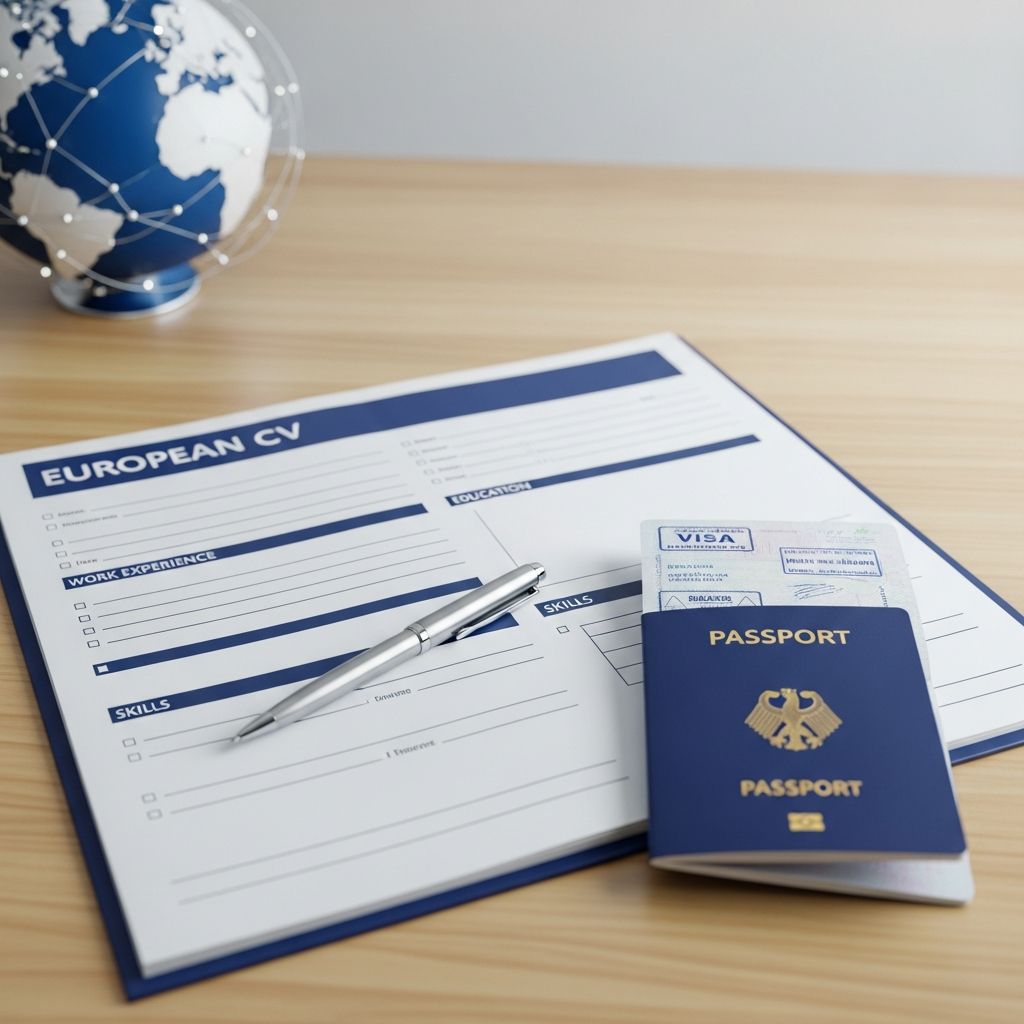
Applying for roles across Europe requires a CV that follows shared regional expectations. While each country has its own customs, employers across the EU are used to a recognizable structure, level of detail, and type of information on a European-style CV.
This guide explains how to format your CV for European job markets, what sections to include, how it differs from other regions, and how to adapt it without breaking local rules or anti-discrimination laws.
1. What Makes a CV “European”?
A European CV is less about one fixed template and more about common conventions used in many EU countries. It typically:
- Uses a reverse-chronological order for work experience and education (most recent first).
- Stays within one to two pages for most professionals.
- Emphasizes job titles, dates, locations, and responsibilities in a structured way.
- Includes a short profile statement (summary or objective) at the top.
- Clearly separates sections such as contact details, experience, education, skills, and languages.
The best-known standardized option is the Europass CV, recommended by the European Commission and widely recognized by universities and employers in Europe.
2. European CV vs. Other CV/Resume Styles
Understanding the differences between a European CV, a typical US-style resume, and an academic CV helps you avoid sending the wrong document.
| Aspect | European CV (General Market) | US Resume | Academic CV |
|---|---|---|---|
| Length | 1–2 pages for most roles | Usually 1 page early career, up to 2 for experienced | As many pages as needed (no strict limit) |
| Structure | Reverse-chronological, fixed core sections | Reverse-chronological or hybrid, more flexible | Extensive sections on research, publications, teaching |
| Focus | Experience, education, skills, languages | Achievements and impact, concise | Academic output, grants, conferences |
| Standardized template | Europass available, but not mandatory | No official standard | Varies by discipline and institution |
| Personal details | Country-dependent: some request more data, some restrict it | Minimal (no photo, DOB, marital status, etc.) | Similar to US resume for personal data |
3. Core Sections of a European CV
Most European recruiters expect to find the following blocks in a predictable order.
3.1 Contact and Basic Information
This section should make it effortless for employers to identify and reach you:
- Full name (first name and surname)
- Professional title matching the target role (e.g., “Software Engineer”)
- Phone number with international dialing code if you apply abroad (e.g., +33, +49)
- Email address that looks professional (use your name, avoid nicknames)
- Location (city and country), especially if relocation or remote work is relevant
- Online links such as LinkedIn or a portfolio if they add value
Some jurisdictions in Europe now discourage including photos or sensitive data such as marital status, religion, or full address to comply with equality and data protection norms. Always verify local customs before sharing more personal information than necessary.
3.2 Professional Summary or Objective
A short paragraph near the top helps recruiters quickly understand your profile.
- A summary highlights your experience, main skills, and a key achievement, suitable for candidates with relevant work history.
- An objective focuses on your career goals, transferable abilities, and motivation, useful for students, graduates, or career changers.
Keep it focused on the specific role and industry instead of describing yourself in generic terms.
3.3 Work Experience
Work history is almost always presented in reverse-chronological order, starting with the most recent job and moving backward. For each role, include:
- Job title
- Employer name and city/country
- Start and end dates in month/year or year-only format, used consistently
- Bullet points summarizing achievements and responsibilities
European employers pay close attention to the continuity and progression of your experience. If you have gaps, you can briefly explain them (e.g., further study, caregiving, travel) in a positive, concise manner.
3.4 Education
Education is typically presented after work experience for experienced professionals and before experience for students or fresh graduates. Mention:
- Degree title (e.g., BSc in Economics, Master of Engineering)
- Institution name and location
- Dates of study or expected graduation date
- Notable modules, projects, or thesis topics that match the role
In some European countries, it is normal to specify your final grade or classification if it strengthens your application.
3.5 Skills
A dedicated skills section supports quick screening by both humans and applicant tracking systems (ATS). You can split skills into categories, such as:
- Technical or hard skills (software, tools, programming languages, technical methods)
- Soft skills (communication, teamwork, leadership, problem solving)
- Industry-specific competences (e.g., regulatory knowledge, methodologies)
Whenever possible, support soft skills with concrete evidence in your work experience bullets instead of listing them without context.
3.6 Languages
Language ability is particularly relevant for cross-border work in the EU. The Europass framework encourages candidates to use levels such as A1–C2 or clear labels like “native,” “fluent,” and “intermediate” for reading, writing, and speaking.
- List each language separately.
- Indicate your proficiency level.
- Highlight certifications (e.g., IELTS, TestDaF, DELF) when relevant.
3.7 Optional Add-On Sections
Depending on the role and country, you might also include:
- Certifications and licenses (e.g., PMP, professional registration)
- Professional memberships in societies or associations
- Volunteer work and community activities
- Publications, conferences, or presentations (for research-heavy roles)
- Projects that demonstrate technical or creative expertise
4. Formatting Standards for European Recruiters
Beyond content, presentation can determine whether your CV is easy to scan and compatible with automated systems.
4.1 Layout and Readability
- Use clear headings and generous white space.
- Choose a legible font (e.g., Arial, Calibri, Times New Roman) at 10–12 pt for body text.
- Keep margins regular to avoid crowded text.
- Align dates and locations consistently to help recruiters skim quickly.
4.2 Length and Level of Detail
- Target one page for students and early career profiles.
- Use up to two pages for experienced professionals with extensive responsibilities.
- Prioritize the last 10–15 years of work history, unless older experience is highly relevant.
4.3 ATS-Friendly Design
Many larger employers in Europe scan CVs with automated systems before a human review. To maximize compatibility:
- Stick to standard section headings (“Work Experience”, “Education”, “Skills”).
- Avoid placing key information in images, charts, or text boxes.
- Use bullet points instead of dense paragraphs.
- Include relevant keywords from the job description naturally within your bullets.
5. Country-Specific Considerations
Although there is a shared baseline format, expectations for photos and personal data still vary across Europe. Always check local norms and anti-discrimination guidance before applying.
5.1 Photos on a CV
- In some countries (e.g., Germany, France, Spain), CV photos remain common in many sectors.
- In others (e.g., UK, Ireland, the Netherlands), photos are usually discouraged to reduce bias and comply with equality legislation.
The European Commission’s guidance for Europass warns candidates to be cautious about including unnecessary personal details and to focus on skills and experience instead.
5.2 Sensitive Personal Information
EU privacy rules and anti-discrimination laws make it risky for employers to ask for certain information. In many markets you should omit:
- Religion or political affiliation
- Marital status and details about children
- National identification numbers
Only provide what is explicitly requested and legally allowed in the job posting or application portal.
6. Tailoring a European CV for Each Application
Sending one generic CV to every employer is rarely effective. Instead, adjust your European CV for each role.
6.1 Analyze the Job Description
- Highlight the skills, tools, and responsibilities that appear repeatedly.
- Note any language requirements or regional knowledge expected.
- Identify the top 3–5 priorities the employer cares about most.
6.2 Adjust Your Sections Strategically
- Reorder optional sections so the most relevant content appears earlier.
- Emphasize projects or experience directly related to the role.
- Mirror keywords naturally in your bullet points.
6.3 Quantify Achievements Where Possible
Numbers help recruiters quickly understand your impact. Where appropriate, mention:
- Percent improvements (e.g., increased revenue, reduced processing time)
- Cost savings or efficiency gains
- Volume metrics (clients served, projects completed, users supported)
7. Common Mistakes on European CVs
Recruiters across Europe often see the same avoidable errors. Avoid these pitfalls:
- Overly long documents filled with minor or outdated roles that dilute your main story.
- Unclear job titles that make it hard to understand your level of responsibility.
- Inconsistent dates that raise questions about gaps.
- Irrelevant personal details that add no value and may breach local norms.
- Spelling and grammar mistakes, especially when applying in a language that is not your native tongue.
University career services across Europe consistently emphasize proofreading, clarity, and tailoring as top success factors in job applications.
8. Using the Europass CV Template
The Europass CV, provided by the European Union, is a free, standardized template that you can complete online.
- You first create a profile with your education, training, work experience, and skills.
- You can then generate multiple CV versions by selecting which information to include.
- The resulting CV follows a structure that is familiar to many employers and educational institutions in the EU.
While you are not obliged to use Europass, it can be useful if you are applying to many countries or institutions and want a consistent, widely recognized layout.
9. Practical Checklist Before Sending Your European CV
Before you submit your application, quickly review these points:
- Your CV is no longer than two pages (unless your field explicitly expects more).
- The most recent roles and studies appear first.
- Dates, job titles, and locations are consistent throughout.
- You have removed unnecessary personal details that may conflict with local norms.
- Spelling and grammar have been checked, ideally by a native or advanced speaker of the application language.
- The CV is aligned with the job description and includes relevant keywords.
10. Frequently Asked Questions About the European CV Format
Q1: Is the Europass CV mandatory for jobs in Europe?
No. The Europass CV is widely known and accepted, but it is not compulsory. Many employers are happy with any well-structured CV that follows common European conventions and is easy to read.
Q2: How many pages should a European CV have?
Most candidates should aim for one to two pages. Universities and career services typically recommend keeping it concise while still covering your key experience and achievements.
Q3: Should I write my CV in English or the local language?
Use the language specified in the job posting. If multiple languages are accepted, English is often a safe choice for international roles, but submitting a strong CV in the local language can sometimes be an advantage for local positions.
Q4: Do I need to include my date of birth or marital status?
In many European countries, employers no longer expect such details and some discourage them to avoid discrimination risks. Check local guidelines and only include sensitive information if clearly requested and lawful.
Q5: Is a photo required on a European CV?
It depends on the country and sector. Some markets still use photos routinely, but others consider them unnecessary or problematic. When in doubt, follow the instructions in the job posting or consult trusted local career advice sources.
References
- Create your Europass CV — European Union / Europass. 2024-05-10. https://europass.europa.eu/en/create-europass-cv
- CVs — University of Oxford Careers Service. 2023-10-01. https://www.careers.ox.ac.uk/cvs
- Curriculum Vitae (CV) Format: Tips & Templates — Zety. 2023-06-15. https://zety.com/blog/cv-format

- Integrated M.A. in Applied Linguistics, University of Hyderabad
- 5+ years in editorial, instructional, SEO, and research-based writing
Sneha is a relationships and lifestyle writer with a strong foundation in applied linguistics and certified training in relationship coaching. She brings over five years of writing experience to theskillvault, crafting thoughtful, research-driven content that empowers readers to build healthier relationships, boost emotional well-being, and embrace holistic living. Her writing and insights reflect the belief that beauty, happiness, and wellness…