
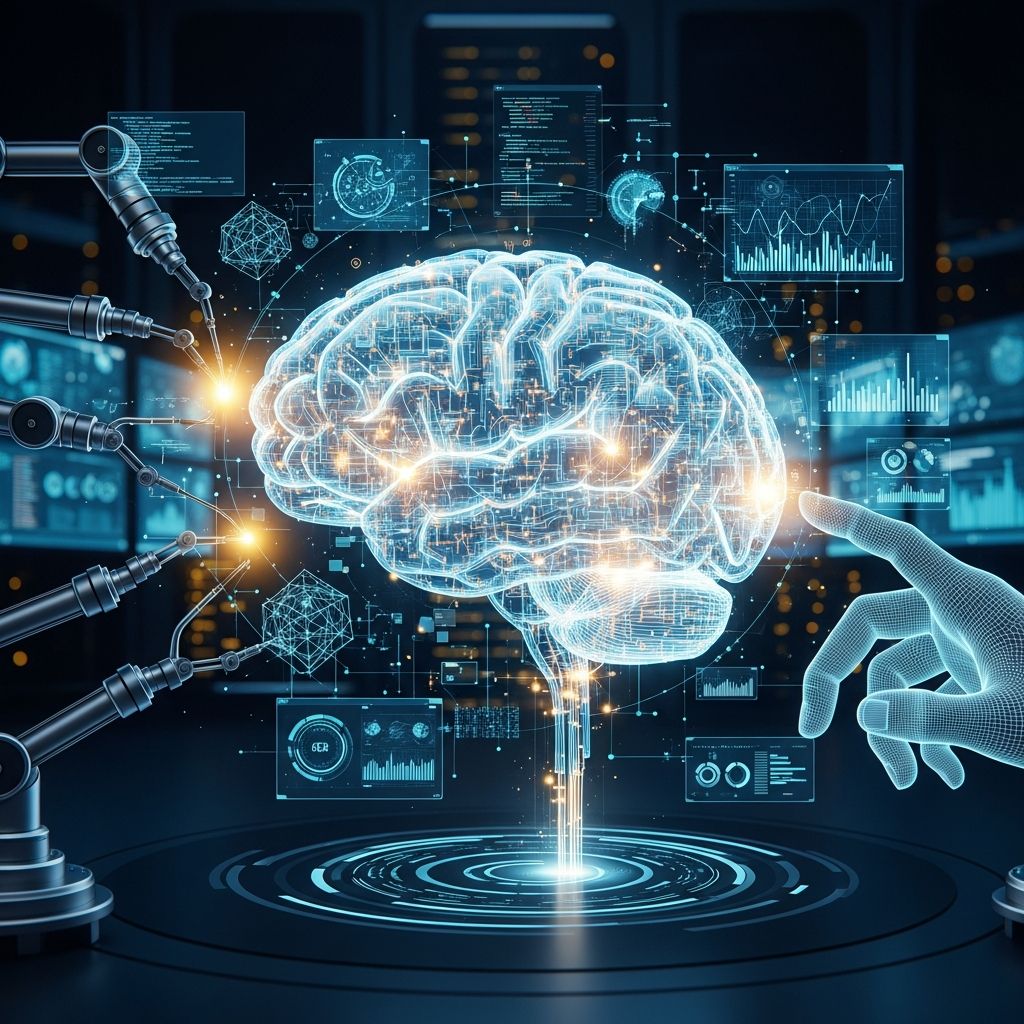
Peering Inside the Black Box
Modern artificial intelligence, especially large language models, often behaves like a black box: we can see what goes in and what comes out, but the internal reasoning remains opaque. This opacity is not just a scientific curiosity—it’s a practical and ethical challenge. How can we trust a system whose decisions we cannot explain? How can we fix it when it goes wrong? And how can we ensure that increasingly powerful models remain aligned with human values?
One of the most promising approaches to addressing these questions is mechanistic interpretability. Rather than treating a neural network as a statistical pattern-matcher, mechanistic interpretability treats it as a computational system that can, in principle, be reverse-engineered. The goal is not just to know what a model does, but to understand how and why it does it—down to the level of individual neurons, weights, and circuits.
From Correlations to Causal Circuits
Traditional interpretability methods often focus on correlations. Techniques like saliency maps, LIME, or SHAP highlight which input features are most associated with a particular output. These methods are useful for debugging and explanation, but they stop short of revealing the internal logic of the model. They answer questions like “Which words influenced this prediction?” but not “How did the model combine those words to reach its conclusion?”
Mechanistic interpretability moves beyond correlation to causation. It asks: What specific subnetworks, or circuits, are responsible for a given behavior? How do features propagate through the layers? What algorithmic steps does the model effectively implement? By answering these questions, researchers aim to reconstruct a kind of pseudocode for the model’s internal operations—akin to decompiling a compiled binary program into readable source code.
Features as the Building Blocks
At the heart of mechanistic interpretability is the idea that neural networks learn to represent meaningful concepts as features in their activation space. A feature might correspond to a simple pattern, like the presence of an edge in an image, or a more abstract concept, like the grammatical subject of a sentence.
These features are not always neatly localized to a single neuron; often, they are distributed across many neurons and layers. However, under certain conditions, high-level concepts appear as approximately linear directions in activation space. This is the intuition behind the linear representation hypothesis: that concepts like “male/female,” “political leaning,” or “sentiment” can be captured by specific directions in the vector space of activations.
Identifying and labeling these features is a crucial first step. Once we know what a model “thinks about” at each layer, we can begin to trace how those thoughts are combined and transformed into decisions.
Mapping the Internal Circuits
If features are the variables in a neural network’s internal program, then circuits are the functions and control flow. A circuit is a subnetwork—often a small set of neurons and connections—that performs a specific computational role, such as detecting a particular pattern, implementing a logical operation, or routing information between layers.
For example, in Transformer-based language models, researchers have identified circuits responsible for tasks like subject-verb agreement, in-context learning, and even simple arithmetic. One famous example is the induction head: a pair of attention heads that together implement a mechanism for copying patterns from earlier in the context to later positions, effectively enabling the model to “learn from examples” in the prompt.
Discovering such circuits involves a combination of techniques:
- Activation analysis: Examining which neurons fire in response to specific inputs or concepts.
- Feature visualization: Generating inputs that maximally activate a particular neuron or direction in activation space.
- Causal interventions: Editing weights or activations to test whether a particular component is necessary for a behavior.
- Path patching: Tracing how information flows through different paths in the network to isolate the critical route for a given output.
Together, these methods allow researchers to build up a mechanistic story: not just that a model knows a fact, but how it retrieves and uses that fact in context.
Why Mechanistic Understanding Matters
Understanding a model’s internal mechanisms is not just an academic exercise. It has concrete implications for safety, reliability, and alignment.
Improving Safety and Reliability
When a model makes a harmful or incorrect decision, traditional debugging often involves retraining or fine-tuning on more data. But without knowing why the model failed, this process can be slow, expensive, and prone to unintended side effects.
Mechanistic interpretability offers a more surgical approach. If we can locate the specific circuit responsible for a problematic behavior—such as a bias, a hallucination, or a security vulnerability—we can potentially edit or disable that circuit directly. This is the idea behind techniques like knowledge editing, where researchers identify the neurons and weights that encode a particular fact and then modify them to correct misinformation, all without retraining the entire model.
Enabling Better Control and Alignment
As AI systems grow more capable, the risk of misalignment increases. A model might optimize for a proxy objective that diverges from human intent, or it might develop internal goals that are difficult to detect from behavior alone.
Mechanistic interpretability provides a way to “look inside” the model and verify whether it is reasoning in ways that are aligned with human values. For instance, we might want to check whether a model is genuinely reasoning about consequences, or whether it is simply mimicking the style of ethical reasoning without understanding. By reverse-engineering the model’s internal decision processes, we can build stronger guarantees about its behavior.
Accelerating Scientific and Engineering Progress
From a scientific perspective, mechanistic interpretability helps us understand how neural networks generalize. Why do models suddenly acquire new capabilities during training? Why do they fail on certain types of inputs? By identifying the circuits responsible for these phenomena, we can turn anecdotal observations into testable hypotheses.
From an engineering perspective, mechanistic insights can guide architecture design, training procedures, and debugging. If we know that a particular circuit is responsible for a desired behavior, we can design models that make such circuits easier to learn and more robust.
Challenges and Open Problems
Despite its promise, mechanistic interpretability faces significant challenges, especially as models grow larger and more complex.
Scalability
Most successful mechanistic analyses to date have been performed on relatively small models or on specific, well-defined behaviors in larger models. Scaling these methods to entire large language models, with billions of parameters and millions of features, remains a major hurdle. Fully reverse-engineering a state-of-the-art LLM is currently infeasible with existing tools and human effort.
Automation
Current work is highly manual, requiring deep expertise and careful experimentation. To make mechanistic interpretability practical for real-world systems, we need more automated tools that can discover, label, and analyze features and circuits at scale. This includes better algorithms for feature detection, circuit discovery, and causal testing, as well as user-friendly interfaces for exploring model internals.
Completeness and Compositionality
Even if we can understand many individual circuits, the challenge remains of how they compose into the model’s overall behavior. Neural networks are highly non-linear and distributed systems; understanding isolated components does not automatically yield a complete picture of the whole. Bridging this gap—moving from local circuits to global algorithms—is a key open problem.
Generalization Across Domains
Most mechanistic interpretability research has focused on language models, but the principles apply equally to vision, reinforcement learning, and other domains. Adapting and extending these methods to different architectures and tasks is an important direction for future work.
Practical Applications and Use Cases
Mechanistic interpretability is already being used in several practical settings:
- Debugging and auditing: Identifying the source of biases, errors, or undesirable behaviors in deployed models.
- Knowledge editing: Correcting false or outdated information in a model without full retraining.
- Security and robustness: Detecting and mitigating backdoors, prompt injection vulnerabilities, or other attack vectors by analyzing internal circuits.
- Alignment verification: Checking whether a model’s internal reasoning aligns with intended values, especially in high-stakes applications like healthcare, law, or autonomous systems.
- Model improvement: Using mechanistic insights to design better architectures, training objectives, or fine-tuning strategies.
How It Fits into the Broader AI Safety Landscape
Mechanistic interpretability is not a standalone solution to AI safety, but it is a critical component of a broader safety stack. It complements other approaches such as:
- Alignment techniques: Reinforcement learning from human feedback (RLHF), constitutional AI, and other methods that shape model behavior.
- Monitoring and oversight: Using interpretability tools to monitor models in production and detect anomalous or dangerous behavior.
- Robustness and verification: Formal methods and testing frameworks that ensure models behave correctly under a wide range of conditions.
Together, these tools can help ensure that powerful AI systems remain controllable, predictable, and aligned with human interests. Mechanistic interpretability, in particular, provides the “microscope” that allows us to see what is happening inside the model, rather than relying solely on external behavior.
FAQs
What is the difference between mechanistic interpretability and other interpretability methods?
Traditional interpretability methods (like saliency maps or SHAP) focus on input-output relationships and correlations. Mechanistic interpretability goes deeper, aiming to reverse-engineer the internal computational mechanisms—features, circuits, and algorithms—that transform inputs into outputs.
Can mechanistic interpretability be applied to any neural network?
In principle, yes. The core ideas apply to any neural network, but most current work focuses on Transformers and language models because of their importance and relative tractability. The methods are being extended to vision, reinforcement learning, and other domains.
Is mechanistic interpretability only useful for safety?
No. While it is crucial for safety and alignment, it also has broad engineering and scientific value: improving model debugging, guiding architecture design, accelerating research, and deepening our understanding of how neural networks learn and generalize.
How close are we to fully reverse-engineering a large language model?
We are still far from a complete, pseudocode-level understanding of state-of-the-art LLMs. However, researchers have successfully reverse-engineered specific behaviors and circuits in smaller models and parts of larger ones. The field is rapidly advancing, but scalability and automation remain major challenges.
Does mechanistic interpretability slow down AI development?
On the contrary, it can accelerate progress by making models easier to debug, improve, and trust. Moreover, by enabling safer and more controllable systems, it helps ensure that AI development proceeds in a responsible and sustainable way.
References
- Mechanistic Interpretability for AI Safety — A Review — Bereska, L. & Gavves, E., Transactions on Machine Learning Research (TMLR). 2024. https://arxiv.org/abs/2404.14082
- Mechanistic Interpretability, Variables, and the Importance of Reverse Engineering — Chris Olah et al., Transformer Circuits. 2022. https://www.transformer-circuits.pub/2022/mech-interp-essay
- Understanding Mechanistic Interpretability in AI Models — IntuitionLabs. 2024. https://intuitionlabs.ai/articles/mechanistic-interpretability-ai-llms

- Integrated M.A. in Applied Linguistics, University of Hyderabad
- 5+ years in editorial, instructional, SEO, and research-based writing
Sneha is a relationships and lifestyle writer with a strong foundation in applied linguistics and certified training in relationship coaching. She brings over five years of writing experience to theskillvault, crafting thoughtful, research-driven content that empowers readers to build healthier relationships, boost emotional well-being, and embrace holistic living. Her writing and insights reflect the belief that beauty, happiness, and wellness…