
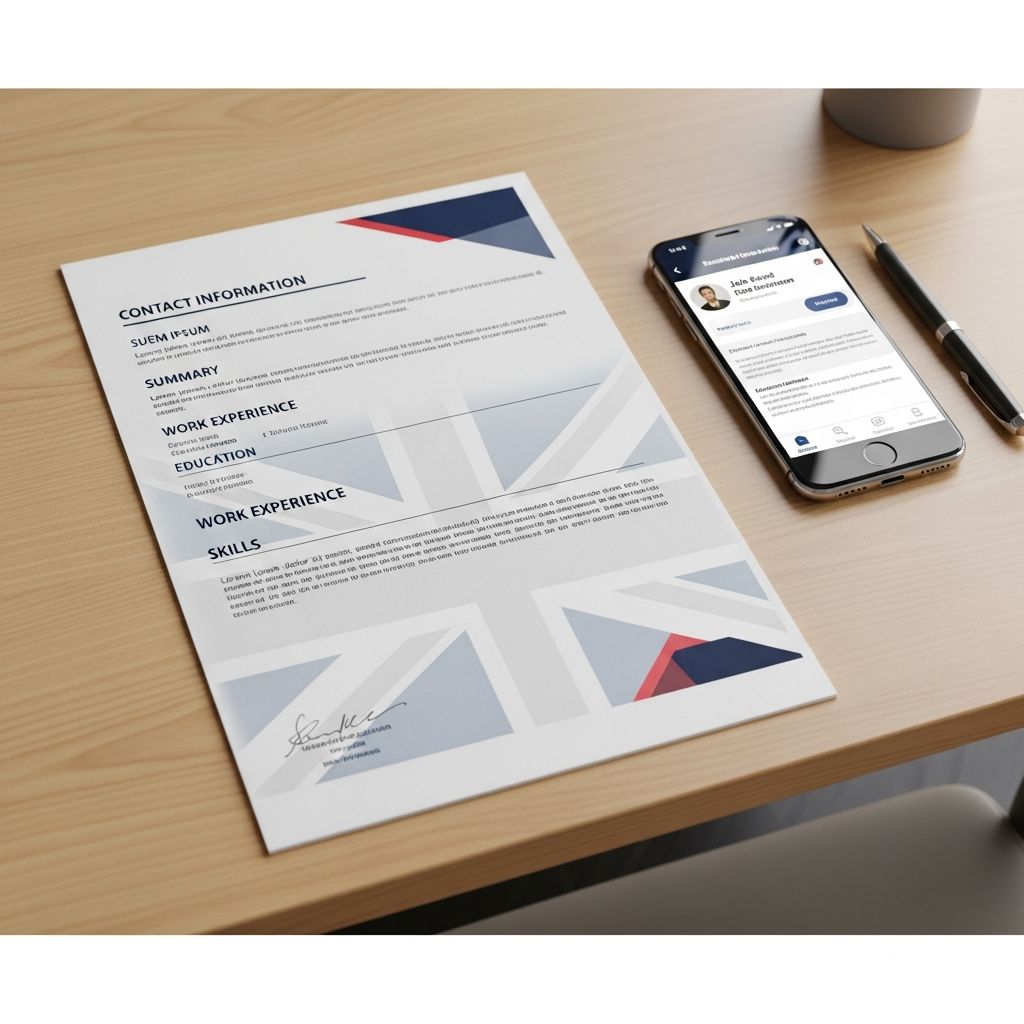
Writing a resume for the UK job market in 2025 means balancing clarity, professionalism, and Applicant Tracking System (ATS) compatibility. While some employers still use the term CV, the expectations around content and layout are now broadly aligned: concise, targeted, and focused on results rather than responsibilities.
This guide explains exactly how to structure a UK resume, what to include, and how to tailor it to UK recruiters’ expectations.
1. UK Resume vs CV: What Recruiters Expect
In the UK, resume and CV are often used interchangeably, but the underlying expectations are consistent.
- Length: For most roles, 1–2 pages is standard; academic and senior posts can run longer when justified.
- Focus: A clear, evidence-based overview of your suitability, not a full life story.
- Tone: Professional, factual, and tailored to the role description.
Universities and national guidance in the UK place strong emphasis on presenting information in a way that can be quickly scanned and compared across candidates.
2. Ideal Length, Layout, and Formatting
Your resume must be easy to skim in under 30 seconds. UK careers services consistently highlight clarity and readability as core principles.
- Length: Aim for one page if you are early in your career, and up to two pages if you have more experience.
- Font: Use a clean, accessible font around 10–11 pt with clear headings.
- Margins and spacing: Leave enough white space so the page does not feel crowded.
- File type: PDF is widely accepted unless an employer specifically asks for Word or an online form.
- Style: Avoid graphics-heavy designs that can confuse ATS software; stick to a simple structure with headings and bullet points.
Recommended Resume Structure Overview
| Section | Purpose | Suggested Order |
|---|---|---|
| Contact information | Allows employers to reach you quickly | Top of page |
| Personal profile / summary | Snapshot of who you are and what you offer | Below contact info |
| Key skills | Highlights capabilities that match the role | Before or after experience |
| Work experience | Evidence of achievements and responsibilities | Core middle section |
| Education | Shows academic background and training | After experience for most, earlier for students |
| Additional sections | Certifications, languages, volunteering, interests | End of resume |
3. Choosing the Right UK Resume Format
UK employers are familiar with three main approaches to structuring experience. Official and university guidance generally recommend a chronological format for most candidates.
3.1 Reverse-Chronological Format
This is the most common and widely accepted layout.
- Lists roles from most recent to oldest.
- Works well when you have a continuous or mostly continuous work history.
- Helps employers quickly see your current level and recent responsibilities.
3.2 Skills-Based (Functional) Format
A skills-based format groups experience under thematic skill headings instead of by job title.
- Useful for those changing careers or with significant gaps.
- Lets you foreground transferable skills over job titles.
- Should still include a brief employment history section for transparency.
3.3 Combination Format
Blends a clear skills section with a shorter chronological work history.
- Effective if you have both strong skills and a varied background.
- Risk of running over two pages if not tightly edited.
4. Essential Sections of a UK Resume
Most official UK careers guidance agrees on a core set of sections that every CV or resume should contain.
4.1 Contact Details
Place your contact information at the top of the first page, clearly and simply.
- Full name
- Professional email address
- Phone number
- General location (e.g. “Manchester, UK”)
- Optional: link to LinkedIn or portfolio if relevant
UK guidance typically does not recommend including date of birth, marital status, or a photo unless specifically requested, to avoid unnecessary personal information.
4.2 Personal Profile (Summary)
UK sources advise including a short opening statement to explain who you are and what you are looking for.
- 1–3 concise sentences near the top of your resume.
- Mention your role, key strengths, and target position or sector.
- Reflect the language of the job advert, particularly its required skills.
4.3 Key Skills Section
A targeted skills section helps recruiters immediately see whether you meet the main requirements.
- Group skills into logical clusters (e.g. technical, languages, communication).
- Prioritise skills explicitly mentioned in the job description.
- Ensure each skill is supported somewhere in your work or education history.
4.4 Work Experience
For many recruiters, this is the most important part of a UK resume. Career services recommend including job title, employer, dates, and a brief description of achievements.
- List roles in reverse chronological order.
- Include employer name, location, and month/year dates.
- Use bullet points to highlight achievements and responsibilities.
- Focus on outcomes and impact rather than only duties.
Turning Duties into Achievements
Whenever possible, show the difference you made. For example:
- Instead of: “Responsible for customer queries”
- Use: “Resolved an average of 40+ customer queries per day while consistently maintaining high satisfaction scores”
This achievement-focused style is widely encouraged across UK careers support and recruiter advice.
4.5 Education
Official UK careers services recommend always including an education section, even for experienced candidates.
- Provide qualification title, institution, and dates.
- Include grades where they are a strength or requested.
- Recent graduates can add relevant modules, projects, or dissertations.
If you have substantial experience, keep this section compact and focus on your highest or most relevant qualifications.
4.6 Additional Sections
Use extra sections to reinforce your suitability without stretching the document unnecessarily.
- Certificates and training: Industry courses, professional exams, and relevant short courses.
- Languages: Specify level (e.g. “fluent”, “intermediate”).
- Volunteering: Experience that demonstrates responsibility or relevant skills.
- Professional memberships: Chartered bodies, professional institutes, or networks.
- Interests: Only where they show qualities valuable to the role (e.g. leadership, commitment).
5. Tailoring Your Resume for the UK Job Market
National and university careers services consistently stress the importance of tailoring your application to each role.
5.1 Read the Job Description Carefully
- Highlight keywords related to skills, tools, and responsibilities.
- Check essential vs desirable criteria in the person specification.
- Mirror the employer’s language where accurate and appropriate.
5.2 Align Content with Employer Priorities
- Reorder bullet points so the most relevant achievements appear first.
- Expand on roles or projects that match the job closely.
- Trim less relevant experience to keep the document within the length guidelines.
5.3 Prepare for ATS Screening
Many large UK employers use Applicant Tracking Systems to screen applications.
- Use standard headings like “Work Experience” and “Education” so ATS can parse them.
- Include relevant keywords from the advert naturally in your profile, skills, and experience.
- Avoid embedding important information in images or complex tables.
6. Handling Employment Gaps and Career Changes
Career breaks and shifts of direction are increasingly common. UK careers guidance suggests being honest and providing brief context where needed.
6.1 Explaining Gaps
- Add short notes in your work history (e.g. “Career break for caregiving”, “Full-time study”).
- Emphasise any skills built during the break, such as courses or volunteering.
- Keep explanations factual and concise.
6.2 Presenting a Career Change
- Use a strong personal profile to clarify your new direction.
- Highlight transferable skills that relate to the target role.
- Consider a skills-focused or combination format if your past job titles differ significantly from your target field.
7. UK-Specific Do’s and Don’ts
While many resume principles are global, certain conventions are particularly relevant in the UK context.
7.1 Common Do’s
- Do keep the document concise and targeted.
- Do use clear headings and bullet points for readability.
- Do include a short introduction summarising your fit for the role.
- Do proofread thoroughly; spelling and grammar errors can quickly weaken your application.
- Do pair your resume with a tailored cover letter when requested.
7.2 Common Don’ts
- Don’t include excessive personal details such as age, marital status, or photos unless the employer clearly asks for them.
- Don’t exaggerate experience or qualifications; employers may verify details.
- Don’t overload your resume with jargon, acronyms, or long paragraphs.
- Don’t add references on the page unless explicitly requested; UK guidance often suggests they can be provided separately if needed.
8. Final Checks Before Sending
Before submitting your resume, run through a brief quality checklist aligned with UK careers advice.
- Is every section clearly titled and easy to find?
- Can a reader understand in 15–20 seconds what you do and why you fit the role?
- Are there obvious spelling, grammar, or formatting errors?
- Is the document tailored to this specific job and employer?
- Does the layout print cleanly on A4 paper without breaking sections awkwardly?
9. Frequently Asked Questions (FAQs)
Q: Should I call it a CV or a resume in the UK?
Both terms are used, and the content is largely the same. Many UK employers and official services still use “CV”, so you can use that term in applications while following the resume structure described here.
Q: Do UK employers expect a photo on my resume?
Generally no. UK guidance typically advises against including a photograph unless clearly requested, as it is not needed to assess your suitability for the role and may raise equality concerns.
Q: How far back should my work history go?
Focus on the last 10 years or the most relevant roles for experienced candidates. Earlier positions can be summarised briefly if they add value; recent graduates may list part-time and volunteer work if it shows useful skills.
Q: Is it acceptable to use colour and design elements?
Light use of colour and consistent styling can help readability, but UK careers services generally prioritize clarity over design. Avoid complex graphics or heavy layouts that might confuse ATS systems or distract from content.
Q: Do I need to include references on my UK resume?
Often you do not need to list referees on the document itself. Employers may ask for contact details later, and some UK guidance suggests that a simple note such as “References available on request” is sufficient if you choose to include it at all.
References
- How to write a CV — National Careers Service. 2023-06-01. https://nationalcareers.service.gov.uk/careers-advice/cv-sections
- CVs — University of Oxford Careers Service. 2024-02-15. https://www.careers.ox.ac.uk/cvs
- CVs and cover letters — University of Cambridge Careers Service. 2023-11-20. https://www.careers.cam.ac.uk/applying-for-jobs/cvs-and-cover-letters
- The complete CV format guide: examples and tips — Indeed UK Career Guide. 2024-05-10. https://uk.indeed.com/career-advice/cvs-cover-letters/cv-format-guide-with-examples
- How to write a great CV in 2025 — Skills Connect. 2025-01-05. https://www.skillsconnect.org.uk/find-your-direction/how-to-write-a-great-cv-in-2025/
- UK Resume Format: Examples & Best Practices — MyPerfectResume Career Center. 2025-03-18. https://www.myperfectresume.com/career-center/resumes/how-to/uk-cv
- How to Write a CV for the UK Market in 2025 — Robert Walters UK. 2025-02-12. https://www.robertwalters.co.uk/insights/career-advice/e-guide/how-to-write-a-cv.html

- Integrated M.A. in Applied Linguistics, University of Hyderabad
- 5+ years in editorial, instructional, SEO, and research-based writing
Sneha is a relationships and lifestyle writer with a strong foundation in applied linguistics and certified training in relationship coaching. She brings over five years of writing experience to theskillvault, crafting thoughtful, research-driven content that empowers readers to build healthier relationships, boost emotional well-being, and embrace holistic living. Her writing and insights reflect the belief that beauty, happiness, and wellness…