
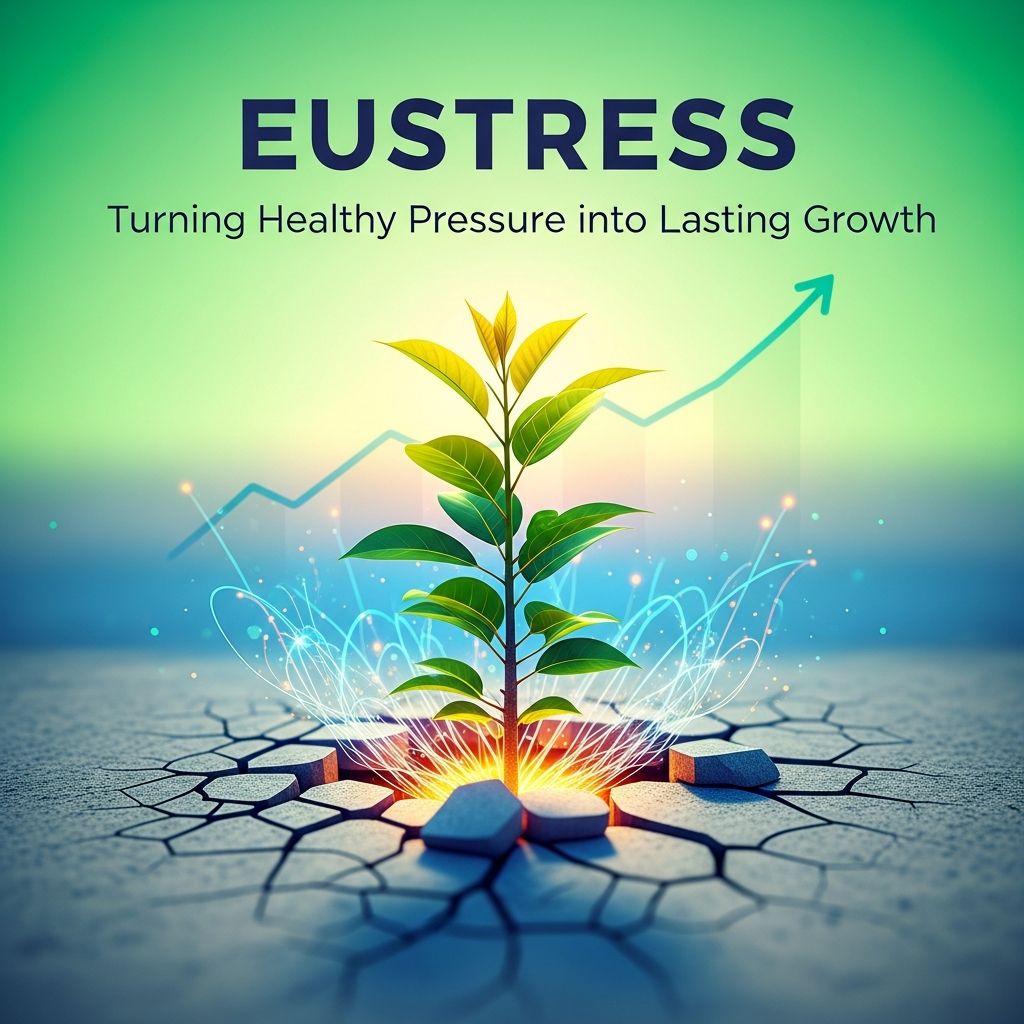
Stress is often treated as the enemy of wellbeing, yet psychology and neuroscience show that some forms of stress can energize, motivate, and strengthen us rather than deplete us. This constructive kind of pressure is called eustress, and learning to harness it can transform how you work, lead, and live.
Instead of asking, “How do I eliminate stress?” a more powerful question is: “How do I reduce harmful stress and intentionally cultivate helpful stress?”
Understanding Eustress: The Basics
Eustress comes from the Greek prefix eu (meaning “good”) and refers to positive stress—the stimulating tension you feel when you are challenged, engaged, and stretched just beyond your comfort zone, but not overwhelmed.
Physically, your body’s response to eustress looks similar to other stress responses: your heart rate rises, stress hormones like cortisol and adrenaline increase, and your attention narrows. The crucial difference lies in how you interpret the situation:
- You believe the challenge is meaningful.
- You sense the demands are within your abilities, even if difficult.
- You expect to learn, grow, or benefit from the experience.
When these conditions are met, stress becomes fuel rather than friction.
Eustress vs. Distress: Two Sides of the Stress Spectrum
Stress is not a simple on/off switch; it is better understood as a spectrum. At one end is eustress, at the other is distress—the type of stress most people think of when they say they are stressed.
| Dimension | Eustress (Positive Stress) | Distress (Harmful Stress) |
|---|---|---|
| Perception of demands | Challenging but achievable | Overwhelming or uncontrollable |
| Typical emotions | Excitement, focus, anticipation | Anxiety, fear, helplessness |
| Time course | Short-term, clearly bounded | Prolonged or chronic |
| Impact on performance | Enhances concentration and output | Impairment, mistakes, exhaustion |
| Effect on health | Can strengthen resilience when recovery follows | Linked to cardiovascular disease, depression, and burnout |
Research in occupational health and performance shows that moderate, well-managed stress can enhance alertness and effectiveness, especially when people feel supported and competent. Problems arise when stress is intense, prolonged, and paired with low control or low social support.
Why Positive Stress Matters for Wellbeing and Performance
Far from being a trivial concept, eustress is increasingly discussed in psychology, physiology, and workplace science as a crucial ingredient of thriving. When experienced in manageable doses and followed by recovery, eustress supports several key outcomes:
- Motivation and goal pursuit: Eustress helps create a sense of urgency and focus, which can drive sustained effort toward meaningful goals.
- Cognitive performance and learning: Short bursts of stress can temporarily sharpen attention, improve working memory, and support learning when they do not become chronic.
- Resilience and self-efficacy: Successfully navigating moderate stress builds a belief that “I can handle challenges,” a core component of psychological resilience.
- Physical adaptation: Training stress (for example, in exercise) uses carefully dosed stress to trigger beneficial adaptation in the cardiovascular and musculoskeletal systems.
- Sense of meaning: Many of life’s most fulfilling experiences—launching a project, learning a new skill, leading a team—are also inherently stressful. Seeing this stress as eustress reframes it as a sign of engagement rather than danger.
Signs You Are Experiencing Eustress
Eustress can be subtle, especially if you are used to labeling all stress as negative. Common indicators include:
- You feel nervous and excited at the same time.
- You notice heightened focus rather than scattered attention.
- You feel energized, not yet depleted.
- You can clearly explain why the task matters to you.
- You believe that, with effort and support, you can meet the demands.
- Once the event or task ends, your body and mind return to baseline relatively quickly.
By contrast, distress is often accompanied by rumination, sleep problems, prolonged tension, and a sense of dread rather than anticipation.
Conditions That Turn Stress Into Eustress
The same situation can trigger eustress in one person and distress in another. Research in occupational and health psychology highlights several factors that influence which side of the spectrum you experience.
1. Perceived Control
Feeling that you have some influence over how a situation unfolds dramatically shifts your stress response. Even partial control—choosing your approach, pacing, or collaborators—can move a difficult task toward eustress.
- Autonomy in how you complete work.
- A say in priorities or deadlines.
- Clarity about what success looks like.
2. Available Resources
Stress becomes eustress when demands are high and resources are sufficient. Resources may be time, information, skills, tools, supportive colleagues, or coaching.
- Skills that match or slightly lag the challenge level (encouraging growth).
- Access to advice, mentoring, or training when needed.
- Reasonable time frames and workload distribution.
3. Meaning and Values Alignment
Tasks closely aligned with your values or long-term aims are more likely to generate eustress. The same workload can feel draining or energizing depending on whether you see it as pointless or purposeful.
- Connection to personal growth or career development.
- Contribution to a cause or mission you care about.
- Opportunities for mastery and creativity.
4. Recovery and Rest
Even positive stress becomes harmful when recovery is missing. Research on stress and health consistently shows that regular breaks, sleep, and psychological detachment from work are essential for preventing chronic distress and burnout.
- Daily micro-breaks away from screens and tasks.
- Consistent sleep schedules and sleep quality.
- Time for hobbies, relationships, and physical activity.
Practical Ways to Cultivate Eustress at Work
Because stress is unavoidable, the goal is not to remove it but to shape it. Leaders, teams, and individuals can all influence whether everyday pressure supports growth or causes harm.
Strategies for Individuals
- Reframe your internal narrative: When you notice activation—faster heart rate, butterflies, tension—experiment with labeling it as “my body preparing to perform” instead of “I am falling apart.” This type of reappraisal has been shown to improve performance under stress in various settings.
- Set challenge bands: Identify what “too little,” “just right,” and “too much” challenge looks like for you in key areas (workload, learning, social demands). Use this as a guide when saying yes or no.
- Break work into sprints: Design 25–50 minute focus bursts for demanding tasks, followed by brief active breaks. This structure mirrors how the stress response naturally rises and falls.
- Invest in skill-building: When a task feels overwhelming, ask, “What skill gap is making this distressing?” Targeted learning can move the same demand back into eustress territory.
- Create personal recovery rituals: Build small non-negotiables into your day—short walks, breathwork, journaling, or a transition routine between work and home.
Strategies for Leaders and Organizations
- Design roles with balanced demands and control: Jobs that combine high responsibility with low control are strongly associated with distress and health risk. Increasing autonomy—where feasible—helps turn pressure into eustress.
- Clarify expectations and success criteria: Ambiguity magnifies distress. Clear goals, time frames, and decision rights reduce unnecessary cognitive load.
- Normalize stretch assignments: Present challenging projects as learning opportunities, not tests of worth, and provide coaching or mentoring support alongside them.
- Model boundaries and recovery: Leaders who protect their own rest and communicate realistic availability make it safer for others to do the same.
- Recognize progress, not just outcomes: Celebrating incremental progress reinforces eustress by linking effort, growth, and positive emotion.
Everyday Examples of Eustress
You may already be experiencing eustress in areas such as:
- Preparing a presentation on a topic you care about.
- Starting a new role that stretches your capabilities.
- Training for a fitness challenge or competition.
- Learning a new technology or language.
- Leading a time-bound project with a motivated team.
In each case, the experience is demanding, but progress feels rewarding rather than purely draining.
Protecting Yourself: When Eustress Slips Into Distress
Even positive stress has limits. It is important to notice when “good challenge” crosses into “too much.” Warning signs include:
- Persistent sleep disturbances or nightmares.
- Ongoing irritability, cynicism, or emotional numbness.
- Frequent headaches, stomach issues, or unexplained aches.
- Loss of interest in activities you usually enjoy.
- Feeling constantly behind, even when working long hours.
If these symptoms continue, especially for several weeks, it may be a sign that stress has become chronic and professional support is needed. Mental health organizations and healthcare providers emphasize early intervention to prevent more severe outcomes such as burnout or depression.
Building a Personal “Eustress Plan”
To make eustress a deliberate part of your life, it can help to map out how you will engage with challenge and recovery over time.
Step 1: Define Areas Where You Want Growth
- Career or leadership development.
- Health and physical fitness.
- Learning or creativity.
- Relationships and communication.
Choose one or two areas where a bit more challenge would be meaningful rather than overwhelming.
Step 2: Select Stretch Goals
Good eustress targets are specific, time-bound, and slightly beyond your current capabilities but still realistic with effort.
- “Lead a cross-functional meeting once a month.”
- “Complete an advanced course in my field within three months.”
- “Add one day of strength training to my weekly routine.”
Step 3: List Your Supports
- People who can mentor, advise, or provide feedback.
- Training, tools, or information you can access.
- Time you can reallocate from lower-priority tasks.
Step 4: Plan Recovery Windows
Treat recovery as part of the plan, not an afterthought.
- Weekly blocks of unstructured time.
- Daily wind-down routines.
- Boundaries around digital communication.
Step 5: Review and Adjust
Regularly reflect on:
- “Where am I energized?”
- “Where am I depleted?”
- “What can I dial up or dial down to keep most of my stress in the eustress zone?”
Frequently Asked Questions About Eustress
Q: Is eustress just another word for being busy?
No. Busyness can be chaotic, unfocused, and meaningless. Eustress refers to a specific kind of stress: challenging, purposeful, time-limited, and accompanied by a sense that you can ultimately cope and grow from the experience.
Q: Can chronic stress ever be considered eustress?
By definition, eustress is short-term and followed by adequate recovery. If high stress continues without relief, even when it is tied to meaningful goals, it shifts toward distress and increases health risks. Sustainable high performance requires cycles of activation and rest, not constant strain.
Q: Does everyone need eustress to thrive?
Levels of optimal stress differ between people. Personality traits, past experiences, and current resources all influence how much challenge feels motivating versus overwhelming. However, research suggests that some degree of manageable challenge supports learning, resilience, and engagement for most people.
Q: How does eustress relate to concepts like “flow”?
Flow is a state of deep immersion in an activity where skill and challenge are well matched. Eustress can be a gateway into flow: the initial stress response mobilizes your attention and energy, and as you become absorbed in the task, the experience can shift toward flow-like focus and satisfaction.
Q: Can eustress help prevent burnout?
Indirectly, yes. Burnout is associated with chronic distress, emotional exhaustion, and loss of efficacy. When organizations balance demands with control, resources, recognition, and recovery, they help keep stress within the eustress range more often. This can protect against the prolonged strain that leads to burnout.
References
- What is eustress? And why it can actually help you — Calm. 2023-05-10. https://www.calm.com/blog/what-is-eustress
- Eustress: The Positive Type of Stress, Examples, and More — Healthline. 2020-03-27. https://www.healthline.com/health/eustress
- Stress at the workplace — World Health Organization. 2020-10-19. https://www.who.int/news-room/questions-and-answers/item/stress-at-the-workplace
- Stress at work — European Agency for Safety and Health at Work. 2019-03-18. https://osha.europa.eu/en/themes/work-related-stress
- Good Stress? (Eustress) — Vail Health. 2019-09-10. https://www.vailhealth.org/news/good-stress
- What Is Eustress and Why Is It Good for You? — Psychology Today. 2023-01-12. https://www.psychologytoday.com/us/blog/optimal-well-being/202301/what-is-eustress-and-why-is-it-good-for-you
- Establishing a comprehensive hierarchical construct of eustress in the workplace — Frontiers in Psychology. 2024-05-07. https://www.ncbi.nlm.nih.gov/pmc/articles/PMC11602813/

Medha Deb is an editor with a master's degree in Applied Linguistics from the University of Hyderabad. She believes that her qualification has helped her develop a deep understanding of language and its application in various contexts. Medha specializes in the areas of beauty, health, sports, and wellness and is committed to ensuring that the content on the website is…