
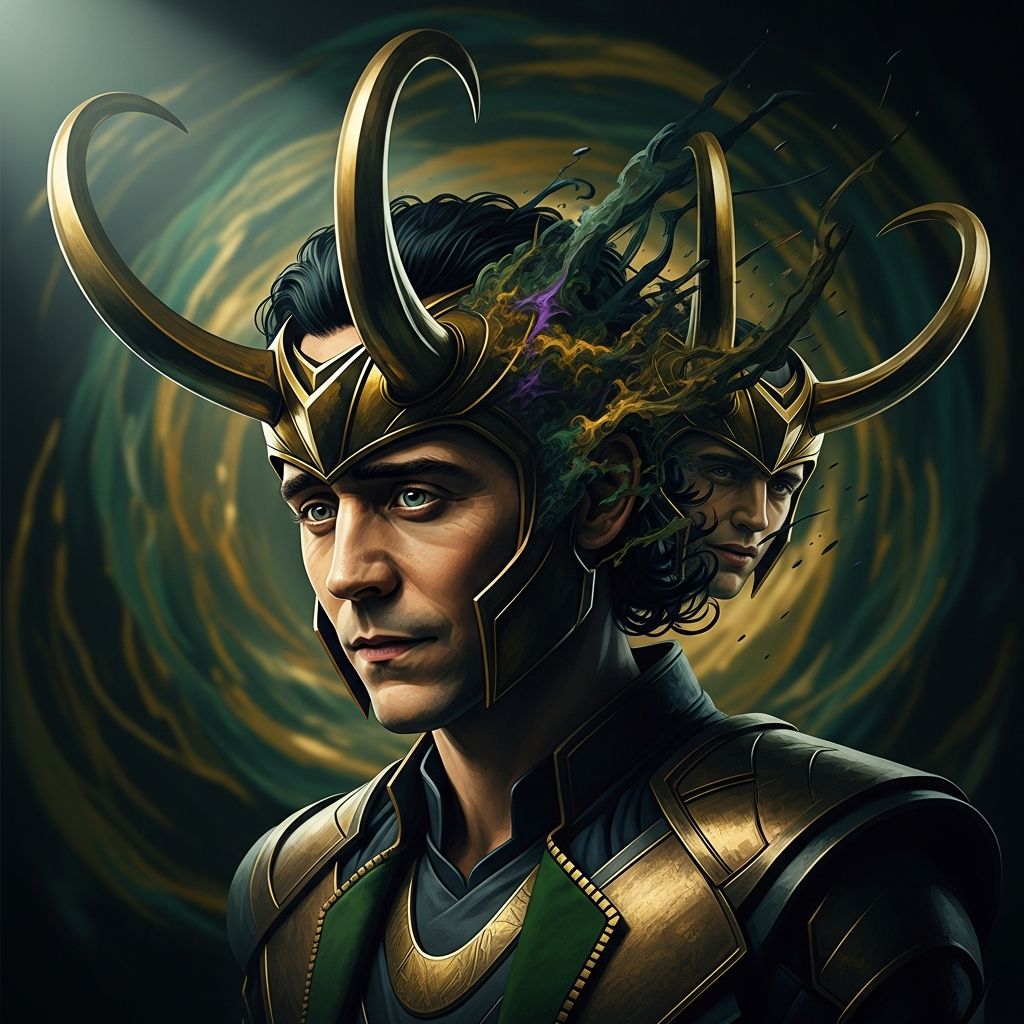
The Many Faces of Loki: A Psychological Portrait
Loki, the God of Mischief in the Marvel Cinematic Universe, is more than just a villain who wants to rule Earth or Asgard. He is a layered, emotionally volatile figure whose actions are driven by deep insecurities, a fragile sense of self, and a desperate need for validation. While he presents himself as cunning, confident, and in control, beneath the surface lies a mind constantly at war with itself. His charm, wit, and strategic brilliance are real, but they are also tools he uses to mask a profound inner turmoil.
Understanding Loki requires looking past the theatrics and examining the psychological patterns that shape his behavior. He is not simply evil; he is someone whose emotional regulation is severely compromised, whose self-worth is tied to external approval, and whose relationships are repeatedly sabotaged by fear of rejection. This article explores Loki’s personality through the lens of emotional instability, interpersonal dynamics, and the psychological mechanisms he uses to cope with shame and abandonment.
The Illusion of Control
Loki’s entire identity is built on the idea of control. He manipulates people, situations, and even reality itself to maintain a sense of power. Whether it’s through illusions, shape-shifting, or elaborate schemes, he constantly seeks to be the one pulling the strings. This need for control is not a sign of strength, but rather a defense mechanism against feeling powerless.
From a young age, Loki was raised in a culture that valued strength, bravery, and direct action—qualities embodied by Thor. Loki, by contrast, is more cerebral, observant, and emotionally reactive. He is not the warrior-king type, and this difference is internalized as a flaw. Odin’s repeated emphasis on worthiness, honor, and strength reinforces the idea that Loki is somehow less than his brother. Over time, this creates a core belief: I am not enough as I am.
To compensate, Loki develops a persona of superiority. He mocks sentimentality, dismisses emotional vulnerability, and frames himself as the only one who truly sees the truth of the world. His famous speech about humanity craving subjugation is not just a political statement—it is a projection of his own inner conflict. He believes people need to be ruled because, on some level, he feels he needs to be in control to avoid being hurt.
Emotional Turbulence and Identity Instability
One of the most striking aspects of Loki’s character is his emotional volatility. He swings rapidly between confidence and despair, arrogance and self-loathing, loyalty and betrayal. These mood shifts are not random; they are responses to perceived threats to his self-image.
When things go his way, he is charismatic, witty, and in command. When he is challenged, rejected, or reminded of his inferior status, he becomes reactive, angry, and destructive. This pattern is consistent with what psychology describes as emotional dysregulation—a hallmark of certain personality patterns where a person struggles to manage intense emotions in a stable way.
Loki’s identity is also remarkably unstable. He changes forms, names, and allegiances frequently. He is never fully settled into a single role: not quite a hero, not quite a villain, not fully Asgardian, not fully Jotun. This lack of a coherent, stable identity makes him hypersensitive to how others see him. Every interaction becomes a test: Do they respect me? Do they fear me? Do they see me as weak?
Because his self-worth is so fragile, even minor slights can trigger disproportionate reactions. A dismissive comment, a moment of doubt, or a reminder of his past failures can send him into a spiral of shame and rage. In those moments, he is not thinking strategically; he is acting out of emotional pain, often in ways that damage his relationships and long-term goals.
The Role of Shame and Rejection Sensitivity
At the heart of Loki’s behavior is shame. Not guilt over specific actions, but a deeper, more pervasive sense of being fundamentally flawed or unworthy. This kind of shame is often rooted in early experiences where a person feels they are not loved or accepted for who they are.
In Loki’s case, this begins with the revelation that he is not Odin’s biological son, but a Frost Giant taken in as a political gesture. While Odin claims to love him, the circumstances of his adoption carry an implicit message: You are different. You are dangerous. You are a secret that must be hidden. This creates a core schema: I am unlovable as myself.
Shame is an intensely private emotion. People who feel deep shame often go to great lengths to hide it, sometimes by becoming the opposite of what they fear being seen as. Loki, who fears being seen as weak, inadequate, or monstrous, compensates by becoming powerful, cruel, and theatrical. He attacks others not just to gain power, but to disown his own feelings of inadequacy. By making others the target of his contempt, he temporarily escapes the pain of self-contempt.
This also explains his rejection sensitivity. Loki is constantly scanning for signs that he is being dismissed, betrayed, or looked down upon. Even when others are trying to help him—like Thor or Frigga—he often interprets their actions as condescending or manipulative. This leads to a self-fulfilling cycle: he pushes people away, they respond with distance or anger, and he takes that as proof that he was right to distrust them all along.
Interpersonal Patterns: Chaos as a Defense
Loki’s relationships are marked by a recurring pattern of idealization, devaluation, and abandonment. He forms intense bonds—especially with Thor—but then repeatedly betrays or sabotages them. This is not because he is inherently evil, but because intimacy feels dangerous.
When someone gets close, the risk of rejection or exposure increases. To protect himself, Loki often initiates the rupture. He double-crosses Thor when they plan to escape Sakaar, not because it’s strictly necessary, but because he cannot tolerate the vulnerability of relying on his brother. By being the one to break the connection, he maintains a sense of control and avoids the pain of being left.
This pattern is common in people who struggle with attachment insecurity. They crave connection but fear it at the same time. The result is a push-pull dynamic: seeking closeness, then pushing the other person away when it feels too intense. Over time, this erodes trust and makes it difficult to sustain healthy relationships.
Loki’s behavior also fits what some psychologists describe as a “dark triad” pattern—traits like narcissism, Machiavellianism, and psychopathy, which together create a tendency to exploit others for personal gain. However, in Loki’s case, these traits are not cold or calculating in a purely instrumental way. They are emotionally charged, reactive, and often self-sabotaging. His manipulation is not just about power; it is also a way of testing loyalty and provoking reactions that confirm his expectations of betrayal.
Personality Type and Cognitive Style
While personality type systems like the Myers-Briggs Type Indicator (MBTI) are not clinical diagnoses, they can offer a useful framework for understanding cognitive preferences. Loki’s behavior suggests a mind that is highly extraverted in its orientation to the world, drawing energy from interaction, drama, and external validation.
He is observant rather than abstract in his planning—his schemes are grounded in the immediate reality around him, not in long-term, idealistic visions. He adapts quickly to changing circumstances, often improvising when his original plan fails. This flexibility is a strength, but it also reflects a difficulty in imagining a stable, positive future for himself. He is more focused on the next move than on a coherent life direction.
His thinking style is also distinctive. He uses logic, but it is often subjective and self-serving. He redefines concepts like freedom, power, and worthiness to fit his current narrative. This is characteristic of a thinking type that prioritizes internal consistency over external norms, using reasoning to justify emotional needs rather than to pursue objective truth.
At the same time, Loki is deeply feeling-driven. His actions are not random; they are responses to emotional wounds. He feels slighted by his family, betrayed by Odin, and overlooked in favor of Thor. His entire motivation is rooted in a desire to prove his worth and to be seen as significant. This emotional core is what makes him more than just a clever villain—he is a tragic figure whose intelligence is turned inward as self-punishment and outward as destruction.
Is Loki Mentally Ill?
It is important to distinguish between dramatic character traits and clinical mental illness. Loki exhibits behaviors that overlap with certain psychological conditions, but he is a fictional character, not a patient in a clinical setting.
His pattern of mood swings, impulsivity, fear of abandonment, and unstable relationships is consistent with what clinicians might describe as traits associated with Borderline Personality Disorder (BPD). People with BPD often experience intense emotions, have difficulty maintaining stable relationships, and engage in self-destructive behaviors when feeling threatened.
Loki also shows signs of narcissistic traits—grandiosity, a need for admiration, and a lack of empathy in moments of rage. However, unlike a purely narcissistic personality, Loki is capable of deep emotional pain, guilt, and even love. His relationship with Sylvie, for example, reveals a capacity for genuine connection and vulnerability that complicates a simple “narcissist” label.
Ultimately, Loki is best understood as a character with significant emotional and personality dysregulation, shaped by trauma, shame, and a toxic family environment. He is not “crazy” in a cartoonish sense, but rather someone whose psychological defenses have become maladaptive, leading to cycles of chaos and self-sabotage.
Redemption and the Possibility of Change
One of the most compelling aspects of Loki’s arc is the possibility of change. Despite his repeated betrayals and destructive choices, there are moments where he shows remorse, loyalty, and even self-sacrifice. These glimpses suggest that his core is not irredeemably evil, but deeply wounded.
Redemption for someone like Loki would require more than just a change of heart. It would require confronting the shame he has spent a lifetime hiding, learning to tolerate vulnerability, and developing a stable sense of self that does not depend on external validation. It would mean facing the truth of his past without using it as an excuse for present behavior.
In the MCU, this process is only beginning. The Loki series, in particular, explores what happens when he is forced to confront versions of himself and to see the consequences of his actions. This kind of self-reflection is the first step toward genuine change. Whether he can sustain it is another question, but the mere fact that he is capable of it makes him one of the most psychologically rich characters in the franchise.
Key Psychological Traits of Loki
| Trait | Description | Example in Loki’s Behavior |
|---|---|---|
| Emotional Dysregulation | Difficulty managing intense emotions; rapid mood shifts | Swings from confidence to despair, rage to self-pity |
| Rejection Sensitivity | Hypervigilance to signs of rejection or criticism | Interprets Thor’s concern as condescension |
| Shame-Based Identity | Core belief of being fundamentally flawed or unworthy | Fears being seen as weak, inadequate, or monstrous |
| Interpersonal Instability | Pattern of intense, unstable relationships | Idealizes Thor, then repeatedly betrays him |
| Defensive Grandiosity | Overcompensation for insecurity through superiority | Presents as all-knowing, manipulative, and in control |
Frequently Asked Questions
Is Loki a psychopath?
Loki displays some traits associated with psychopathy, such as manipulation and lack of empathy in certain moments, but he also experiences deep emotional pain, guilt, and love. This complexity makes him more consistent with someone with emotional dysregulation than a classic psychopath.
Does Loki have Borderline Personality Disorder?
His pattern of mood swings, fear of abandonment, unstable relationships, and impulsive behavior aligns with traits seen in Borderline Personality Disorder. However, he is a fictional character, and any diagnosis would be speculative rather than clinical.
Why does Loki keep betraying Thor?
Loki’s betrayals are not just about power; they are also about protecting himself from vulnerability. By being the one to break the connection, he avoids the pain of being rejected or abandoned by Thor.
Can Loki be redeemed?
Redemption is possible, but it would require deep psychological work: confronting shame, learning emotional regulation, and building a stable sense of self. The MCU has begun to explore this possibility, but lasting change would be a long and difficult process.
What is Loki’s core motivation?
At his core, Loki is driven by a need to prove his worth and to be seen as significant. His actions are shaped by a deep fear of being inadequate, unloved, or powerless, which he masks with control, manipulation, and grandiosity.
References
- Diagnostic and Statistical Manual of Mental Disorders, Fifth Edition (DSM-5) — American Psychiatric Association. 2013. https://www.psychiatry.org/psychiatrists/practice/dsm
- Borderline Personality Disorder — National Institute of Mental Health (NIMH). 2023. https://www.nimh.nih.gov/health/topics/borderline-personality-disorder
- Dark Triad of Personality — Paulhus, D.L., & Williams, K.M. Journal of Research in Personality. 2002. https://doi.org/10.1016/S0092-6566(02)00505-6

- Integrated M.A. in Applied Linguistics, University of Hyderabad
- 5+ years in editorial, instructional, SEO, and research-based writing
Sneha is a relationships and lifestyle writer with a strong foundation in applied linguistics and certified training in relationship coaching. She brings over five years of writing experience to theskillvault, crafting thoughtful, research-driven content that empowers readers to build healthier relationships, boost emotional well-being, and embrace holistic living. Her writing and insights reflect the belief that beauty, happiness, and wellness…