
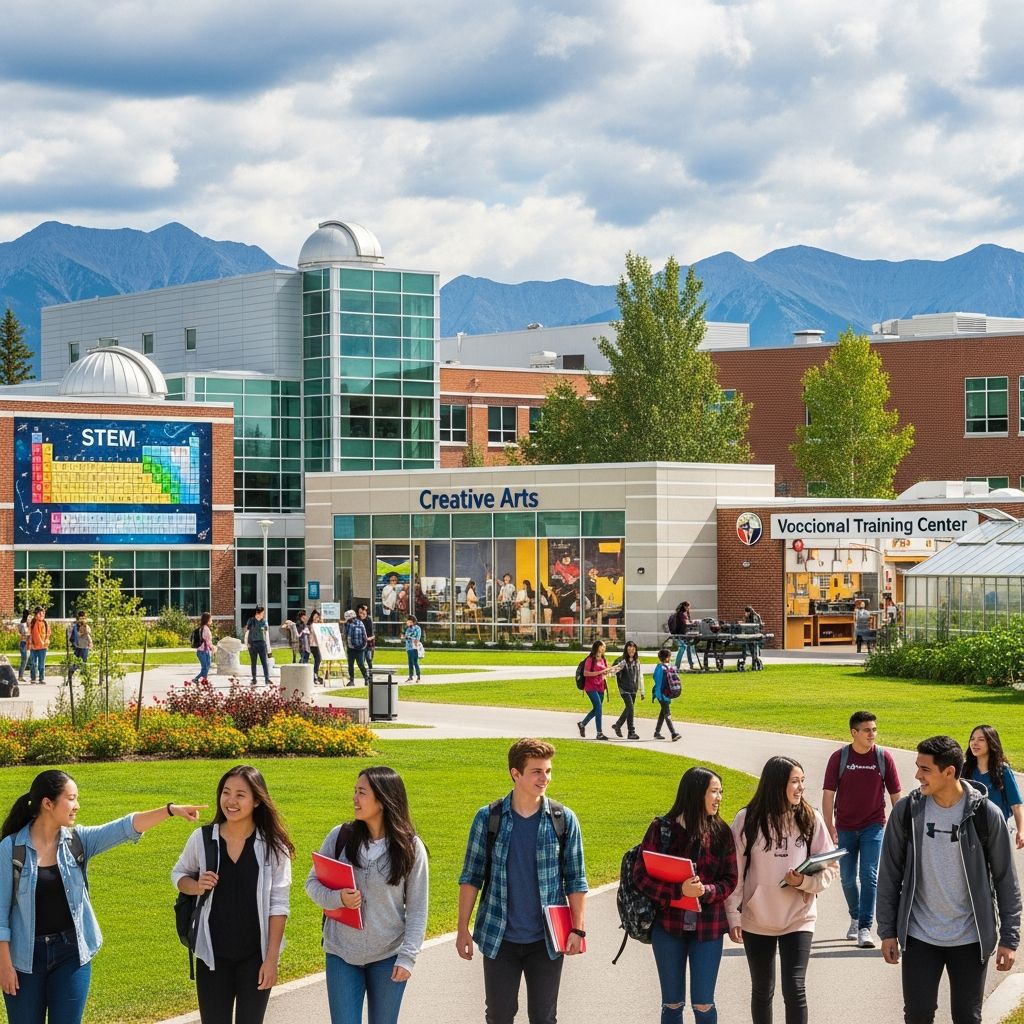
Alberta boasts one of Canada’s premier education systems, offering a wide spectrum of schooling choices tailored to diverse learner needs, from early childhood through high school and into post-secondary preparation. With 379 school authorities overseeing public, separate, francophone, charter, private, and alternative programs, families have unprecedented flexibility to select environments that foster academic excellence and personal growth.
Overview of Alberta’s K-12 Framework
The foundation of Alberta’s education system rests on the School Act, which governs kindergarten to Grade 12 (K-12) delivery across public, separate, and francophone authorities. Administered by Alberta Education, this structure ensures standardized curricula while accommodating varied delivery models. Funding primarily flows from provincial sources, supporting tuition-free access in most public options, with supplemental fees minimal and appealable for affordability.
Core to this system are Provincial Achievement Tests (PATs) in Grades 6 and 9, assessing math, science, language arts, and social studies in English and French, alongside Diploma Examinations in Grade 12 that contribute 30% to final marks—unique among Canadian provinces. These measures uphold high standards, positioning Alberta students favorably in global rankings.
Public School Networks: Accessible Foundations
Public schools form the backbone, serving the majority of Alberta’s approximately 830,000 K-12 students through 379 authorities. Governed by elected boards, these institutions deliver the Alberta Programs of Study, emphasizing competencies like literacy, numeracy, critical thinking, and digital fluency.
- Neighborhood Accessibility: Assigned by residence, ensuring local proximity and community integration.
- Diverse Programs: Inclusive of French immersion, career and technology studies (CTS), and dual credits with post-secondary partners.
- Funding Model: Fully provincial, covering operations with optional fees for extras like busing.
Public options excel in standardized testing, reflecting rigorous oversight and teacher certification requirements.
Separate Schools: Faith-Inspired Learning
Separate school boards, rooted in constitutional rights, provide publicly funded Catholic or other religious education, operating parallel to public systems with identical curriculum standards. These serve families seeking values-aligned environments without tuition costs.
| Aspect | Public Schools | Separate Schools |
|---|---|---|
| Governance | Elected secular boards | Elected faith-based boards |
| Funding | Provincial full | Provincial full |
| Curriculum | Alberta standard | Alberta standard + faith integration |
| Enrollment | Residency-based | Faith-affiliated priority |
This table highlights key parallels and distinctions, ensuring equitable quality.
Francophone Immersion: Bilingual Excellence
Five provincial francophone authorities deliver full French-language instruction to eligible families, fulfilling Charter rights post-1982. These schools emphasize cultural preservation alongside core subjects, with PATs and diplomas available in French.
- Eligibility: At least one parent with French as primary language.
- Coverage: Province-wide networks for rural and urban access.
- Benefits: Enhanced bilingualism, global competitiveness.
Charter Schools: Innovative Public Models
Charter schools blend public funding with specialized foci, such as arts, STEM, or Montessori, approved via rigorous applications to Alberta Education. Tuition-free and independently managed, they must meet or exceed public performance benchmarks.
With around 50 operating, they attract through small class sizes and thematic curricula, fully funded like publics but with operational autonomy.
Private Institutions: Customized Excellence
Private schools offer premium, specialized programs like international baccalaureate (IB) or Waldorf, charging tuition but receiving partial provincial grants based on enrollment. They adhere to Alberta certification for teachers and core outcomes, ideal for niche interests.
- Examples: Boarding schools, elite academies, religious independents.
- Funding: 70% grant for certified programs; full tuition otherwise.
Home Education: Flexible Family-Led Paths
Home education empowers parents as primary instructors, with two routes: affiliated (guided by school authorities) or non-affiliated (independent). Both access partial funding, resources, and assessments like PATs.
Affiliated families receive teacher oversight, materials, and up to 70% grants; non-affiliated handle all but report progress annually. This option suits travel, health needs, or personalized pacing, with thousands participating province-wide.
Online and Blended Learning: Digital Frontiers
Online programs via public authorities like The Highlands or Vista Virtual School offer full-time or supplemental courses, perfect for flexibility. Blended models combine virtual and in-person, supporting rural students or athletes.
- Access: Free for residents, certified teachers, diploma-eligible.
- Tools: Interactive platforms, parent portals, progress tracking.
These surged post-pandemic, enhancing equity.
Specialized Programs for Unique Needs
Alberta prioritizes inclusivity via Individual Program Plans (IPPs) for diverse learners, plus options like outreach for at-risk youth and immersive language programs. Career pathways include CTS from Grade 7, RAP (Registered Apprenticeship), and dual credits earning credits toward trades or university.
Transitioning to Post-Secondary Success
High school culminates in Alberta High School Diploma requirements: 100 credits including English, math, science, social studies, plus 10 fine arts/optional. Diploma exams ensure readiness for 20+ universities/colleges under Alberta Advanced Education.
Bridging programs like Green Certificate prepare for agriculture vocations.
Frequently Asked Questions
How do I choose the right school type for my child?
Consider learning style, location, values, and programs; visit open houses and review performance data from Alberta Education.
Are all schools free in Alberta?
Public, separate, francophone, and charters are tuition-free with minimal fees; privates and non-affiliated home ed involve costs.
What assessments determine student progress?
PATs (Gr 6/9), Diploma Exams (Gr 12, 30% weight), and ongoing formative evaluations.
Can homeschoolers take provincial exams?
Yes, affiliated students standardly; non-affiliated opt-in with supervision.
What post-secondary paths follow K-12?
Diploma enables university, college, apprenticeships via dual credits or direct entry.
Empowering Choices for Tomorrow’s Leaders
Alberta’s array—from traditional publics to innovative charters and virtual realms—equips families to match education to aspirations, backed by world-class standards and support. Research options thoroughly via Alberta Education portals for optimal fits.
References
- Education in Alberta — Wikipedia. 2024-01-15. https://en.wikipedia.org/wiki/Education_in_Alberta
- Education in Alberta Facts for Kids — Kids Kiddle. 2023-11-20. https://kids.kiddle.co/Education_in_Alberta
- Alberta’s K to 12 education system — Government of Alberta. 2025-09-10. https://www.alberta.ca/albertas-k-12-education-system
- Alberta Curriculum — TheTuitionE. 2024-06-05. https://thetuitione.com/alberta
- Education 101 — Chinook’s Edge School Division. 2023-02-14. https://www.cesd73.ca/download/350520
- Academic Overview — Mount St. Agnes Academy. 2024-08-22. https://msa.bm/academic-overview/

Medha Deb is an editor with a master's degree in Applied Linguistics from the University of Hyderabad. She believes that her qualification has helped her develop a deep understanding of language and its application in various contexts. Medha specializes in the areas of beauty, health, sports, and wellness and is committed to ensuring that the content on the website is…