
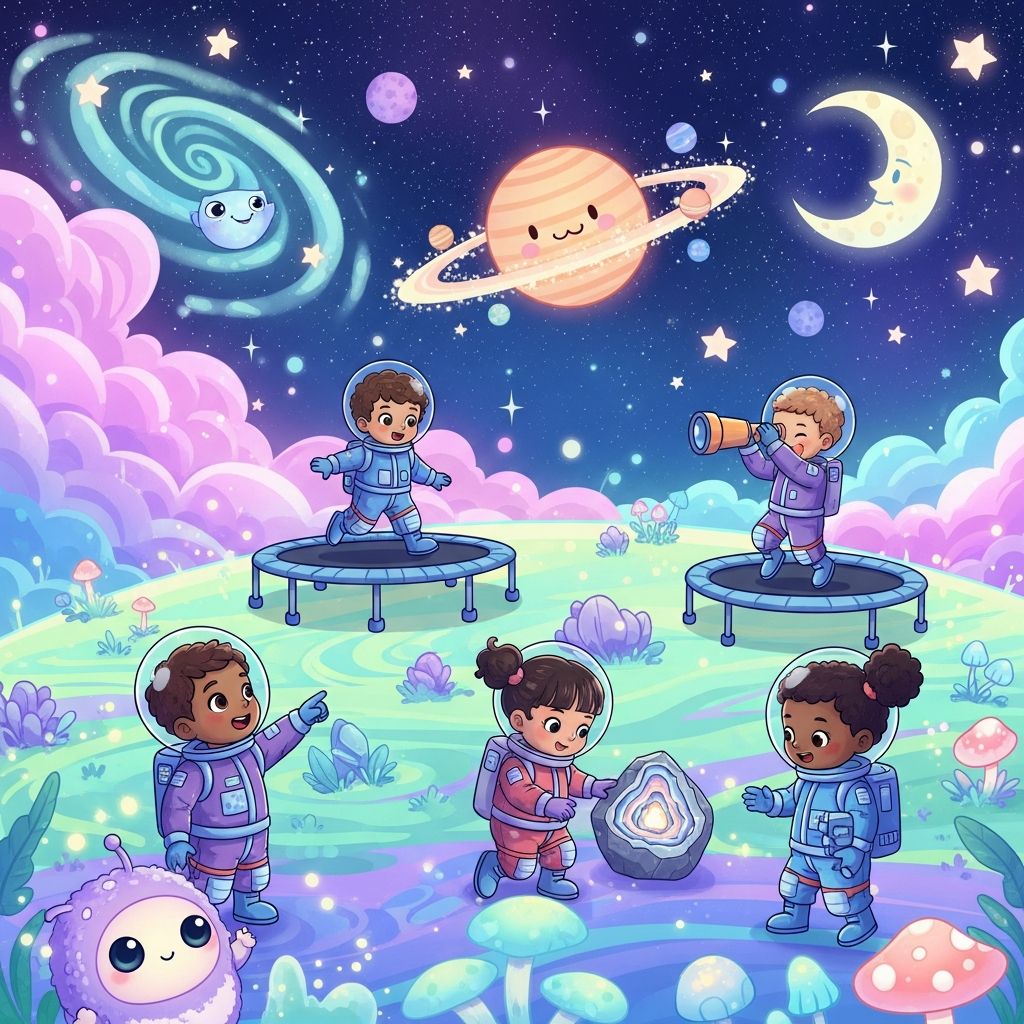
Introducing preschoolers to the wonders of outer space opens doors to imagination, scientific inquiry, and foundational skills. Through playful activities centered on rockets, planets, stars, and astronauts, children develop motor abilities, cognitive thinking, and social-emotional growth. This guide offers a fresh collection of engaging ideas tailored for ages 3-5, adaptable for home or classroom settings. Dive into a universe of learning where every activity blasts off curiosity.
Setting the Stage for Galactic Learning
Transform your space into a launchpad by creating immersive environments. Begin with a dramatic play area resembling a mission control center: use cardboard boxes for control panels, toy helmets, and printed star maps. Add soft lighting with glow-in-the-dark stars on the ceiling to evoke nighttime skies. In sensory zones, fill bins with black rice dyed to mimic cosmic dust, embedding plastic planets and shuttles for digging adventures. These setups encourage role-playing as astronauts, fostering language skills through storytelling and collaboration.
Incorporate daily routines with space chants. For circle time, chant countdowns from 10 to 1, mimicking rocket launches, which builds number sense and anticipation. Pair with slow-motion moonwalks to music, helping kids grasp low-gravity concepts while enhancing gross motor control. Such integrations make learning seamless and exciting.
Sensory Journeys Through the Cosmos
Sensory play captivates young senses, promoting exploration and calming focus. Create a lunar landscape bin using kinetic sand mixed with silver glitter and crushed foil ‘rocks.’ Add astronaut figures and LED lights for twinkling effects. Children scoop, mold, and bury treasures, refining hand-eye coordination.
For water-based thrills, fill a table with purple-tinted water, floating foam planets, and glowing star stickers. Provide droppers, funnels, and tubes for pouring experiments. Kids observe sinking and floating, discussing why planets vary in mass—a gentle intro to physics. Extend by adding dish soap for bubbly nebula effects.
- Moon Dust Dig: Mix flour, cocoa powder, and baking soda for edible ‘dust.’ Hide star-shaped gems inside for discovery hunts.
- Galaxy Gel: Hair gel in a ziplock with sequins and beads simulates swirling galaxies, safe for squishing without mess.
- Starlight Slime: Clear glue base with iridescent glitter creates stretchy, starry goo for pulling and shaping constellations.
These activities not only soothe but also teach texture differentiation and cause-effect relationships.
Artistic Creations from the Stars
Art invites self-expression while sneaking in skills like scissoring and patterning. For planet masterpieces, have kids paint coffee filters with washable markers, spritz water to bleed colors into marbled orbs, then mount on black cardstock. Label with planet names for literacy ties.
Earth collages start with blue watercolor washes on paper plates, topped with green tissue scraps for continents. Dilute glue holds pieces, teaching adhesion. Advanced learners add white cotton clouds. Display as a classroom solar system mobile.
Sticker galaxies encourage fine motor precision: provide black paper, metallic dot stickers, and comet trails drawn with crayons. Kids design personal universes, narrating stories about their creations to build vocabulary.
| Art Project | Materials Needed | Skills Developed |
|---|---|---|
| Filter Planets | Coffee filters, markers, spray bottles, black paper | Color mixing, fine motor, naming shapes |
| Earth Collage | Paper plates, paint, tissue, glue | Tearing, gluing, spatial awareness |
| Sticker Constellations | Black paper, stickers, crayons | Patterning, storytelling, pinching |
Gross Motor Missions to the Moon
Physical challenges mimic space travel, burning energy while teaching body awareness. Set up an obstacle course: crawl through tunnels as wormholes, balance on mats as planetary rings, hop across ‘craters’ made from pillows. Time laps with a stopwatch for healthy competition.
Rocket jumps involve squatting low, counting backward, then exploding upward. Vary with partner pushes using hands for low-gravity simulation. Outdoors, chalk planetary orbits on pavement; kids run laps while naming celestial bodies.
Parachute play as a ‘black hole’—lower it sticky-side up (using contact paper), toss foil balls to stick, retrieving strengthens reaching and grasping.
Math Magic in Orbit
Space themes excel for numeracy. Size sorting stations offer star cutouts in small, medium, large; glue to matching sheets. Graph rocket colors post-launch races.
Countdown blasts use counters like mini erasers: roll a die, remove that many, count down aloud until zero for takeoff cheers. Builds subtraction fluency.
Constellation numbers: Trace numerals with toothpicks on black paper, poke holes; backlight reveals starry shapes. Pairs counting with geometry.
- Planet Patterns: String beads in ABAB sequences mimicking orbital paths.
- Star Roll-and-Move: Board game with dice advances spaceships toward a central moon.
Literacy Launches and Letter Rockets
Link letters to rockets: write name letters on strips, assemble into personalized ships, decorate with foil. Read-alouds of space tales prompt retells with props.
Mirror writing with dry-erase markers on foil sheets: roll letter dice, copy upside-down for cosmic fun. Matching puzzles pair uppercase/lowercase in astronaut suits.
Foam shape sorts by color onto planetary charts, then glue into scenes. Sticker journals: place image, write initial sound (e.g., ‘R’ for rocket).
Science Sparks from the Galaxy
Straw-blow rockets from paper cutouts taped to pipettes test air propulsion; measure distances with tape. Explore light with flashlights casting shadows of cutout moons.
Playdough aliens hide googly eyes, pinching mats refine pinching. Smush paint between plates forms abstract suns or planets, folding teaches symmetry.
According to NASA’s educational resources, early exposure to astrophysics concepts via play enhances STEM interest. PreKinders emphasizes integrated themes for holistic development.
Frequently Asked Questions
What age group are these space activities best for?
Designed for 3-5-year-olds, with adaptations for younger toddlers (simpler sensory) or kindergartners (added challenges like measuring).
How can I make space activities inclusive for all learners?
Use adaptive tools like larger grips, verbal cues, or seated options; focus on process over product to accommodate diverse abilities.
What supplies do I need to start a space theme unit?
Basics: black paper, glitter, recyclables, toy figures. Dollar stores offer affordable planets and stars.
Can these be done without a big budget?
Yes—repurpose household items like foil, bottles, and printed templates for zero-cost fun.
How long should a space unit last in preschool?
One to two weeks, rotating activities to maintain engagement while revisiting favorites.
Extending the Cosmic Quest at Home
Parents extend learning with bedtime stargazing apps or DIY telescopes from tubes and lenses. Bake constellation cookies using star cutters, counting dough balls. Family rocket launches with baking soda/vinegar propel film canisters skyward, safely demo chemistry.
Track real NASA missions via kid-friendly sites, drawing mission posters. These bridges school-home solidify concepts.
Space themes captivate because they tap universal awe. As the U.S. Department of Education notes, play-based STEM in early years predicts later academic success. Child Care Lounge highlights songs’ role in retention.
References
- STEM Engagement in Early Childhood — NASA Office of STEM Engagement. 2023-10-15. https://www.nasa.gov/stem
- Early Learning and Development Standards — U.S. Department of Education. 2024-02-20. https://www.ed.gov/early-learning
- Space Theme Activities for Pre-K — PreKinders.com. 2022-08-12. https://www.prekinders.com/space-theme/
- Preschool STEM Resources — National Science Teaching Association (NSTA). 2025-01-10. https://www.nsta.org/early-childhood
- Play-Based Learning Guidelines — Head Start Early Childhood Learning. 2023-11-05. https://eclkc.ohs.acf.hhs.gov/

- Integrated M.A. in Applied Linguistics, University of Hyderabad
- 5+ years in editorial, instructional, SEO, and research-based writing
Sneha is a relationships and lifestyle writer with a strong foundation in applied linguistics and certified training in relationship coaching. She brings over five years of writing experience to theskillvault, crafting thoughtful, research-driven content that empowers readers to build healthier relationships, boost emotional well-being, and embrace holistic living. Her writing and insights reflect the belief that beauty, happiness, and wellness…