
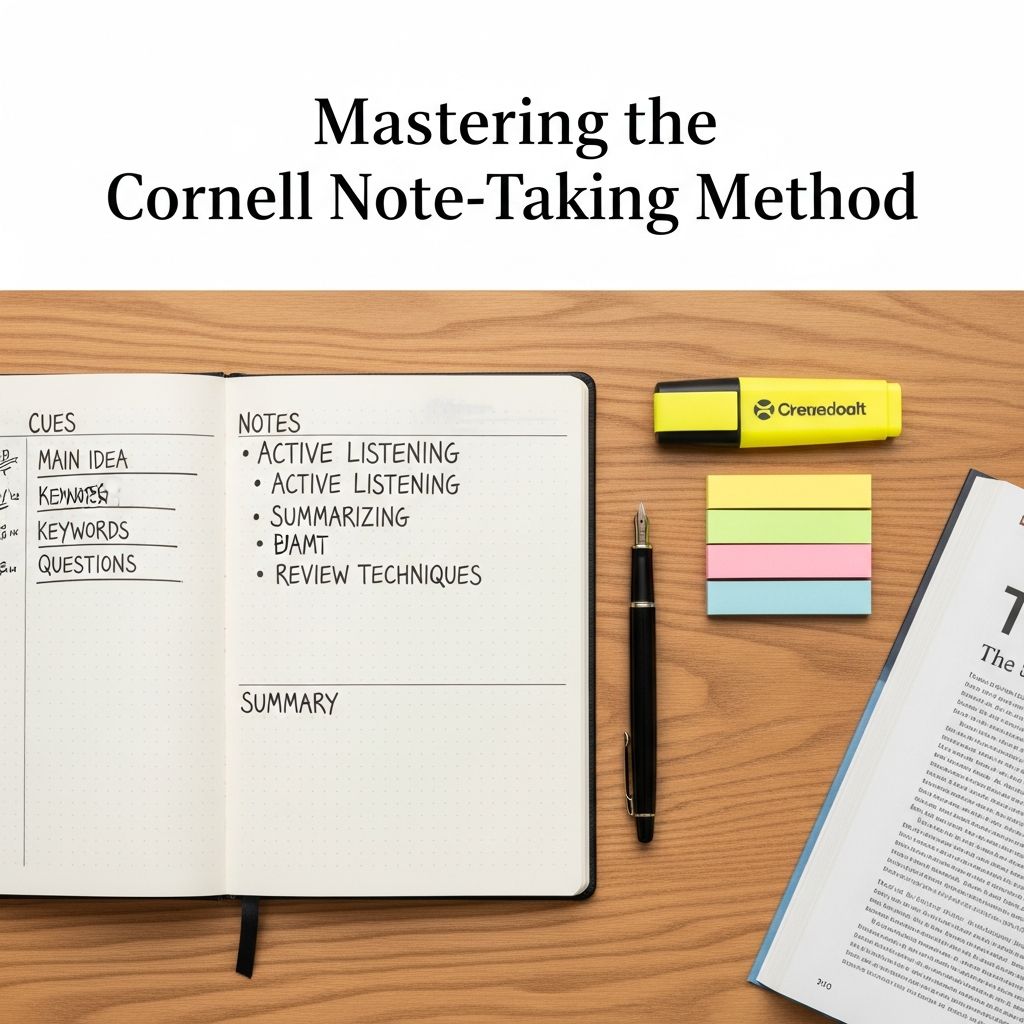
The Cornell note-taking method stands as a cornerstone of effective learning strategies, offering a systematic approach to capturing, processing, and recalling information. Developed decades ago, this technique transforms passive listening or reading into active engagement, making it indispensable for students, professionals, and lifelong learners alike.
Origins and Evolution of a Timeless Technique
Created by Walter Pauk, a professor at Cornell University and director of its reading and study center, the method debuted in the 1950s as part of his influential book How to Study in College. Pauk designed it to address common pitfalls in traditional note-taking, such as disorganized pages and poor retention. Today, institutions like Cornell’s Learning Strategies Center continue to endorse it, emphasizing its role in promoting active learning.
What began as a tool for college undergraduates has evolved into a versatile system used in lectures, meetings, and personal study sessions. Its endurance stems from simplicity—no fancy tools required, just paper and pen—combined with psychological principles of spaced repetition and self-testing.
Core Components of the Cornell Layout
At the heart of this method lies a deliberate page division into three distinct zones, each serving a unique purpose in the learning cycle. This structure prevents information overload and fosters deeper comprehension.
- Main Notes Section: Occupying the largest area (typically two-thirds of the page on the right), this is where you record lecture content, key facts, diagrams, or reading excerpts in real-time. Use bullet points, abbreviations, and concise phrases to capture essence without verbatim transcription.
- Cue Column: A narrow left margin (about 2-2.5 inches wide) reserved for questions, keywords, or prompts derived from the notes. These act as memory triggers during review.
- Summary Area: A 2-inch footer across the bottom for distilling the page’s content into 2-5 sentences, reinforcing understanding through synthesis.
This division creates visual clarity, turning a chaotic page into a organized study aid.
Step-by-Step Guide to Implementation
Adopting the Cornell method involves a straightforward five-phase process often remembered by the mnemonic: Record, Reduce, Recite, Reflect, Review. Here’s how to apply it during and after any information session.
- Record: During the lecture or reading, fill the main section rapidly. Focus on main ideas, supporting details, and examples. Ignore minor anecdotes unless pivotal.
- Reduce: Immediately after or within 24 hours, scan notes and craft 4-6 cues per page in the left column—questions like “What are the causes?” or keywords like “Photosynthesis stages.”
- Recite: Cover the main notes, using cues to verbally or mentally recall details. This active retrieval strengthens neural pathways.
- Reflect: In the summary, paraphrase core concepts in your own words, noting connections to prior knowledge.
- Review: Revisit weekly, folding the page to quiz yourself, ensuring long-term retention without cramming.
For digital adaptation, apps like Evernote or Notion offer templates mimicking this layout, though handwriting boosts retention per research.
Key Benefits for Learning and Productivity
Users report transformative results: clearer thinking, reduced anxiety, and superior exam performance. The method excels by separating raw data from analysis, allowing sense-making to emerge organically.
| Benefit | Description | Impact |
|---|---|---|
| Structured Organization | Prevents cluttered pages; easy categorization | Quick retrieval during study |
| Active Recall | Cues prompt self-testing | Enhanced memory retention |
| Synthesis Skills | Summaries force evaluation | Deeper understanding |
| Anti-Cramming | Incremental review | Lower stress, better grades |
| Versatility | Works for lectures, meetings, books | Broad applicability |
Studies from academic centers affirm handwriting notes via Cornell improves comprehension over typing, as it engages cognitive processing.
Practical Examples Across Scenarios
Consider a biology lecture on cell division: Main notes list mitosis phases with diagrams. Cues ask “Mitosis vs. Meiosis?” Summary: “Mitosis produces identical cells for growth; key in multicellular organisms.”
In a business meeting, record action items and decisions in the wide column, add cues like “Next steps? Owner?” and summarize outcomes. This asymmetry—info vs. reflection—elevates utility beyond academia.
Tips for Maximizing Effectiveness
To optimize:
- Practice on low-stakes content first to build speed.
- Use color-coding: blue for facts, red for questions.
- Combine with spaced repetition apps for cues.
- Adapt widths for content type—wider cues for question-heavy topics.
- Review in short bursts to avoid fatigue.
Common pitfalls include overfilling cues or skipping summaries; discipline yields results.
Customizing for Digital and Hybrid Use
While low-tech, printable templates abound online. For tablets, GoodNotes or OneNote replicate the format. Hybrid: Handwrite, scan, and annotate digitally for searchability.
Evidence of Real-World Success
Cornell’s own alumni and faculty highlight its active engagement edge. Jen Bokaer-Smith notes it turns passive note-takers into active learners, boosting test performance. Users in professional settings praise its role in clarifying meetings.
Frequently Asked Questions
Is the Cornell method suitable for fast-paced lectures?
Yes, its focus on key phrases allows rapid capture; refine cues later.
Can it be used for textbooks?
Absolutely—annotate margins with cues while summarizing chapters.
How long until proficiency?
Most master it in 1-2 weeks with consistent practice.
Does it work better than linear notes?
Evidence shows superior retention via built-in review.
Any free resources?
Cornell LSC offers modules; search for templates.
Overcoming Challenges and Advanced Variations
Challenges like small handwriting? Use larger paper or landscape orientation. For visual learners, integrate mind maps in the notes section. Advanced users layer meta-reflections, like “How does this link to last week’s topic?”
In group study, share pages for collective cue generation, amplifying insights.
References
- Note-taking: a Practical Guide – Cornell method — University of York Subject Guides. 2023. https://subjectguides.york.ac.uk/note-taking/cornell
- A Simple, Effective Note-Taking Technique — The Cornell Method — California Coast University. 2023-10-12. https://www.calcoast.edu/news/simple-effective-note-taking-technique-the-cornell-method
- Why the Cornell Note-Taking Method Still Works — Cultivated Management. 2023. https://www.cultivatedmanagement.com/the-cornell-note-taking-method/
- The Cornell Notes System: Five Words That Lead to Powerful Results — Evernote Blog. 2018-09-25. https://evernote.com/blog/cornell-notes-powerful-results
- Take Note: Popular Study Method has ‘Cornell’ Written All Over It — Cornell Alumni Magazine. 2023. https://alumni.cornell.edu/cornellians/cornell-notes/
- The Cornell Note Taking System — Cornell University Learning Strategies Center. 2025. https://lsc.cornell.edu/how-to-study/taking-notes/cornell-note-taking-system/

Medha Deb is an editor with a master's degree in Applied Linguistics from the University of Hyderabad. She believes that her qualification has helped her develop a deep understanding of language and its application in various contexts. Medha specializes in the areas of beauty, health, sports, and wellness and is committed to ensuring that the content on the website is…