
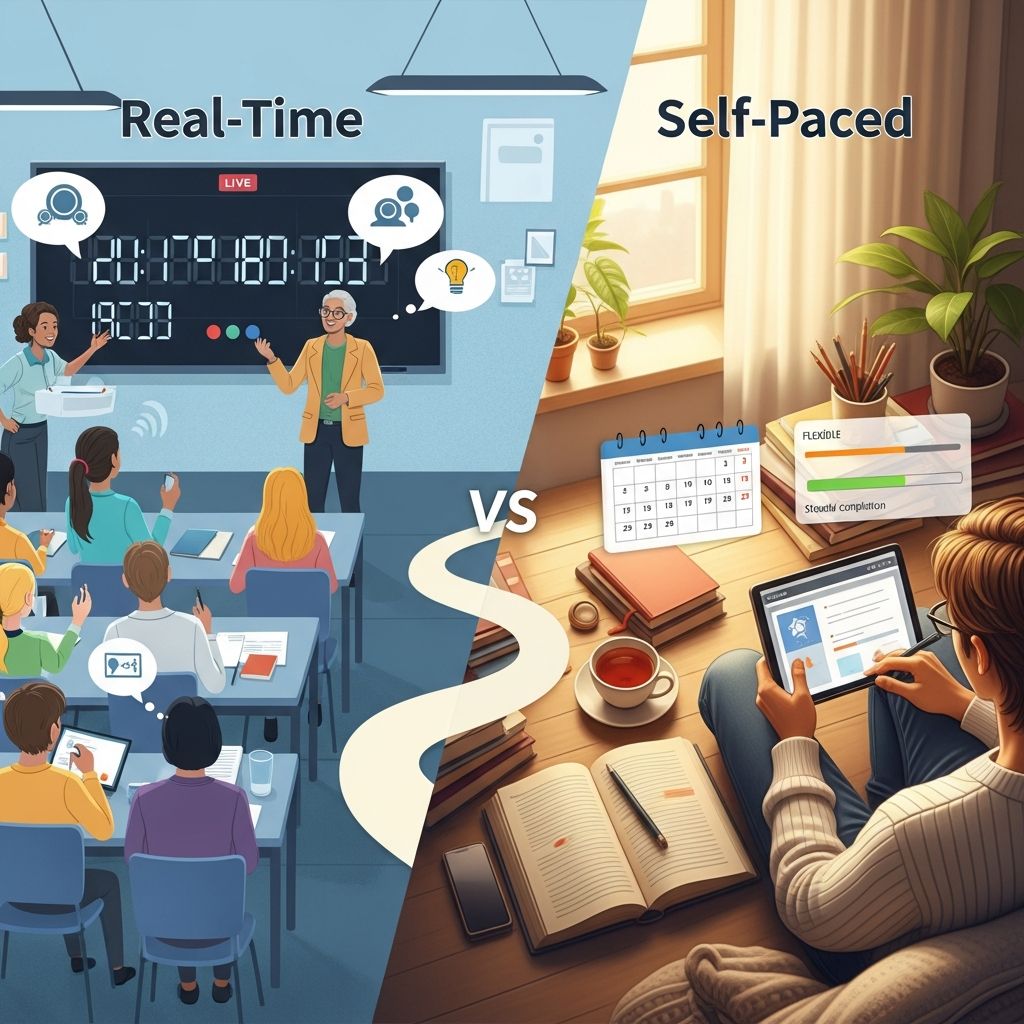
The landscape of education has undergone a remarkable transformation in recent years, with technological advancement enabling learners to engage with educational content in increasingly diverse ways. Two fundamental approaches have emerged as dominant models in contemporary learning environments: real-time instruction and self-paced learning. Understanding the distinctions between these methodologies, along with their respective strengths and limitations, is essential for students, educators, and institutional administrators seeking to optimize learning outcomes.
Defining the Two Learning Paradigms
Educational delivery systems fundamentally differ in their temporal structure and interaction patterns. Real-time learning creates an environment where instructors and learners engage simultaneously, whether in physical classrooms or through virtual platforms. This synchronization enables immediate dialogue, collaborative problem-solving, and instantaneous clarification of complex concepts.
Self-paced learning, conversely, operates on a different temporal framework where students access educational materials independently according to their personal schedules. Instructors prepare learning resources—such as recorded lectures, written materials, and interactive modules—that remain available for learners to engage with at moments convenient to their circumstances.
The fundamental distinction between these approaches transcends mere scheduling differences; it reflects distinct pedagogical philosophies regarding how knowledge transfer should occur and how learner autonomy should be balanced with instructional guidance.
Immediate Feedback and Real-Time Interaction in Synchronous Settings
Real-time learning environments offer distinctive advantages centered on the immediacy of communication and assessment. When instructors and students occupy the same temporal space, several pedagogical benefits materialize naturally.
Educators can observe learner responses instantaneously, identifying comprehension gaps as they emerge. A student’s facial expression, question phrasing, or silence can signal confusion, prompting instructors to adjust their explanatory approach on the spot. This responsive teaching methodology ensures that learning difficulties receive immediate attention rather than persisting unaddressed.
The capacity for real-time questioning creates dynamic intellectual engagement. Students can pose inquiries and receive authoritative responses without temporal delays, fostering deeper exploration of nuanced topics. Similarly, instructors benefit from immediate insight into student understanding, enabling them to calibrate pacing and emphasis according to actual classroom needs rather than predetermined assumptions.
Furthermore, synchronous environments naturally support collaborative learning experiences. Group discussions, peer-to-peer knowledge exchange, and collective problem-solving occur organically when participants share temporal and spatial presence, even in virtual contexts. This collaborative dimension often strengthens social cohesion and establishes shared intellectual community among learners.
Flexibility and Autonomy in Self-Directed Learning
Self-paced learning models prioritize accessibility and individual agency in ways that real-time instruction cannot readily accommodate. The flexibility inherent to asynchronous delivery addresses practical constraints affecting many contemporary learners.
Students managing employment, caregiving responsibilities, or complex personal circumstances find self-paced models transformative. Rather than conforming their lives to institutional schedules, learners structure their educational engagement around existing commitments. This flexibility proves particularly valuable for adult learners, international students spanning multiple time zones, and individuals with irregular schedules.
Beyond logistical convenience, self-paced learning accommodates diverse cognitive processing speeds and learning preferences. Some learners benefit from extended reflection periods before progressing to new concepts, while others prefer rapid advancement through material they comprehend quickly. Self-paced environments enable each student to navigate content at an optimal tempo rather than forcing uniformity upon heterogeneous learners.
The capacity for private, deliberative engagement with materials constitutes another significant advantage. Learners can pause, review, and contemplate complex ideas without experiencing social pressure or time constraints. This extended contemplation period proves especially valuable for subjects requiring nuanced analysis or moral judgment, such as historical controversies or ethical dilemmas.
Cognitive Demands and Self-Discipline Considerations
While self-paced learning offers flexibility, it simultaneously generates psychological and organizational demands that real-time environments largely mitigate.
Research examining cognitive load—the mental effort required during learning—demonstrates that asynchronous instruction generates greater cognitive burden than synchronous approaches. Students navigating self-paced environments must independently manage temporal organization, motivation maintenance, and material sequencing without the external structure that real-time instruction provides. This increased cognitive demand extends beyond mere content comprehension to encompass metacognitive management of the learning process itself.
The absence of scheduled accountability can facilitate procrastination, particularly for learners lacking strong intrinsic motivation or time-management capabilities. Without fixed meeting times and immediate instructor presence, students may postpone engagement with materials, compress learning into insufficient timeframes, or abandon coursework entirely.
Conversely, real-time learning’s structured schedule naturally promotes consistent engagement. Fixed class meetings create external accountability mechanisms that support learners who struggle with self-directed organization. The commitment to attend scheduled sessions at predetermined times reduces temporal ambiguity and decision fatigue regarding when to study.
Technology Infrastructure and Communication Patterns
The technological ecosystems supporting each learning model reflect their distinct operational requirements and pedagogical objectives.
Real-time learning relies on video conferencing platforms, live polling tools, and synchronous communication technologies that facilitate simultaneous interaction across geographic distances. These systems prioritize bandwidth-intensive features supporting real-time dialogue, screen-sharing, and instantaneous responsiveness.
Self-paced learning typically operates through learning management systems delivering pre-recorded content, discussion forums enabling asynchronous dialogue, and interactive modules supporting independent exploration. These platforms emphasize accessibility, content preservation, and flexible temporal navigation rather than synchronous interaction capabilities.
The technological distinction has important implications for accessibility. Real-time systems require robust internet connectivity during specific windows, potentially excluding students with unreliable access or technical limitations. Self-paced platforms offer greater resilience, permitting offline engagement with downloaded materials and flexibility regarding connection quality requirements.
Pedagogical Suitability: Matching Models to Instructional Contexts
Optimal learning design requires thoughtful alignment between instructional model and pedagogical objectives, subject matter characteristics, and learner populations.
Real-time instruction proves particularly effective for subjects emphasizing discussion-based learning, collaborative inquiry, and dynamic skill development. Disciplines requiring frequent instructor feedback, such as writing and performance-based skills, benefit substantially from synchronous immediacy. Similarly, courses incorporating mentorship, apprenticeship elements, or intensive problem-solving benefit from real-time instructor accessibility and peer collaboration opportunities.
Self-paced models excel for content-delivery-heavy subjects where learners benefit from multiple exposures to recorded material, opportunities for individual pacing, and flexibility accommodating diverse schedules. Courses featuring substantial reading components, independent projects, and self-assessment align naturally with asynchronous structures. Additionally, globally distributed learner populations spanning multiple time zones find self-paced approaches more logistically feasible than attempting synchronous coordination across incompatible schedules.
Institutional capacity and resource availability also influence suitability. Converting highly interactive courses to self-paced formats may prove prohibitively time-consuming, whereas certain content-focused courses convert readily to asynchronous delivery.
Learning Outcomes and Academic Performance
Comparative research on learning outcomes between synchronous and asynchronous methods reveals nuanced findings without clear dominance of either approach.
Studies examining academic performance demonstrate that both real-time and self-paced instruction significantly improve learning outcomes relative to no instruction. When comparing the two approaches directly, synchronous methods show a statistical trend toward higher achievement scores, though this advantage does not reach statistical significance across all subject areas. This suggests that both approaches can effectively facilitate knowledge acquisition when properly designed.
Student satisfaction levels remain consistently high in both environments when instruction quality meets appropriate standards. This indicates that learner preference for one model or another reflects personal circumstances and learning preferences rather than inherent educational quality differences.
The critical variable mediating outcomes appears to be instructional quality, course design, and alignment between pedagogical approach and learning objectives, rather than the inherent superiority of one temporal model.
Selecting the Appropriate Model: Decision Framework for Learners
Students contemplating course selection or program enrollment should evaluate several dimensions when determining whether real-time or self-paced models better serve their circumstances.
- Schedule Predictability: Learners with fixed, predictable daily schedules can commit to real-time sessions, while those with variable commitments benefit from self-paced flexibility
- Learning Style Preferences: Students thriving through discussion and real-time interaction should gravitate toward synchronous environments, while independent learners preferring reflective engagement suit asynchronous contexts
- Subject Matter: Practical skills and collaborative inquiry benefit from real-time instruction, whereas content-heavy subjects often suit self-paced delivery
- Self-Discipline Capacity: Learners with strong intrinsic motivation and temporal organization skills can manage self-paced demands, while those requiring external structure benefit from real-time accountability
- Cognitive Load Tolerance: Students capable of managing higher cognitive demands can navigate asynchronous self-organization, while those preferring reduced mental overhead benefit from real-time structure
- Geographic and Temporal Constraints: International students and those spanning multiple time zones find self-paced models more accessible than real-time coordination
Hybrid Approaches: Synthesizing Advantages of Both Models
Contemporary educational institutions increasingly recognize that dichotomous choice between real-time and self-paced models represents unnecessary limitation. Hybrid approaches integrating synchronous and asynchronous elements capitalize on distinct advantages while mitigating respective limitations.
Blended learning models might reserve real-time sessions for discussion-based learning, collaborative projects, and complex skill development while delivering foundational content through self-paced materials. This structure maintains real-time connection for subjects benefiting from synchronous interaction while preserving flexibility for content acquisition phases less dependent on immediacy.
Recorded real-time sessions can subsequently serve as asynchronous resources for students unable to attend live meetings, extending access beyond temporal constraints while preserving the instructional advantages of spontaneous, unscripted real-time dialogue.
Frequently Asked Questions
Q: Which learning model produces better academic results?
A: Research indicates both real-time and self-paced instruction significantly improve learning outcomes compared to no instruction. The synchronous approach shows a slight statistical trend toward higher scores, though the difference is not significant. Success depends more on instructional quality and alignment with learner needs than on the inherent superiority of either temporal model.
Q: Is self-paced learning suitable for all subjects?
A: While self-paced learning works well for content-heavy subjects and allows flexible access, it proves less ideal for courses emphasizing discussion, real-time collaboration, and immediate instructor feedback, such as writing workshops or intensive skills training.
Q: How do I manage procrastination in self-paced learning?
A: Self-paced learning demands stronger self-discipline and time management. Students can mitigate procrastination by establishing personal deadlines, creating structured study schedules, utilizing accountability partners, and breaking content into manageable segments.
Q: Can real-time learning accommodate students across different time zones?
A: Real-time learning requires coordinating schedules across time zones, which becomes increasingly challenging as geographic disparity increases. Recording sessions for asynchronous access partially addresses this limitation but sacrifices the immediacy benefits of synchronous participation.
Q: What cognitive load differences exist between these approaches?
A: Research shows students experience lower cognitive load in synchronous settings compared to asynchronous environments. Self-paced learning requires managing learning process organization alongside content comprehension, increasing overall mental effort, though the practical significance of this difference remains debated.
Q: Can hybrid models effectively combine both approaches?
A: Yes, hybrid approaches integrating real-time sessions for discussion and collaboration with self-paced content delivery capitalize on respective advantages while accommodating diverse learner circumstances and subject requirements.
References
- Synchronous vs. Asynchronous Learning: What Makes Them Different — Infobase. Retrieved from https://infobase.com/blog/higher-education/synchronous-vs-asynchronous-learning-what-makes-them-different/
- The Difference Between a Synchronous and an Asynchronous Class — Boise State University Online Learning. 2024-10-25. Retrieved from https://www.boisestate.edu/online/2024/10/25/the-difference-between-a-synchronous-and-an-asynchronous-class/
- Asynchronous vs. Synchronous Learning: Which Is Best? — Articulate. Retrieved from https://www.articulate.com/blog/asynchronous-vs-synchronous-e-learning-which-is-best/
- 5 Differences Between Asynchronous vs Synchronous Learning — Summit Learning Charter. Retrieved from https://summitlearningcharter.org/resources/blog/asynchronous-vs-synchronous-learning/
- The Evaluation of Synchronous and Asynchronous Online Learning — National Center for Biotechnology Information (NCBI/NIH). 2024. Retrieved from https://pmc.ncbi.nlm.nih.gov/articles/PMC10960437/
- What is Synchronous and Asynchronous Learning? — Stanford University Teaching Resources. Retrieved from https://teachingresources.stanford.edu/resources/what-is-synchronous-and-asynchronous-learning/

- Integrated M.A. in Applied Linguistics, University of Hyderabad
- 5+ years in editorial, instructional, SEO, and research-based writing
Sneha is a relationships and lifestyle writer with a strong foundation in applied linguistics and certified training in relationship coaching. She brings over five years of writing experience to theskillvault, crafting thoughtful, research-driven content that empowers readers to build healthier relationships, boost emotional well-being, and embrace holistic living. Her writing and insights reflect the belief that beauty, happiness, and wellness…