
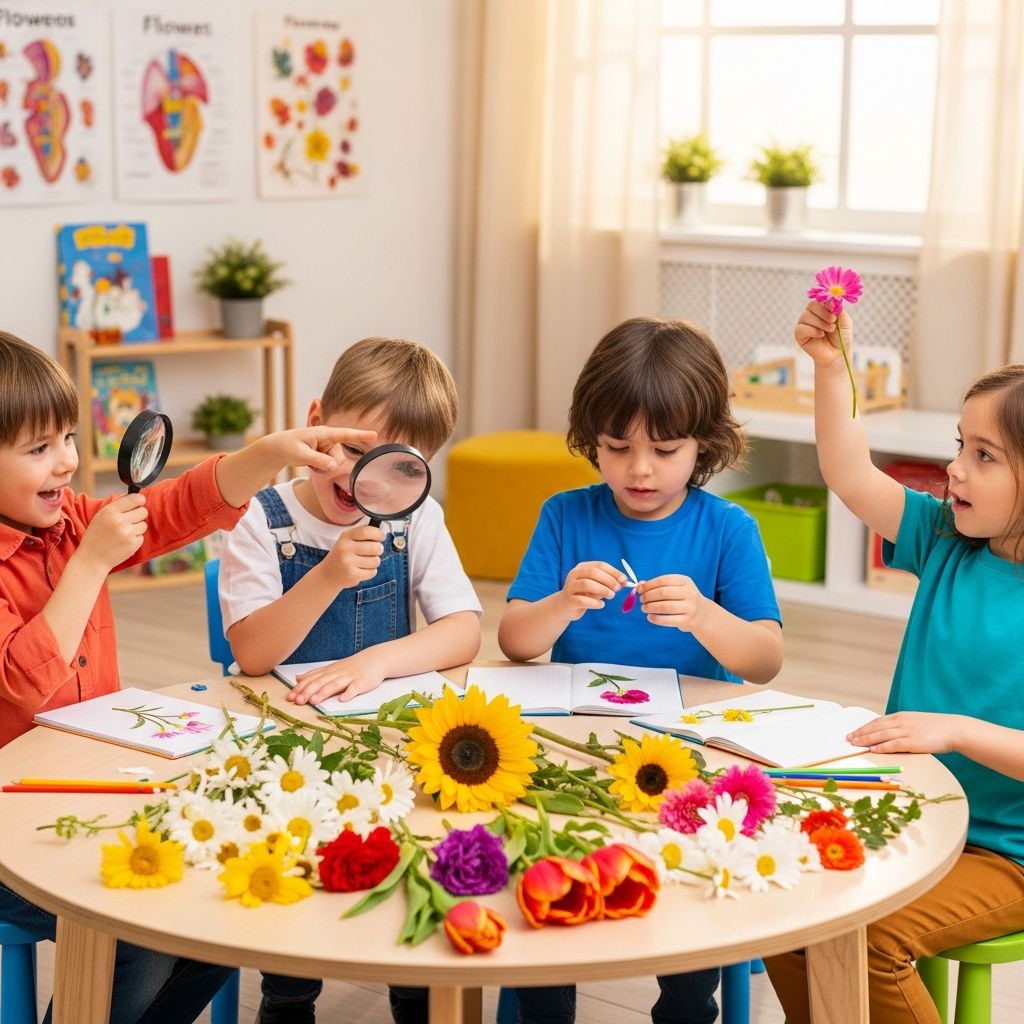
Introduction to Botanical Learning Through Flowers
The arrival of spring brings vibrant blooms that capture the imagination of young learners. Incorporating flowers into preschool curricula offers educators a multisensory approach to teaching fundamental concepts across numerous developmental domains. When children engage with flowers through structured activities, they gain exposure to botanical science, develop fine and gross motor coordination, practice color recognition, and cultivate an appreciation for the natural world. Flowers serve as accessible tools for inquiry-based learning, allowing preschoolers to observe, manipulate, and explore at their own pace while building confidence in their investigative abilities.
Building Fine Motor Competencies with Flower-Based Tasks
Fine motor skill development represents a critical milestone in early childhood education. Activities centered on flower themes provide engaging contexts for strengthening the small muscles in children’s hands and fingers. These controlled movements form the foundation for future writing, drawing, and self-care abilities.
One effective approach involves having children work with natural materials found in flowers. When presented with flower petals and small stems, young learners can practice tearing, picking, and arranging these delicate components. This tactile exploration naturally develops finger dexterity and hand strength without feeling like formal instruction.
Threading and wrapping activities using flowers as motivation yield particularly strong results. Children can wrap yarn around cardboard circles to create textured flower representations, or thread beads through stems to construct flower chains. These activities demand sustained focus and precise hand movements that directly transfer to pre-writing skills.
Cutting activities using flower themes provide additional opportunities for scissor skill development. Providing children with pre-drawn flower outlines or flower images to cut strengthens the hand muscles necessary for effective scissor control. As children progress, offering more complex flower shapes with intricate petal designs encourages increasing precision and control.
Gross Motor Development Through Movement-Based Flower Games
While fine motor activities target small muscle groups, flower-themed gross motor activities engage the larger muscle systems essential for balance, coordination, and body awareness. These movement experiences complement sitting-based fine motor work and provide necessary physical outlets for active learners.
Dance and yoga activities centered on flower growth provide particularly effective gross motor engagement. Children can begin in a crouched position, slowly rising and stretching as flowers “bloom,” incorporating movements that develop core stability and body control. Following flower growth sequences—seed, sprout, bud, and bloom—gives purposeful structure to these movements while maintaining playful engagement.
Obstacle course activities using flower-themed stations allow multiple children to move through different physical challenges simultaneously. A hopscotch course with flower decals in each square, a flower balance walk where children carry artificial flowers while traversing a line, and a flower toss station where children throw flowers into buckets all develop different aspects of gross motor coordination.
Racing and relay games featuring flower components introduce competitive elements that motivate sustained physical effort. Relay races where children pass flowers to teammates, races to collect flowers scattered across a play area, and flower-themed limbo challenges using flower garlands provide vigorous cardiovascular activity while maintaining thematic consistency.
Cognitive Development Through Flower Observation and Classification
Flowers present ideal subjects for developing observational and classification skills. By examining real or high-quality artificial flowers, children practice careful attention to detail and systematic thinking.
Comparative analysis activities encourage children to examine multiple flowers and identify similarities and differences. Asking questions about petal shape, color variation, stem thickness, and leaf arrangement prompts observation of specific characteristics. Children can sort flowers by single attributes—grouping by color, petal count, or size—or by multiple attributes simultaneously, advancing cognitive complexity as skills develop.
Learning the structural components of flowers combines botanical knowledge with visual learning. Identifying sepals, petals, stamens, and pistils gives children vocabulary for discussing what they observe. Flowers with large, obvious petals and visible central structures—such as sunflowers or daffodils—work particularly well for this instructional purpose because children can readily identify each part.
Creating flower journals supports sustained observation over time. Children can sketch flowers they observe, record color changes, note how flowers appear at different times of day, and document growth patterns if flowers are placed in water. These records develop documentation skills and reinforce the scientific observation process.
Sensory Exploration and Nature Connection
The multisensory nature of flowers makes them ideal for developing sensory awareness and environmental connection. Engaging multiple senses simultaneously creates rich learning experiences and helps children process information through their preferred sensory channels.
Olfactory exploration through flower scents introduces children to the diversity of natural fragrances. Allowing children to smell different flowers safely and describe the scents builds vocabulary while creating positive associations with botanical investigation. Some flowers produce strong, pleasant scents while others are nearly odorless, offering opportunities to discuss variation in nature.
Tactile investigation of flower petals, leaves, and stems reveals textural variety. Comparing the smoothness of certain petals to the roughness of some leaves or the delicacy of thin petals to the sturdiness of thick stems develops tactile discrimination. Water-based sensory bins filled with flower petals, water, and natural materials create immersive sensory experiences that support quiet, focused exploration.
Visual exploration extends beyond simple observation to include color mixing and light exploration. Placing flowers in water tinted with food coloring demonstrates how plants absorb liquids, while holding flowers up to light sources reveals the translucence of certain petals. These experiments make invisible processes visible and concrete for young thinkers.
Creative Expression Through Flower-Inspired Artistic Activities
Flowers inspire diverse artistic expressions that allow children to represent their observations and feelings through multiple media.
Painting with flowers rather than brushes offers unconventional artistic approaches. Dipping flower heads in paint to stamp patterns, rolling flowers through paint and across paper, or using stems as drawing implements creates unique aesthetic results while exploring how different flower parts produce different marks and patterns.
Collage and construction activities using flower components—petals, leaves, stems—develop spatial reasoning and compositional skills. Children can arrange pressed flowers on paper, construct three-dimensional flower sculptures from recycled materials decorated with flower elements, or create mixed-media representations combining flowers with paint, markers, and other materials.
Drawing and sketching flowers develops observational skills while allowing artistic interpretation. Still-life arrangements of flowers encourage careful attention to detail, while imagination-based flower drawings freed from representational constraints allow expressive, creative responses to the flower theme.
Mathematical Concepts Embedded in Flower Activities
Flowers naturally incorporate mathematical concepts including counting, patterning, symmetry, and spatial relationships. Structured flower activities provide engaging contexts for mathematics exploration.
Counting activities utilizing flowers progress in complexity from simple one-to-one correspondence to more advanced enumeration. Counting flower petals, arranging flowers in groups, or tallying different flower types in a collection builds number sense and counting fluency. Flower-themed counting mats, number cards, and clip activities provide structured practice with mathematical language and concepts.
Pattern work using flowers develops recognition and continuation of sequences. Creating patterns with different colored flowers, arranging petals in alternating patterns, or sequencing flower growth stages builds foundational mathematical thinking.
Symmetry exploration through flower structures helps children recognize bilateral and radial symmetry. Many flowers display obvious symmetrical arrangements, making them ideal for investigating mathematical properties. Folding flower drawings in half to create symmetrical patterns provides hands-on symmetry exploration.
Language Development Through Flower-Centered Conversations
Flowers provide excellent springboards for rich language development across listening, speaking, and emerging literacy skills.
Vocabulary expansion occurs naturally when children discuss flower characteristics. Introducing descriptive words—delicate, fragrant, vibrant, velvety—during flower exploration increases children’s expressive vocabulary. Naming different flower varieties and their parts provides specific botanical vocabulary while general descriptors develop overall language richness.
Sound recognition activities with flower names develop phonological awareness. Discussing the beginning sounds in flower names—Rose, Tulip, Lily, Sunflower—builds phonemic awareness essential for later reading development. Rhyming flower names and creating simple flower-themed poems support phonological development.
Storytelling and narrative development emerge when flowers serve as story prompts. Creating narratives about where flowers grow, how they came to be in the classroom, or imagined journeys flowers might take develops narrative skills and imaginative thinking.
Scientific Investigation and Discovery Processes
Structured flower activities introduce children to scientific thinking and investigative processes in developmentally appropriate ways.
Observation and prediction activities help children develop hypothesis formation skills. Before examining a flower, children might predict what they will find inside. After careful investigation and comparison of multiple flowers, children can refine their predictions and develop understandings about flower structure and variation.
Water absorption demonstrations using cut flowers introduce children to plant biology. Placing white flowers in water tinted with food coloring and observing color changes over time makes invisible processes visible. Comparing how quickly different flowers absorb water develops understanding of variation in nature.
Growth and life cycle exploration through seed planting and nurturing cultivates understanding of botanical development. Observing seeds germinate, seedlings develop into plants, and flowers eventually bloom demonstrates natural processes while building patience and responsibility.
Social-Emotional Learning Through Shared Flower Experiences
Flower-based activities provide contexts for developing social and emotional competencies essential for healthy development and positive peer relationships.
Collaborative projects requiring children to work together toward a shared goal—creating a large sunflower mural, building a classroom flower garden, or arranging a centerpiece—develop cooperation and communication skills. Working alongside peers toward aesthetic and functional goals builds relationship skills and shared accomplishment.
Sensory and calming activities centered on flowers support emotional regulation. The peaceful nature of flower observation, the gentle handling required when working with delicate petals, and the typically quiet atmosphere surrounding flower exploration create optimal conditions for emotional settling and focused attention.
Gift-giving activities where children create flower-based gifts for family members develop empathy, consideration for others, and positive social connections. Decorating flowers or attaching flowers to cards with personal messages extends learning beyond the classroom into family relationships.
Integrating Flowers Across Learning Environments
Maximizing the educational potential of flowers requires intentional integration across multiple learning spaces and times throughout the day.
Science exploration areas benefit from fresh flowers in vases for observation and investigation. Providing magnifying glasses, hand lenses, and reference materials allows independent exploration and discovery. Arranging flowers at different stages of bloom progression demonstrates temporal changes accessible to young observers.
Art centers stocked with flower materials—petals, stems, leaves, pressed flowers—invite ongoing creative expression. Providing painting supplies, collage materials, drawing implements, and construction materials alongside flower components encourages experimentation and artistic problem-solving.
Reading areas featuring flower-themed books create literacy connections. Picture books showcasing flowers, stories featuring flowers as central elements, and informational texts about flower varieties support language development and positive associations with reading.
Outdoor exploration of naturally occurring flowers in gardens or landscaped areas connects classroom learning to authentic natural environments. Observing pollinators visiting flowers, examining flowers in their natural settings, and discussing seasonal flower changes extend learning beyond constructed classroom contexts.
Selecting and Preparing Materials for Flower Activities
Successful flower activities depend on thoughtful material selection and preparation that considers safety, accessibility, and learning objectives.
Real flowers offer authenticity and genuine sensory experiences but require careful consideration of allergens and toxicity. Non-toxic flowers suitable for young children include sunflowers, daisies, zinnias, marigolds, and cosmos. Artificial flowers provide allergen-free alternatives and greater durability for activities involving manipulation and water exploration.
Considering material quantity ensures sufficient materials for all participating children without excessive waste. Having adequate flowers allows multiple children to work simultaneously without needing to share materials, reducing conflict and frustration while maximizing engagement.
Preparing materials in advance—cleaning stems, removing thorns, arranging flowers in accessible containers—demonstrates respect for children’s time and ensures activities proceed smoothly without unnecessary delays or safety concerns.
Frequently Asked Questions
Q: Are real flowers always necessary for flower activities with preschoolers?
A: No, artificial flowers work well for many activities and offer advantages including durability, allergen-free properties, and availability year-round. Real flowers provide authentic sensory experiences but require consideration of toxicity and allergen concerns. Many educators use combinations of both.
Q: How can flower activities be adapted for children with sensory sensitivities?
A: Activities can be modified by offering choices about participation level, allowing observation without direct contact, using artificial flowers if scents cause distress, providing hand gloves for tactile-sensitive children, and creating quiet spaces for children who become overstimulated during group activities.
Q: What safety considerations should I keep in mind during flower activities?
A: Ensure flowers are non-toxic, remove thorns and sharp stems, supervise water-based activities closely, verify no child allergies exist, wash hands after handling flowers, and avoid flowers treated with pesticides unless specifically labeled as pesticide-free.
Q: How do flower activities support children with different learning styles?
A: Flower activities naturally incorporate visual, tactile, auditory, and kinesthetic learning modalities. Visual learners benefit from observing flower colors and structures; tactile learners engage through handling petals and stems; auditory learners develop vocabulary through discussions; kinesthetic learners participate in movement and construction activities.
Q: Can flower activities be extended beyond spring and summer months?
A: Yes, using dried flowers, pressed flowers, photographs of flowers, artificial flowers, or indoor-grown flowers allows flower activities year-round. Discussing seasonal changes in flower availability and comparing seasonal flower varieties adds instructional depth to year-long flower exploration.
References
- 30+ Flower Activities for Preschool — Pre-K Pages. Accessed 2026. https://www.pre-kpages.com/flower-activities-preschoolers/
- Flower Gross Motor Activities for Preschoolers — The Early Childhood Academy. Accessed 2026. https://theearlychildhoodacademy.com/flower-powered-movement-activities-for-preschoolers/
- Fun Preschool Spring Activities Using Flowers — Teaching 2 and 3 Year Olds. Accessed 2026. https://teaching2and3yearolds.com/preschool-spring-activities-using-flowers/
- Preschool Flower Activities & Sensory Bin — Little Bins for Little Hands. Accessed 2026. https://littlebinsforlittlehands.com/flower-activities-for-preschoolers/
- Preschool Flowers and Bees Lesson Planning Ideas — Pre-K Printable Fun. Accessed 2026. https://www.prekprintablefun.com/flowers-and-bees-lesson-planning-page.html

Medha Deb is an editor with a master's degree in Applied Linguistics from the University of Hyderabad. She believes that her qualification has helped her develop a deep understanding of language and its application in various contexts. Medha specializes in the areas of beauty, health, sports, and wellness and is committed to ensuring that the content on the website is…