
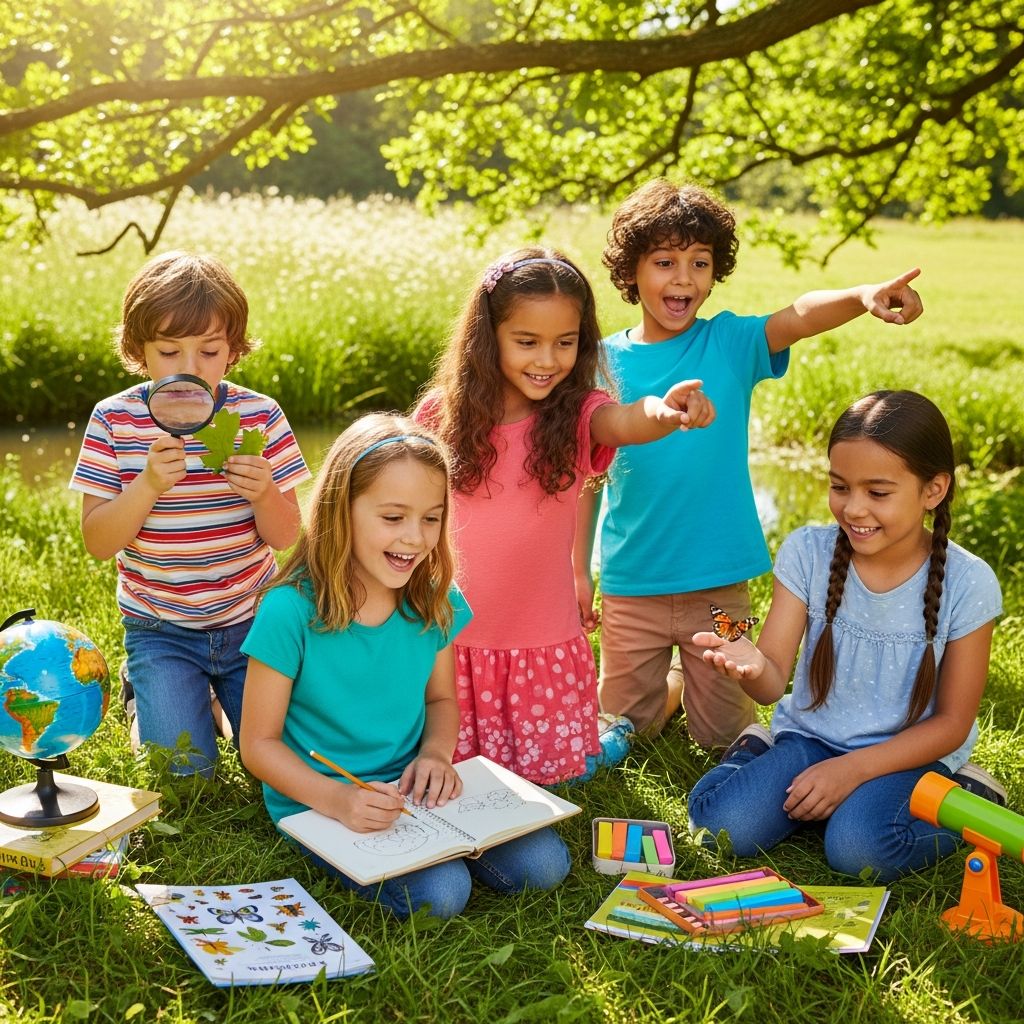
Summer offers endless opportunities for children to explore, create, and grow without the structure of school. These carefully curated activities transform idle days into enriching experiences, fostering curiosity in science, literacy, math, and artistic expression. Parents can easily implement them using household items or local parks, ensuring learning feels like play.
Harnessing Nature for Discovery
Outdoor environments provide a natural classroom where kids can observe real-world phenomena. Start with guided explorations that sharpen senses and encourage documentation.
- Organize a sensory scavenger hunt: Challenge children to find items representing each sense—crisp leaves to touch, buzzing insects to hear, wildflowers to smell, and safe berries to taste.
- Build an alphabet from nature: Collect or sketch objects starting with each letter, like acorns for ‘A’ or bark for ‘B’, compiling them into a personalized book.
- Track weather patterns: Set up a simple station with a rain gauge made from a bottle and a thermometer, recording daily changes to discuss climate basics.
These pursuits not only teach biology and meteorology but also promote physical activity and mindfulness.
Hands-On Science at Home and Beyond
Science comes alive through experiments that demonstrate principles like reactions, energy, and physics. Use everyday materials to spark wonder.
For younger learners, try a cloud in a jar: Fill a jar with hot water, add ice on top, and watch condensation form, mimicking weather cycles. Older kids can engineer a water wall with recycled bottles and tubing, exploring gravity and flow rates.
| Experiment | Key Concept | Materials Needed | Age Group |
|---|---|---|---|
| Baking Soda Volcano | Chemical Reactions | Baking soda, vinegar, dish soap, food coloring | 4-8 |
| Solar Oven | Solar Energy | Pizza box, foil, plastic wrap, tape | 6-12 |
| Elephant Toothpaste | Catalysis | Hydrogen peroxide, yeast, dish soap | 7+ |
| Watermelon Volcano | Acid-Base | Watermelon, baking soda, vinegar | 5-10 |
Such projects align with STEM education goals, helping children grasp abstract ideas through tangible results.
Boosting Literacy Through Play
Reading and writing thrive when tied to personal interests. Integrate them into daily routines for sustained progress.
- Launch a family book club: Select age-appropriate titles, discuss chapters, and create bookmarks with summaries or drawings.
- Practice ‘story chain’: Family members alternate sentences to co-author tales, building vocabulary and sequencing skills.
- Daily journaling: Provide prompts like ‘Describe your dream adventure’ or ‘Invent a new animal,’ encouraging expressive language.
- Comic creation: Draw three-panel strips with dialogue bubbles about summer mishaps or heroes.
Consistent reading combats ‘summer slide,’ with studies showing daily sessions maintain grade-level proficiency. Word games like unscrambling summer-themed puzzles further enhance phonics and spelling.
Math in Motion: Everyday Challenges
Math becomes exciting when embedded in games and measurements, turning vacations into skill-building quests.
Measure backyard ‘whales’: Research animal sizes online, then use tape to mark equivalents on grass, practicing scale and units. Cooking projects involve fractions—halving recipes for cookies or doubling ingredients for salads—while counting reinforces number sense.
- Scavenger math hunts: Find objects of specific lengths, shapes, or patterns, like ‘something taller than 20 cm’ or ‘symmetrical leaves.’
- Budget a lemonade stand: Calculate costs, profits, and change, introducing basic economics.
- Pattern hunts: Spot repeating sequences in nature, like pinecone spirals or tile mosaics.
These methods make abstract concepts concrete, supporting long-term retention.
Artistic Expression and Crafts
Creativity flourishes with open-ended art, using nature’s bounty for unique masterpieces.
Plein air painting invites kids outdoors to capture landscapes with watercolors, fostering observation. Craft flower crowns or shadow paintings from wildflowers, blending botany and design. For indoor days, build forts from blankets and chairs, then decorate with handmade signs.
- Nature collages: Glue pressed leaves, petals, and twigs into themed artworks.
- DIY pottery: Mold air-dry clay into pots, painting after drying.
- Scrapbook summers: Compile photos, tickets, and captions into memory albums.
Art activities develop fine motor skills and emotional intelligence.
Building Structures and Engineering Fun
Engineering play encourages problem-solving and perseverance through construction challenges.
Domino chains test physics: Arrange for chain reactions incorporating ramps and balls. Sandcastles at the beach teach stability—experiment with moats and towers. Backyard forts from sticks promote spatial planning.
These hands-on builds mirror real engineering, enhancing critical thinking.
Culinary Creations and Sensory Play
Kitchen time combines math, science, and following directions in tasty experiments.
- Seasonal salads: Chop veggies, measure dressings, discuss nutrition.
- Homemade ice cream: Shake bags with cream and salt, observing freezing points.
- Sensory bins: Fill with rice, shells, and scoops for octopus-themed exploration.
Cooking boosts independence and healthy habits.
Nighttime Wonders and Family Bonding
Evenings extend learning with stargazing or glow-in-the-dark hunts, strengthening family ties.
Planning Your Summer Success
Create a flexible schedule: Dedicate mornings to outdoors, afternoons to indoors. Track progress with charts, rewarding milestones. Adapt for ages—simplify for toddlers, add complexity for tweens.
Routines prevent learning loss, with research emphasizing balanced play and structure.
Frequently Asked Questions
What if it rains during outdoor plans?
Shift to indoor alternatives like science experiments or storytelling; many activities adapt seamlessly.
How do I motivate reluctant learners?
Incorporate their interests, like sports-themed math, and use short sessions with choices.
Are these suitable for all ages?
Yes, scale difficulty: Simplify hunts for preschoolers, add research for older kids.
Do I need special supplies?
Mostly household items; check dollar stores for basics like magnifying glasses.
How much time per day?
30-60 minutes suffices; integrate into play for natural flow.
References
- 101 Easy, Free, and Fun Ways to Keep Kids Learning Over Summer — Scholastic. Accessed 2026. https://www.scholastic.com/parents/family-life/summer-vacation-learning-activities.html
- Engaging Summer Learning Activities for Kids: A Complete Guide — Greenhouse Learning. Accessed 2026. https://greenhouselearning.co.uk/engaging-summer-learning-activities-for-kids-a-complete-guide/
- Screen-Free Summer Fun: 100 Engaging Activities for Kids — Treehouse Schoolhouse. Accessed 2026. https://treehouseschoolhouse.com/blog/100-screen-free-kids-summer-activities
- 15 Fun Summer School Activities for Elementary and Middle Students — HMH Co. Accessed 2026. https://www.hmhco.com/blog/fun-summer-learning-activities-for-elementary-middle-school-students
- Summer Learning Activities for Kids of All Ages — Pathways.org. Accessed 2026. https://pathways.org/summer-learning-activities-for-kids-of-all-ages
- Fun Summer Learning Activities for Kids — Waterford.org. Accessed 2026. https://www.waterford.org/blog/9-summer-learning-activities-that-promote-school-readiness-for-prek-2nd-grade-families/

- Integrated M.A. in Applied Linguistics, University of Hyderabad
- 5+ years in editorial, instructional, SEO, and research-based writing
Sneha is a relationships and lifestyle writer with a strong foundation in applied linguistics and certified training in relationship coaching. She brings over five years of writing experience to theskillvault, crafting thoughtful, research-driven content that empowers readers to build healthier relationships, boost emotional well-being, and embrace holistic living. Her writing and insights reflect the belief that beauty, happiness, and wellness…