
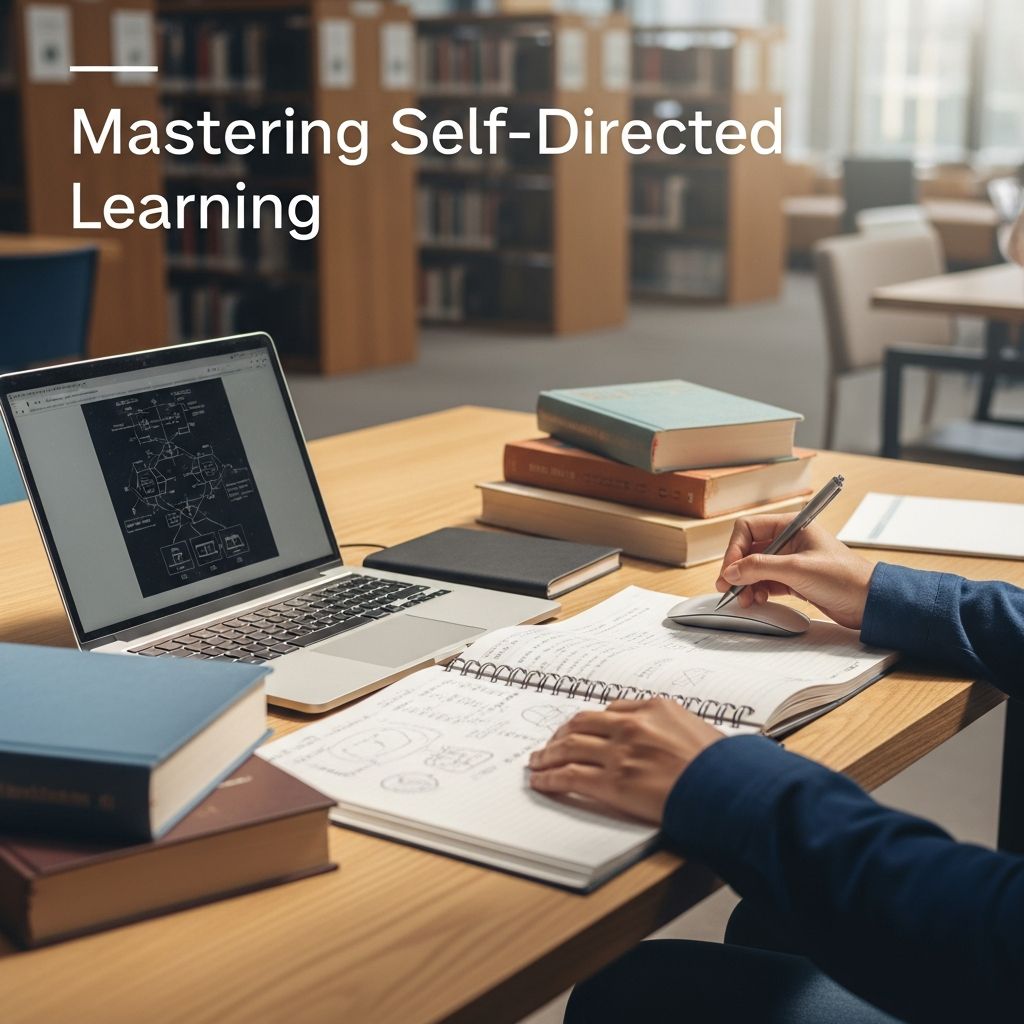
Self-directed learning empowers individuals to take control of their education, enabling them to acquire new skills and knowledge without relying on traditional classrooms. This approach is essential in today’s fast-evolving world, where personal growth often demands independent effort. Research highlights that structured methods significantly outperform unstructured practice, as demonstrated in classic experiments comparing guided learning to mere repetition. By adopting science-backed techniques, learners can enhance retention, deepen understanding, and achieve expertise more efficiently.
Understanding the Foundations of Effective Self-Study
The core principle of self-directed learning lies in treating it as a deliberate process rather than passive absorption. Historical experiments, such as those involving skill acquisition like dart throwing, reveal that groups using systematic approaches—focusing first on understanding fundamentals before practice—far surpassed those who practiced blindly or without strategy. This underscores that how you learn often determines success more than the volume of study time.
Key foundations include recognizing learning as an active construction of knowledge. Rather than rote memorization, effective self-study involves deconstructing complex topics into manageable components and rebuilding them through personal synthesis. Books like Peter Hollins’ The Science of Self-Learning emphasize building a personal syllabus: start with broad research, identify core concepts, and create a roadmap tailored to your goals.
- Deconstruct Topics: Break down subjects into hierarchies—from broad overviews to specific details.
- Build Self-Regulation: Monitor progress, adjust strategies, and maintain motivation through small wins.
- Cultivate Confidence: Early successes reinforce belief in your ability to learn independently.
These elements form the learning success pyramid, where self-regulation and confidence underpin motivation and retention.
Implementing Active Learning Techniques
Passive reading yields shallow understanding; active learning transforms information into lasting knowledge. Techniques like the SQ3R method—Survey, Question, Read, Recite, Review—structure engagement with material. Begin by surveying headings and summaries for an overview, then generate questions to guide reading. After reading, recite key points from memory and review to reinforce connections.
| Step | Description | Benefits |
|---|---|---|
| Survey | Skim structure, headings, visuals | Builds mental framework |
| Question | Formulate ‘what’, ‘why’, ‘how’ queries | Focuses attention |
| Read | Deep dive answering questions | Active comprehension |
| Recite | Recall without notes | Strengthens memory |
| Review | Summarize and revisit | Ensures long-term retention |
Complement SQ3R with the Feynman Technique: explain concepts simply, as if teaching a child. Gaps in explanation reveal knowledge voids to target. Self-explanation—asking ‘why’ repeatedly—forces deeper insight, mimicking expert thinking.
In practice, apply these during study sessions. For programming, survey languages, question syntax purposes, read documentation, recite code logic aloud, and review by debugging your implementations.
Setting Ambitious Yet Achievable Goals
Clear goals anchor self-study, preventing aimless effort. Vague intentions like ‘learn Python’ falter; specific, challenging targets like ‘build a web app in 30 days using Flask’ drive progress. Balance ambition with realism—stretch beyond comfort zones by modeling experts.
- Analyze field leaders: Study their breakthroughs and routines.
- Define SMART goals: Specific, Measurable, Achievable, Relevant, Time-bound.
- Break into milestones: Weekly checkpoints with rewards.
Psychological research shows ambitious goals boost performance via heightened focus and persistence, provided they’re paired with feedback loops. Track via journals: note achievements, setbacks, and adjustments.
Practical Application: Bridging Theory and Practice
True mastery emerges from applying knowledge. After grasping basics, create projects that demand integration. Aspiring bakers adapt recipes; coders build apps from scratch. This elaboration—linking new info to existing knowledge—solidifies neural pathways.
- Project-Based Learning: Design real-world tasks, e.g., analyze stock data with Python for finance learners.
- Teaching Others: Blog or tutor to expose misunderstandings.
- Iterative Challenges: Scale difficulty, celebrating milestones to sustain momentum.
Application prevents the ‘illusion of competence’ from rereading alone, ensuring skills transfer to novel situations.
Fostering Connections and Holistic Understanding
Experts view fields as interconnected systems. Seek links: How does calculus underpin machine learning? Linda Elder’s framework advises mapping concepts as an ‘organized intelligible system’. Use mind maps to visualize relationships, enhancing recall through associative networks.
Delve into expert mindsets post-basics. Read advanced texts, attend webinars, or join communities. Question: ‘How do professionals frame problems?’ This meta-cognition elevates self-study from skill acquisition to wisdom.
The Power of Reflection in Sustaining Progress
Reflection cements learning, countering short-term cramming’s pitfalls. Regular reviews—weekly or post-project—assess: What worked? What to refine? Metacognitive journals reveal patterns, like over-reliance on videos versus hands-on practice.
Spaced repetition combats forgetting curves: revisit material at increasing intervals. Tools like Anki automate this, but manual reflection adds depth. Long-term, reflect on expertise evolution—shift from procedural knowledge to intuitive grasp.
Overcoming Common Self-Study Challenges
Motivation wanes in tedium; combat with routines like Benjamin Franklin’s schedules: fixed study blocks with variety. Build discipline via environment design—minimize distractions, pair tasks with rewards.
| Challenge | Solution |
|---|---|
| Procrastination | Pomodoro: 25-min focused bursts |
| Overwhelm | Chunking: One concept at a time |
| Plateaus | Deliberate practice: Target weaknesses |
| Burnout | Rest + reflection cycles |
These tactics, drawn from cognitive science, turn obstacles into growth opportunities.
Frequently Asked Questions
How long does it take to master a new skill through self-study?
Time varies by complexity and prior knowledge, but consistent 1-2 hours daily with structured methods can yield proficiency in 3-6 months, per expertise research.
Is self-directed learning better than formal education?
It complements formal education, excelling in flexibility and personalization, though structured courses provide accountability.
What if I lack motivation for self-study?
Use habit stacking, accountability partners, and intrinsic goals tied to personal aspirations.
Can anyone become an expert via self-study?
Yes, with deliberate practice and the right strategies, as evidenced by autodidacts like Benjamin Franklin.
How do I measure self-study progress?
Track via milestones, self-quizzes, project outputs, and reflection logs.
References
- The Science of Self-Learning: How to Teach Yourself Anything — Peter Hollins. 2019-11-12. https://www.goodreads.com/book/show/42847046-the-science-of-self-learning
- The Science Of Self Study: Six Things To Know — The Learning Agency Lab. 2023-01-01. https://the-learning-agency-lab.com/the-learning-curve/the-science-of-self-study/
- The Science of Self-Learning – by Peter Hollins (Hardcover) — Target. 2020-06-15. https://www.target.com/p/the-science-of-self-learning-by-peter-hollins-hardcover/-/A-94478765
- The Science of Self-Learning Audiobook — Audible. 2018-11-20. https://www.audible.com/pd/The-Science-of-Self-Learning-Audiobook/B07L5WXBNT
- The Science of Self-Learning by Peter Hollins: 10 Minute Summary — YouTube (SnapTale). 2023-05-10. https://www.youtube.com/watch?v=59BDEnFMQRU
- The Science of Self-Learning Free Summary — getAbstract. 2019-12-01. https://www.getabstract.com/en/summary/the-science-of-self-learning/45535

Medha Deb is an editor with a master's degree in Applied Linguistics from the University of Hyderabad. She believes that her qualification has helped her develop a deep understanding of language and its application in various contexts. Medha specializes in the areas of beauty, health, sports, and wellness and is committed to ensuring that the content on the website is…