
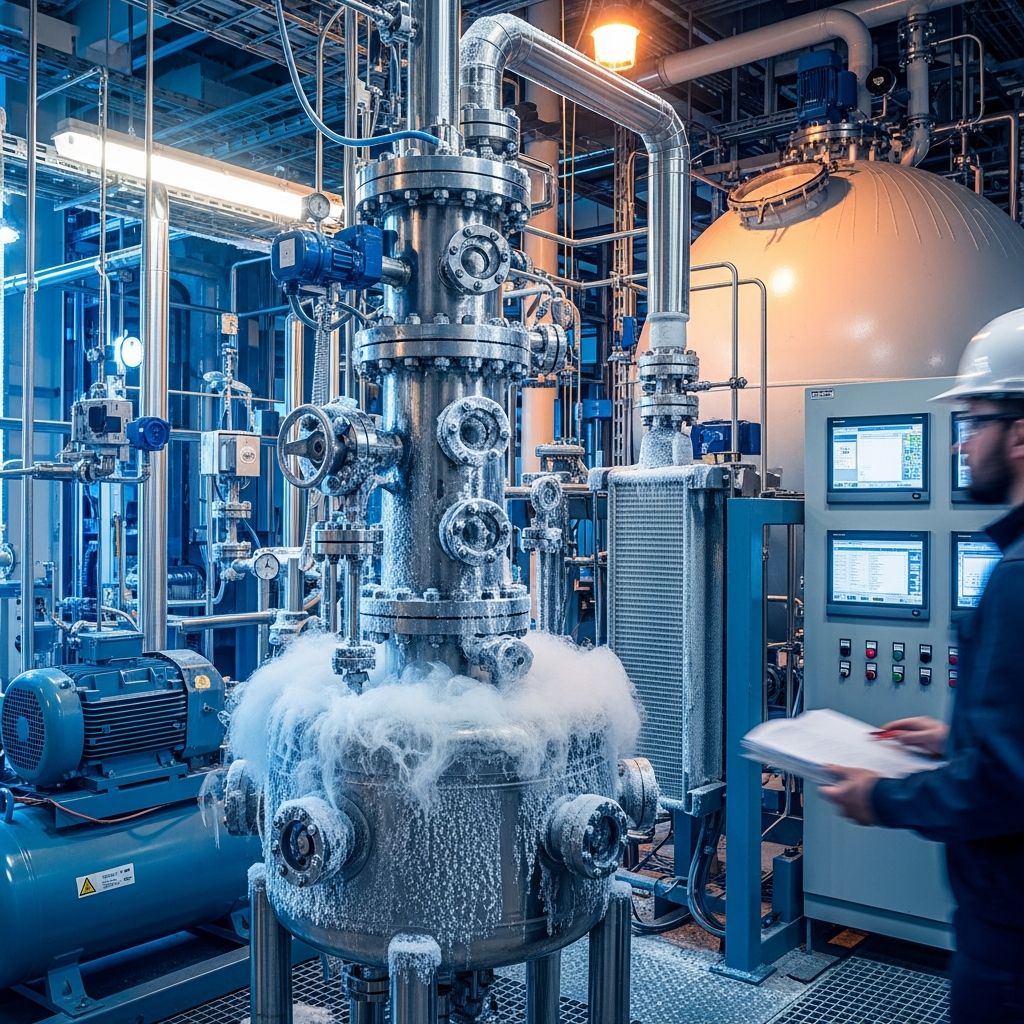
Liquid oxygen, a pale blue cryogenic fluid, forms when oxygen gas cools below its boiling point of -183°C. This substance powers rockets, supports medical applications, and fuels scientific curiosity, but its production demands precision and caution due to extreme cold and reactivity.
Understanding the Science Behind Oxygen Liquefaction
Oxygen exists as 21% of Earth’s atmosphere, making it abundant for extraction. Liquefaction exploits the gas’s critical properties: it transitions to liquid under specific temperature and pressure conditions. At atmospheric pressure, oxygen liquefies at -183°C, slightly warmer than nitrogen’s -196°C, enabling selective separation in air distillation.
The process hinges on the Joule-Thomson effect, where compressed gases cool upon expansion. Industrial plants compress air, remove water and CO2, then cool it progressively until liquefaction occurs. For smaller scales, direct cooling with cryogens like liquid nitrogen suffices.
- Key Physical Properties: Density of 1.141 g/cm³, expansion ratio of 1:861 (gas to liquid), paramagnetic behavior attracting it to magnets.
- Visual Traits: Appears sky-blue due to oxygen molecule absorption in the red spectrum.
Basic Home Production Using Liquid Nitrogen
The most accessible method for enthusiasts involves condensing atmospheric or generated oxygen into liquid nitrogen. This DIY approach requires minimal equipment but strict safety adherence.
Start by generating pure oxygen gas. Decompose 3-6% hydrogen peroxide over manganese dioxide catalyst in a flask: 2H₂O₂ → 2H₂O + O₂. Dry the gas with calcium chloride to remove moisture, then direct it into a test tube submerged in liquid nitrogen within a vacuum-insulated thermos.
Lower the tube slowly to avoid splashing; rapid immersion causes violent boiling. As oxygen condenses, it pools as a clear blue liquid. Expect yields of a few milliliters per session, confirming purity by its magnetic attraction or ignition tests (never pour fuels into it).
| Step | Materials | Tips |
|---|---|---|
| 1. Generate O₂ | H₂O₂, MnO₂, flask | Use dilute peroxide to control heat. |
| 2. Dry gas | CaCl₂ tube | Prevents ice formation in cryogen. |
| 3. Condense | LN₂, test tube, thermos | Slow submersion minimizes boil-off. |
Alternative: Condensing Oxygen from Ambient Air
For pure experimentation, chill a container of air with liquid nitrogen. Oxygen, with its higher boiling point, liquefies first and settles at the bottom as blue droplets amid evaporating nitrogen.
Use styrofoam cups or narrow vessels to trap the denser liquid oxygen. Submerge fully in liquid nitrogen, allowing fractional distillation by natural separation. This yields impure liquid air but demonstrates cryogenics simply. Volumes reduce dramatically as nitrogen vaporizes, leaving concentrated oxygen.
Enhance purity with an oxygen concentrator, which employs pressure swing adsorption to filter ~90% O₂ from air. Feed this into a cryocooler reaching 77K for efficient liquefaction.
Advanced Techniques with Specialized Equipment
Beyond home setups, Stirling cryocoolers or pulse-tube refrigerators enable continuous production. These devices, salvaged from scientific gear, cool oxygen streams to cryogenic temperatures without liquid nitrogen dependency.
Monitor with temperature diodes at the cold head. A steady O₂ flow from a concentrator yields 100ml+ of liquid in under an hour, verified by color and tests. For ultra-pure samples, integrate ozone generators or secondary adsorption, though this escalates complexity.
Industrial-Scale Oxygen Liquefaction
Commercial production fractionally distills liquefied air. Air compresses to 5-10 bar, cools via heat exchangers, and expands in turbines, reaching -200°C. Nitrogen boils off first (-196°C), followed by argon (-186°C), leaving oxygen.
Purity exceeds 99.5% for medical/rocket use. Storage in double-walled, vacuum-insulated tanks prevents heat ingress and expansion.
Critical Safety Protocols for Handling Liquid Oxygen
Liquid oxygen amplifies combustion: ordinary materials like grease, rubber, or clothing ignite fiercely in its presence, generating explosive pressures.
- Contamination Risks: Hydrocarbons oxidize violently, vaporizing LOX and rupturing vessels. Clean containers to oil-free standards.
- Ignition Sources: Ban sparks, flames, or static near operations. Exposed fabrics retain oxygen, burning post-exposure.
- Cryogenic Hazards: Causes severe frostbite; use insulated tools and PPE. Unlike nitrogen, LOX poses no asphyxiation risk due to density.
- Vessel Requirements: Use only LOX-rated materials like stainless steel, free of combustibles.
Never add LOX to unapproved containers. Post-use, allow full evaporation in ventilated areas.
Practical Applications and Experiments
LOX propels spacecraft (e.g., SpaceX Falcon 9) as a storable oxidizer. Medically, it supplies high-purity O₂ for respirators.
Lab demos include quenching glowing splints (reignites in LOX) or levitating magnets via diamagnetism. Fuel droplets explode on contact, illustrating hyperoxia—perform remotely.
Common Challenges and Troubleshooting
| Issue | Cause | Solution |
|---|---|---|
| No liquefaction | Insufficient cooling | Pre-chill thermos; use fresh LN₂. |
| Cloudy liquid | Water impurity | Enhance drying agent. |
| Explosion risk | Fuel contamination | Strict cleaning; no organics. |
Frequently Asked Questions (FAQs)
Is it safe to make liquid oxygen at home?
With precautions, small-scale production is feasible but risky. Prioritize cleanliness and avoid combustibles.
How much liquid oxygen from 1L liquid nitrogen?
Typically 10-50ml, depending on efficiency and purity.
Why is liquid oxygen blue?
O₂ molecules absorb red light, scattering blue.
Can I store it long-term?
Yes, in purpose-built Dewar flasks; evaporation is slow.
What if it contacts skin?
Immediate frostbite; warm gradually, seek medical aid.
Environmental and Regulatory Considerations
LOX production is eco-friendly, recycling atmospheric gases. However, comply with lab safety regs; permits needed for large volumes. Dispose by safe vaporization.
In summary, from simple condensation to industrial distillation, liquid oxygen captivates with its properties and perils. Approach with knowledge and respect.
References
- Liquid Oxygen – Environment, Health, and Safety — Lawrence Berkeley National Laboratory. 2023. https://ehs.lbl.gov/service/chemical-lab-safety/liquid-oxygen/
- Making and playing with Liquid Oxygen — NileRed (YouTube). 2017-10-15. https://www.youtube.com/watch?v=zu7revUCefw
- How To Make Liquid OXYGEN! TKOR Experiments With Homemade — The King of Random (YouTube). 2016-08-20. https://www.youtube.com/watch?v=YJqvN4_2rxE
- Making Liquid Oxygen: Far From Easy But Worth The Effort — Hackaday. 2025-04-09. https://hackaday.com/2025/04/09/making-liquid-oxygen-far-from-easy-but-worth-the-effort/
- How liquid oxygen is produced? — WHO/UNICEF (YouTube). 2021-06-10. https://www.youtube.com/watch?v=Ns1Y_aU30Eg
- Liquid oxygen — Wikipedia. 2026-04-01. https://en.wikipedia.org/wiki/Liquid_oxygen

- Integrated M.A. in Applied Linguistics, University of Hyderabad
- 5+ years in editorial, instructional, SEO, and research-based writing
Sneha is a relationships and lifestyle writer with a strong foundation in applied linguistics and certified training in relationship coaching. She brings over five years of writing experience to theskillvault, crafting thoughtful, research-driven content that empowers readers to build healthier relationships, boost emotional well-being, and embrace holistic living. Her writing and insights reflect the belief that beauty, happiness, and wellness…