
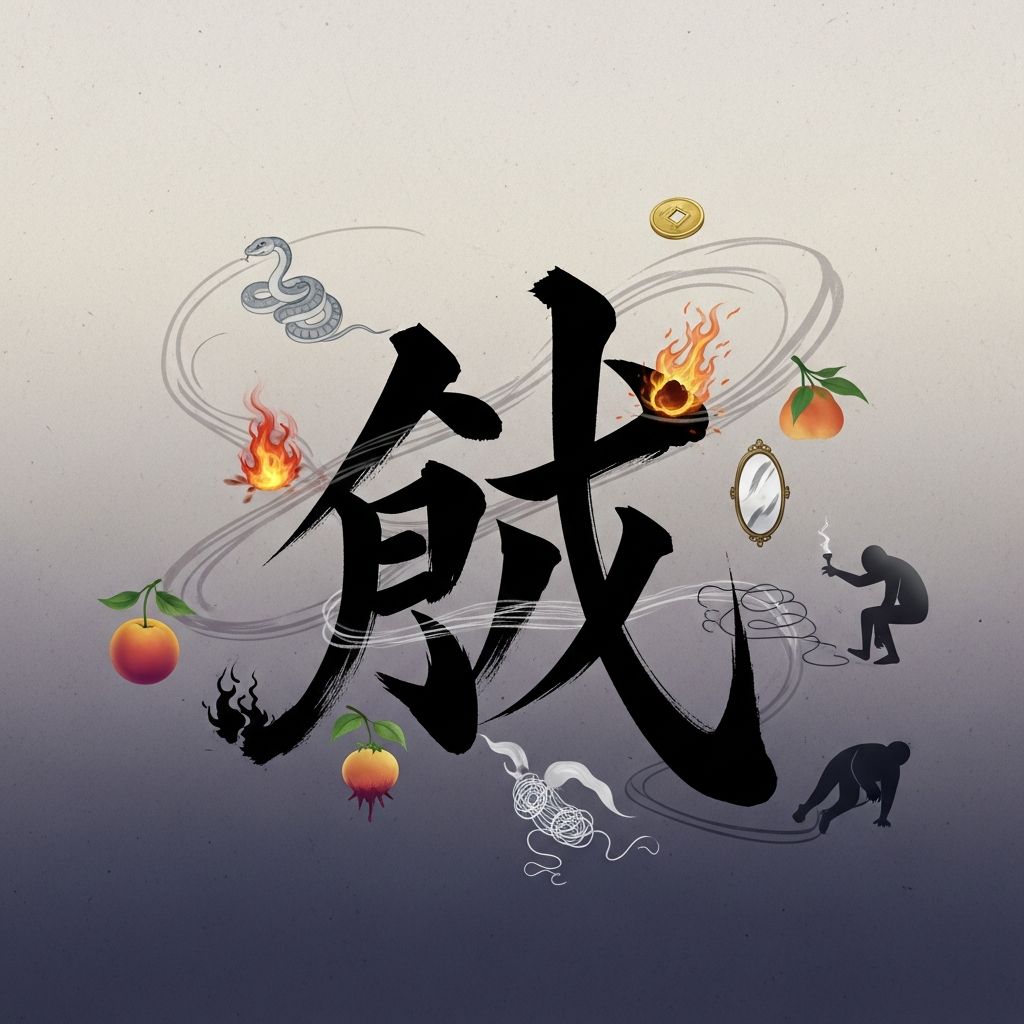
The Seven Deadly Sins, a cornerstone of Christian theology, have found intriguing parallels in Japanese culture through kanji representations. These characters not only convey profound moral concepts but also showcase the artistry of Japanese writing. This guide explores each sin’s kanji form, breaking down stroke orders, readings, and historical nuances to help learners master them.
Understanding the Cultural Bridge
While originating in Western tradition, the Seven Deadly Sins—pride, greed, lust, envy, gluttony, wrath, and sloth—resonate in Japan via adaptations in literature, anime like Nanatsu no Taizai, and philosophical discussions. The term ‘七つの大罪’ (nanatsu no taizai) directly translates to ‘seven great sins,’ using basic kanji like 七 (seven) and 大罪 (great sin). Kanji for individual sins draw from native concepts, blending Shinto, Buddhist, and imported ideas.
Learning these kanji enhances vocabulary for advanced Japanese studies, especially in ethics or pop culture. Each character involves specific stroke counts and orders, crucial for legibility and digital input.
Essential Kanji Building Blocks
Before diving into sins, grasp foundational elements:
- 七 (nana, shichi): Means ‘seven.’ Stroke order: horizontal, then zigzag down. Used in counters like nanatsu (seven items).
- 大 (dai, oo): ‘Big’ or ‘great.’ Three strokes: curve, horizontal, vertical.
- 罪 (zai, tsumi): ‘Sin’ or ‘crime.’ Complex with 13 strokes, starting from top ‘net’ radical.
These form compounds, but individual sins use unique kanji reflecting behaviors.
Pride: The Kanji of Arrogance
Pride, or 傲 (gō), depicts haughty self-elevation. On’yomi: gō; kun’yomi: rare. Stroke order: 1. Dot left. 2. Horizontal. 3-9: 高 (high) radical. 10-14: Heart below.
In sentences: ‘傲慢 (gōman) means arrogance.’ Culturally, pride contrasts bushido humility. Table below shows stroke breakdown:
| Stroke # | Description |
|---|---|
| 1 | Left dot |
| 2 | Top horizontal |
| 3-9 | High structure |
| 10-14 | Bottom heart |
Practice yields elegant writing, vital for calligraphy.
Greed: Grasping the Character
Greed is 貪 (don, tan), from ‘animal desire.’ 18 strokes. Order: Enclosure first, then dog radical inside mouth-like frame.
Compound: 貪欲 (donyoku, greed). In Buddhism, tanha (craving) parallels this. Anime often portrays greedy villains with this kanji trait.
- Reading: Don (Chinese-style), tan (native).
- Usage: Legal texts for avarice crimes.
Lust: Flames of Desire in Kanji
色 (shoku, iro) represents lust, literally ‘color’ implying allure. 6 strokes: Simple dot-horizontal top, then axe-like below.
In compounds: 色欲 (shokuyoku). Erotic literature uses it subtly. Stroke table:
| Stroke | Part |
|---|---|
| 1-2 | Top flag |
| 3-6 | Knife base |
Distinguish from 刀 (knife) by slants.
Envy: The Green-Eyed Kanji
Envy’s 羨 (san, urayamashii) shows ‘missing lamb,’ implying want. 18 strokes: Complex with net, lamb radicals.
Common: 羨ましい (urayamashii, envious). Literature like Genji Monogatari evokes this.
Gluttony: Devouring Excess
暴 (bō, abareru) for gluttony, meaning ‘violent eating.’ 12 strokes: Enclosure with dog and rice bowl.
暴食 (bōshoku). Ties to sumo overindulgence stereotypes, balanced by discipline.
Wrath: Fury’s Fierce Strokes
Wrath is 怒 (do, ikaru). 9 strokes: Heart under slave radical.
怒り (ikari). Samurai codes temper this; modern media amplifies it.
Sloth: Laziness Embodied
Sloth: 怠 (tai, okotaru). 10 strokes: Heart with sickness top.
怠惰 (taida). Contrasts Japanese work ethic.
Stroke Order Mastery Techniques
Practice grids aid perfection. Apps simulate writing. Mnemonics: For 傲, visualize ‘high heart.’
- Daily 10 reps per kanji.
- Trace then freehand.
- Combine into phrases.
Historical Evolution of These Kanji
Kanji evolved from Chinese oracle bones. Sins’ characters adapted post-Heian era, influenced by Christianity via missionaries. Today, in manga like The Seven Deadly Sins, they symbolize power.
Buddhist ‘Three Poisons’ (greed, anger, ignorance) overlap, enriching interpretations.
Practical Applications in Modern Japan
Beyond theology, these appear in psychology texts, games, tattoos. Learning boosts JLPT N2+ levels.
| Sin | Kanji | Strokes | Key Compound |
|---|---|---|---|
| Pride | 傲 | 14 | 傲慢 |
| Greed | 貪 | 18 | 貪欲 |
| Lust | 色 | 6 | 色欲 |
| Envy | 羨 | 18 | 羨望 |
| Gluttony | 暴 | 12 | 暴食 |
| Wrath | 怒 | 9 | 怒り |
| Sloth | 怠 | 10 | 怠惰 |
Frequently Asked Questions (FAQs)
What is the Japanese term for Seven Deadly Sins?
七つの大罪 (nanatsu no taizai), as in the popular manga.
How many strokes in pride’s kanji?
傲 has 14 strokes; follow top-to-bottom rule.
Are these kanji JLPT tested?
Many like 七, 大, 罪 are N5-N3; advanced ones N1.
Differences from Chinese versions?
Japanese use shinjitai simplifications, unique kun readings.
Best resources for practice?
Jisho.org for lookups, Anki for flashcards.
Expanding Your Kanji Repertoire
Pair with virtues’ opposites: humility (謙), generosity (施). Explore radicals: heart (忄) common in emotions.
Calligraphy workshops teach fluid strokes. Digital tools like Kanji Study app provide feedback.
In pop culture, Nanatsu no Taizai popularized these, boosting learner interest.
References
- Definition of 七つの大罪 — JapanDict. Accessed 2026. https://www.japandict.com/%E4%B8%83%E3%81%A4%E3%81%AE%E5%A4%A7%E7%BD%AA
- 七つ Search Results — Jisho.org. Accessed 2026. https://jisho.org/search/%E4%B8%83%E3%81%A4
- 七つ Entry — Wiktionary. Accessed 2026. https://en.wiktionary.org/wiki/%E4%B8%83%E3%81%A4
- The Seven Deadly Sins (manga) — Wikipedia. 2026-04-04. https://en.wikipedia.org/wiki/The_Seven_Deadly_Sins_(manga)

Medha Deb is an editor with a master's degree in Applied Linguistics from the University of Hyderabad. She believes that her qualification has helped her develop a deep understanding of language and its application in various contexts. Medha specializes in the areas of beauty, health, sports, and wellness and is committed to ensuring that the content on the website is…