
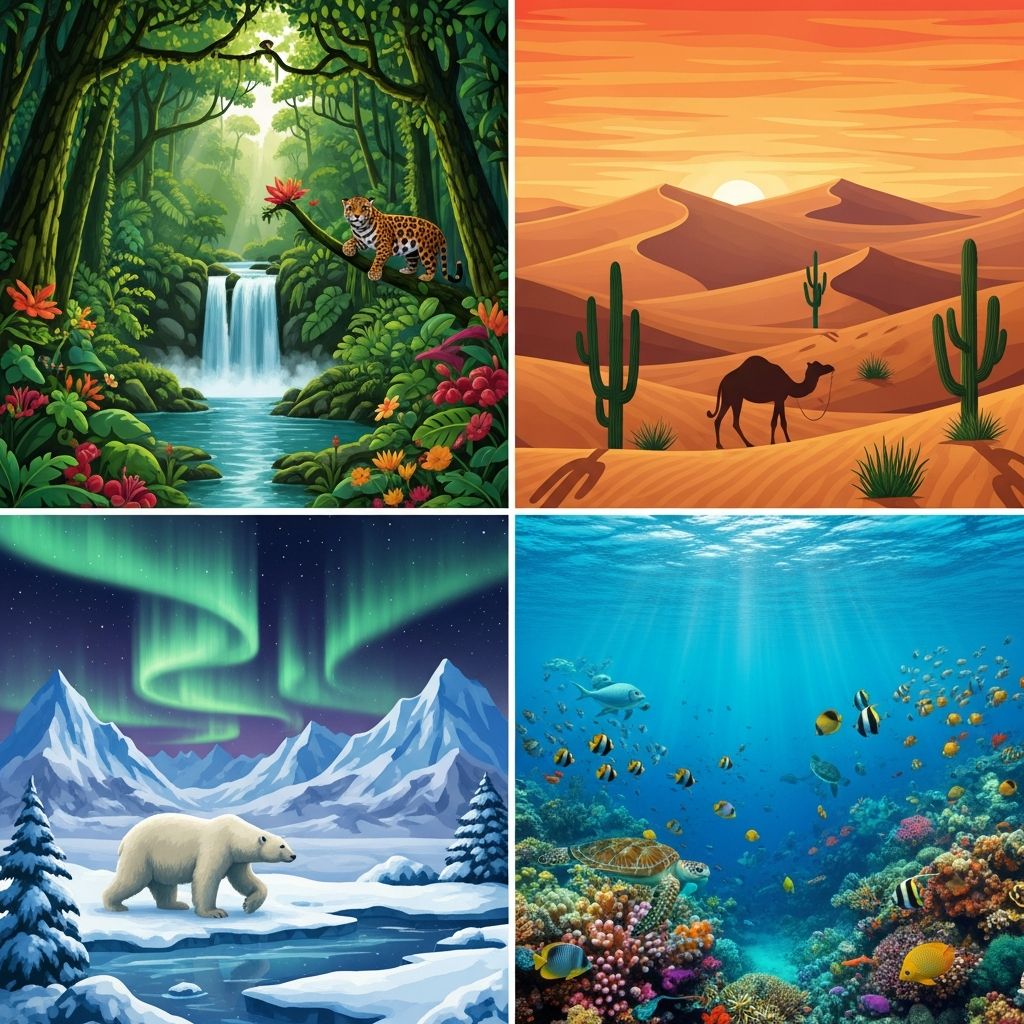
Biomes represent vast expanses of Earth where specific climate patterns, soil conditions, and dominant plant life create unique habitats for communities of animals and microorganisms. These expansive regions, larger than individual ecosystems, provide critical insights into global biodiversity and environmental dynamics.
Defining Biomes in Ecological Terms
A biome constitutes a broad geographic area characterized by consistent environmental features that dictate the types of vegetation and wildlife present. Unlike smaller ecosystems, biomes span continents and are primarily shaped by factors like temperature ranges, annual precipitation levels, and sunlight exposure. Scientists classify them into two primary groups: terrestrial, which cover land surfaces, and aquatic, encompassing water bodies. This division helps in studying how life adapts to varying conditions across the planet.
Understanding biomes is essential for grasping planetary health, as they influence carbon cycling, oxygen production, and species migration patterns. For instance, alterations in one biome can ripple through global weather systems due to interconnected atmospheric influences.
Key Factors Shaping Biome Development
Several abiotic elements drive the formation and sustainability of biomes. Temperature and rainfall stand out as primary influencers, determining whether an area supports dense forests or sparse shrubs. Soil composition further refines these patterns; nutrient-rich loams favor lush growth, while sandy substrates limit it to drought-resistant species.
- Temperature: Affects metabolic rates in plants and animals, with extremes creating specialized adaptations like thick fur in cold zones.
- Precipitation: Dictates water availability, crucial for photosynthesis and hydration.
- Latitude and Altitude: Proximity to equator or elevation mimics climate shifts, producing similar biomes at different locations.
- Soil Quality: Influences nutrient uptake and root systems.
Biotic interactions, such as predation and symbiosis, also refine biome compositions over time.
Major Terrestrial Biomes and Their Traits
Terrestrial biomes dominate land coverage and are often identified by their prevailing vegetation types, which in turn support food webs. Below, we detail the principal categories.
Tropical Rainforests: Biodiversity Hotspots
Found near the equator, these biomes receive over 2000 mm of rain yearly, maintaining temperatures between 17°C and 25°C. Towering trees form a multi-layered canopy, sheltering epiphytes, vines, and understory plants. Fauna includes jaguars, parrots, and countless insect species, making these areas the planet’s most diverse. The Amazon exemplifies this biome, cycling vast amounts of water vapor to influence global rainfall.
Temperate Forests: Seasonal Transformers
These biomes experience distinct seasons with moderate rainfall (750-1500 mm annually) and cooler winters. Deciduous trees shed leaves in fall, while evergreens persist. Wildlife like deer, bears, and owls thrive here. Eastern North America’s forests highlight this type, where leaf litter enriches soils.
Coniferous Forests (Boreal or Taiga): Cold-Resilient Woodlands
Spanning high northern latitudes, taiga features needle-leaved conifers adapted to short summers and long, snowy winters. Precipitation is low to moderate, often as snow. Moose, wolves, and migratory birds inhabit these vast tracts, which store significant carbon. Canada’s boreal forests represent this biome prominently.
Grasslands: Open Expanse of Grasses
With 250-750 mm of rain, grasslands support grasses over trees, ideal for herds of bison, zebras, and predators like lions. Fires and grazing maintain openness. North American prairies and African savannas showcase varieties, aiding soil fertility through root systems.
| Biome | Avg. Temp (°C) | Annual Rain (mm) | Dominant Plants | Key Animals |
|---|---|---|---|---|
| Tropical Rainforest | 17-25 | 2000+ | Broadleaf trees, vines | Monkeys, frogs, birds |
| Temperate Forest | -10 to 25 | 750-1500 | Deciduous trees | Deer, squirrels |
| Taiga | -40 to 20 | 300-850 | Conifers | Moose, bears |
| Grassland | -20 to 30 | 250-750 | Grasses, herbs | Bison, antelope |
| Desert | 20-50 (day) | <250 | Cacti, succulents | Lizards, camels |
| Tundra | -40 to 10 | 150-400 | Mosses, lichens | Caribou, arctic foxes |
Deserts: Arid Survival Zones
Receiving under 250 mm of rain, deserts feature extreme temperature swings. Plants like cacti store water, and animals such as scorpions and roadrunners conserve it efficiently. The Sahara and Sonoran Desert illustrate adaptations to scarcity.
Tundra: Frozen Frontiers
The coldest biome, tundra has permafrost and brief growing seasons. Low shrubs, mosses, and lichens dominate, supporting lemmings and ptarmigans. Arctic and alpine tundras face rapid changes from warming.
Shrublands: Transitional Scrub
These fire-prone areas with mild, wet winters and dry summers host chaparral shrubs and grazing mammals. California’s chaparral exemplifies resilience to periodic blazes.
Aquatic Biomes: Water-Dominated Worlds
Aquatic biomes cover over 70% of Earth and are categorized by salinity: freshwater (rivers, lakes) and marine (oceans, reefs). Light penetration, currents, and nutrient flows define their productivity.
Freshwater Biomes: Rivers, Lakes, and Wetlands
These low-salinity environments host salmon, otters, and aquatic plants. Wetlands filter pollutants and support amphibians. The Great Lakes demonstrate high biodiversity.
Marine Biomes: Oceans and Coastal Zones
Oceans drive global currents, with coral reefs teeming with fish and invertebrates. Estuaries blend fresh and salt water, nurturing migratory birds. The Great Barrier Reef highlights reef complexity.
Productivity Comparison: Freshwater biomes often exceed marine in nutrient density per area, but oceans hold more total biomass.
Biome Interconnectivity and Human Influence
Biomes do not exist in isolation; migrations and weather patterns link them. Human activities like deforestation and urbanization fragment habitats, leading to biodiversity loss. Conservation efforts, such as protected reserves, aim to preserve these vital zones. Climate change shifts biome boundaries, with tundras greening and deserts expanding.
Frequently Asked Questions (FAQs)
What is the difference between a biome and an ecosystem?
A biome is a large-scale regional unit with similar climates and life forms across vast areas, while an ecosystem is a smaller, specific community of organisms interacting with their environment.
Which biome has the highest biodiversity?
Tropical rainforests host the greatest species diversity due to stable warmth and moisture.
How many major biomes are there?
Typically, 8-10 terrestrial and several aquatic types are recognized, varying by classification schemes.
Can biomes change over time?
Yes, through natural succession or human-induced shifts like global warming.
Why study biomes?
They reveal adaptation strategies and inform conservation amid environmental threats.
References
- Biome Definition, Types & Examples — Study.com. 2023-10-15. https://study.com/academy/lesson/what-is-a-biome-definition-types-quiz.html
- Biomes – Definition, Meaning, Example, Type — GeeksforGeeks. 2024-05-20. https://www.geeksforgeeks.org/biology/biome-definition-meaning-example-type/
- What Is A Biome? Definition, Types and Examples — Global Bioenergy Partnership. 2023-08-12. https://www.globalbioenergy.org/biome-definition/
- Biome — Wikipedia (referencing primary ecological classifications). 2026-04-01. https://en.wikipedia.org/wiki/Biome

Medha Deb is an editor with a master's degree in Applied Linguistics from the University of Hyderabad. She believes that her qualification has helped her develop a deep understanding of language and its application in various contexts. Medha specializes in the areas of beauty, health, sports, and wellness and is committed to ensuring that the content on the website is…