
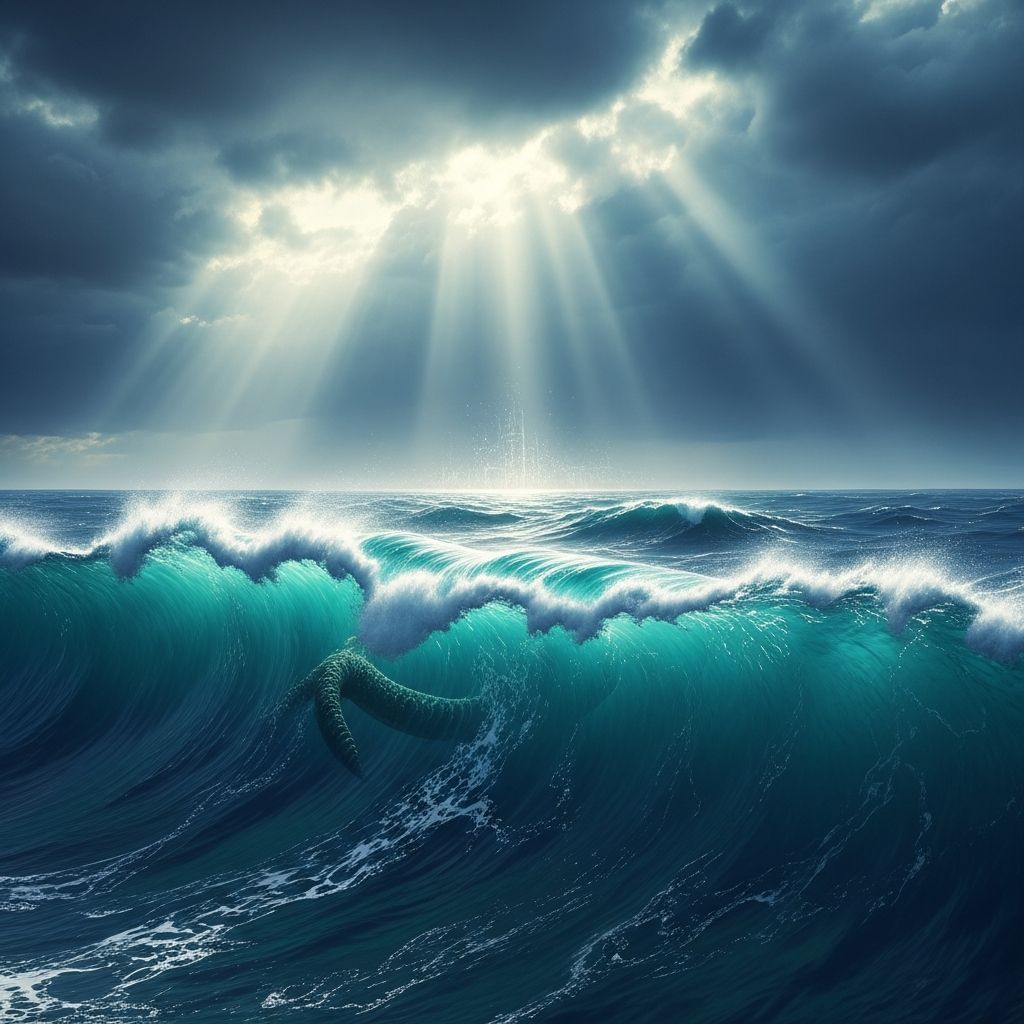
The phrase ‘Seven Seas’ evokes images of boundless adventure, ancient mariners charting unknown waters, and the timeless allure of the ocean. Far from referring to a fixed set of seven specific bodies of water, this term has morphed over millennia, reflecting the geographical knowledge, cultural priorities, and exploratory ambitions of different societies. Its origins trace back thousands of years, and today it stands as a metaphor for the entirety of the world’s oceans.
Ancient Origins: From Sumer to the Classical World
The earliest recorded mention of the Seven Seas appears in a Sumerian hymn around 2300 B.C., composed by Enheduanna, high priestess to the goddess Inanna. This poetic reference symbolized vastness and divine power rather than literal geography. In Persian lore, the term described the streams feeding the Oxus River (modern Amu Darya), highlighting local hydrology’s mythic importance.
Roman interpretations localized it further. The septem maria denoted seven saltwater lagoons near Venice, separated by sandbanks from the Adriatic. This practical designation underscored Rome’s Mediterranean dominance. Phoenician traders, masters of commerce, identified their Seven Seas within the Mediterranean basin: Alboran, Balearic, Ligurian, Tyrrhenian, Ionian, Adriatic, and Aegean Seas. These routes fueled trade in raw materials and markets across the ancient world.
Medieval Maritime Visions: Greek, Roman, and Arab Perspectives
During the medieval period, Greek and Roman influences shaped a broader definition. The Seven Seas encompassed the Adriatic, Mediterranean (including Aegean), Black, Caspian, Persian Gulf, Arabian Sea, and Red Sea—sometimes extending to the Dead Sea and Sea of Galilee. This lineup mirrored the known world from Europe to Asia.
Arab explorers and traders, venturing eastward from the 9th century, redefined it through their commerce networks. Ya’qubi, a notable geographer, listed the Persian Gulf, Gulf of Khambhat, Bay of Bengal, Strait of Malacca, Singapore Strait, Gulf of Thailand, and South China Sea. These waters were vital for spice trade and Islamic expansion post-Muhammad. Venetian sailors adopted a similar flourish, using ‘sailing the seven seas’ to boast nautical prowess long before oceanic voyages.
| Culture | Seven Seas Listed |
|---|---|
| Greek/Roman | Adriatic, Mediterranean/Aegean, Black, Caspian, Persian Gulf, Arabian, Red Sea |
| Arab Traders | Persian Gulf, Gulf of Khambhat, Bay of Bengal, Malacca Strait, Singapore Strait, Gulf of Thailand, South China Sea |
| Venetian | Mediterranean lagoons and regional seas (figurative) |
This table illustrates how cultural lenses shaped the term, prioritizing navigable trade paths over global consistency.
The Age of Discovery: Expanding Horizons to the Americas
The 15th-17th century Age of Discovery transformed the Seven Seas yet again. As Europeans like Columbus and Magellan crossed the Atlantic, the list incorporated New World waters. Common groupings included the Arctic, Atlantic, Indian, and Pacific Oceans, plus the Mediterranean, Caribbean Sea, and Gulf of Mexico. Alternative sets added the Red Sea, Persian Gulf, China Sea, and African coastal waters, blending old and new.
This era marked a shift from regional seas to oceanic scales, driven by colonial ambitions and technological advances in navigation. The phrase began symbolizing ultimate seafaring achievement, a badge for those who had ‘conquered’ the globe’s major waters.
Eastern Traditions: Hindu and Symbolic Interpretations
Beyond Western narratives, Hindu cosmology offers a profound take. In Vaishnavism, the Seven Seas encircle seven Dvipas (island-continents) formed by Priyavrata’s chariot wheels, as described in texts like the Yoga Vasistha. They represent life’s vast challenges, spiritual quests, interconnectedness, and earthly diversity.
- Vastness: Symbolizing infinite exploration and barriers.
- Diversity: Encompassing varied beings and resources.
- Spiritual Depth: Metaphors for personal growth amid oceanic trials.
These seas embody not just geography but philosophical infinity, influencing Indian maritime history and poetry.
Modern Definitions: Oceans, Seas, and Figurative Legacy
Today, with over 50 recognized seas—defined as ocean divisions partially enclosed by land—the Seven Seas is largely idiomatic. Precise modern lists divide the world’s oceans into seven equators:
- North Atlantic Ocean
- South Atlantic Ocean
- North Pacific Ocean
- South Pacific Ocean
- Indian Ocean
- Arctic Ocean
- Southern (Antarctic) Ocean
Looser versions retain historical flavors: Pacific, Atlantic, Indian, Arctic Oceans, Mediterranean, Caribbean, and Gulf of Mexico. Notably, endorheic basins like the Caspian (world’s largest lake) and Dead Sea blur lines, as they lack ocean outlets yet featured in ancient lists.
The phrase persists in culture, denoting worldly experience. ‘Sailing the seven seas’ adorns tattoos, novels, and sailor lore, romanticizing adventure amid globalization.
Cultural and Linguistic Impact Worldwide
The Seven Seas motif permeates idioms globally. In English, it signifies comprehensive travel; Venetians used it pre-oceans for bravado. Arabic Buhair as-Saba’a evokes eastern trade epics. Hindu symbolism inspires art depicting cosmic voyages.
In literature, from Homer’s epics to Melville’s Moby-Dick, it underscores human insignificance against nature’s might. Modern media, like Disney’s Sinbad tales, perpetuate the legend, blending history with fantasy.
Navigational and Scientific Relevance Today
Contemporary oceanography builds on this legacy. Dividing oceans aids climate modeling, as the seven-part system tracks currents like the Gulf Stream (North Atlantic) or Antarctic Circumpolar Current (Southern Ocean). Understanding these ‘seas’ informs biodiversity, with the deep Pacific hosting unique ecosystems.
Exploration continues: submersibles probe abyssal zones, echoing ancient quests. The term inspires STEM education, teaching hydrography— the science of surveying seas.
Frequently Asked Questions (FAQs)
What is the origin of the term ‘Seven Seas’?
It first appeared in a 2300 B.C. Sumerian hymn, evolving as a metaphor for known waters across cultures.
Did the Seven Seas ever refer to exactly seven fixed bodies?
No; lists varied by era and region, from Mediterranean gulfs to global oceans.
How many seas exist worldwide today?
Over 50, per definitions of partially enclosed ocean divisions; lakes like Caspian complicate counts.
What do the Seven Seas symbolize in Hinduism?
Vastness, life’s challenges, spiritual journeys, and Earth’s diversity around seven continents.
Is ‘sailing the seven seas’ a literal achievement?
Figurative; it means extensive global seafaring experience.
This exploration reveals the Seven Seas as a dynamic cultural artifact, adapting to humanity’s expanding worldview. From clay tablets to satellite maps, it captures our enduring fascination with the blue unknown.
References
- What Are the Seven Seas? — Live Science. 2013-05-28. https://www.livescience.com/27663-seven-seas.html
- Seven Seas — Wikipedia. 2023-10-15. https://en.wikipedia.org/wiki/Seven_Seas
- Seven Seas: Significance and Symbolism — Wisdom Library. N/A. https://www.wisdomlib.org/concept/seven-seas
- The Seven Seas: A Sailing Legend — San Diego Sailing Tours. 2022-08-10. https://sandiegosailingtours.com/the-seven-seas-a-sailing-legend/
- What Are the Seven Seas? — Mental Floss. 2016-07-12. https://www.mentalfloss.com/article/54607/what-are-seven-seas
- What are the seven seas? — Library of Congress. 2024-01-22. https://www.loc.gov/everyday-mysteries/item/what-are-the-seven-seas
- SAIL THE SEVEN SEAS OCEANS OF THE WORLD — Elizabeth Swann. N/A. https://www.elizabethqueenseaswann.com/Seven_Seas_Sail_The_Oceans.html

Medha Deb is an editor with a master's degree in Applied Linguistics from the University of Hyderabad. She believes that her qualification has helped her develop a deep understanding of language and its application in various contexts. Medha specializes in the areas of beauty, health, sports, and wellness and is committed to ensuring that the content on the website is…