
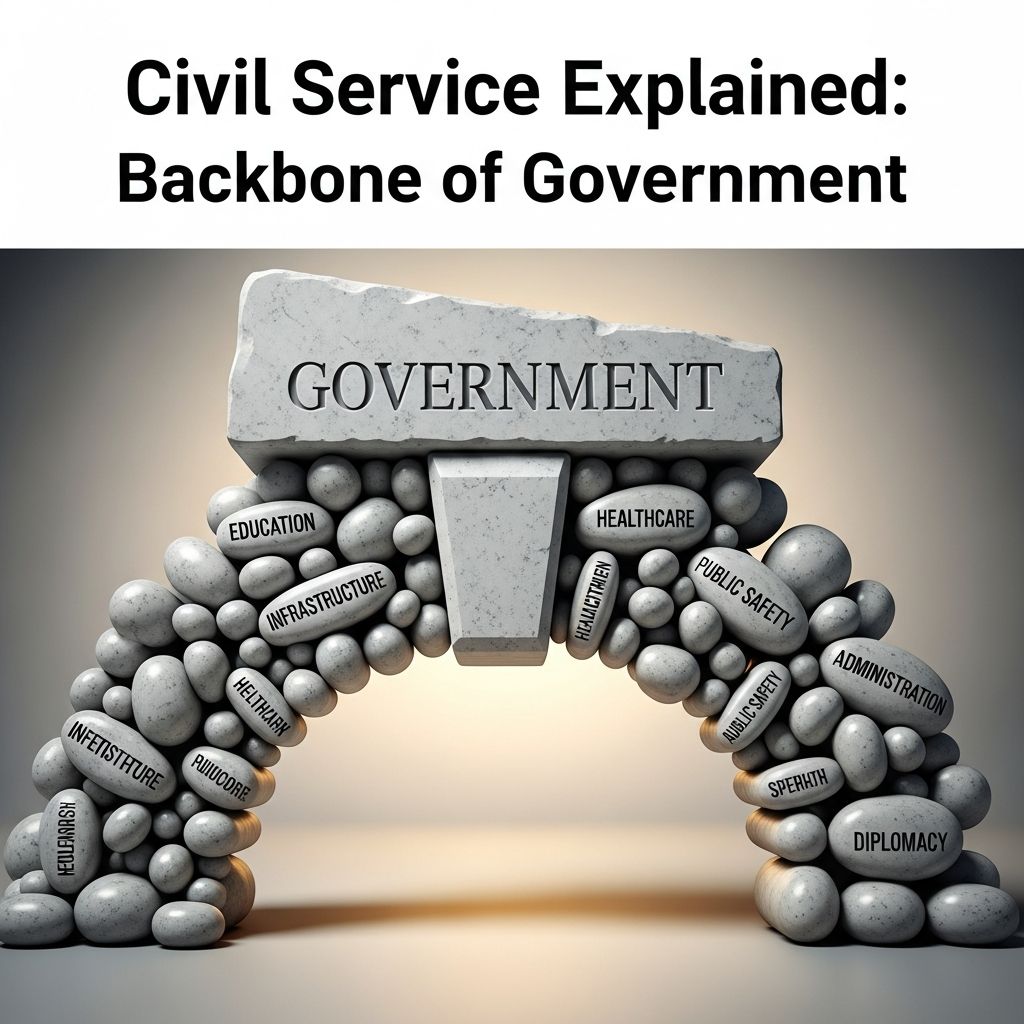
The civil service forms the permanent, professional workforce that executes government policies and delivers essential public services, distinct from elected or political appointees. It operates on principles of merit, neutrality, and continuity, ensuring governance stability regardless of political changes.
Core Principles and Definition
At its heart, the civil service comprises career professionals hired into non-political, non-judicial government roles at federal, state, local, or municipal levels. These public servants manage daily operations, implement laws, and provide services like infrastructure maintenance, welfare programs, and security. Unlike politicians, civil servants prioritize expertise over allegiance, selected via competitive exams or assessments to promote fairness and competence.
This merit-based system emerged to combat patronage, where jobs were rewards for political loyalty. Today, it embodies impartiality: civil servants advise policymakers without bias and execute decisions efficiently.
Historical Development Worldwide
The modern civil service traces roots to ancient empires like China’s Han Dynasty (206 BCE–220 CE), which used exams for bureaucratic selection. In Europe, Britain’s 1854 Northcote-Trevelyan Report formalized merit recruitment, influencing global models.
In the United States, the 1883 Pendleton Civil Service Reform Act ended the ‘spoils system’ post-President Garfield’s assassination by a disgruntled office-seeker. It mandated exams for federal hires, expanding to cover most positions by the 20th century. Similar reforms shaped systems in India (via 1853 British model) and France (post-Revolution concours exams).
Key Functions and Responsibilities
Civil servants fulfill protective and facilitative roles critical to society. Protective duties include law enforcement support, public health safeguards, and environmental protection, ensuring citizen safety and order.
Facilitative functions cover infrastructure (roads, utilities), economic development (trade promotion), and social welfare (programs like Social Security or SNAP). They also handle budgeting, policy analysis, and program delivery.
- Policy Implementation: Turning legislation into action, e.g., rolling out healthcare reforms.
- Administrative Management: Overseeing budgets, human resources, and operations.
- Public Service Delivery: Managing schools, hospitals, and utilities.
- Advisory Roles: Providing data-driven insights to elected leaders.
Structure and Levels of Operation
Civil services vary by jurisdiction but typically span hierarchies from entry-level clerks to senior executives. In the U.S., the federal civil service employs about 2.2 million, with 70% in defense/security, stable since the 1960s despite population growth.
State and local levels add millions more, handling education, policing, and zoning. Globally, the UK civil service excludes military/police in core definitions, focusing on ministries. Some nations broaden it to include teachers and health workers.
| Level | Examples of Roles | Typical Responsibilities |
|---|---|---|
| Federal/National | Diplomats, analysts, park rangers | National policy, security, inter-agency coordination |
| State/Provincial | Highway engineers, welfare caseworkers | Regional infrastructure, social services |
| Local/Municipal | City planners, librarians, firefighters (support) | Community services, zoning, public safety admin |
Recruitment and Career Progression
Entry relies on merit: exams test knowledge, skills, and aptitude, followed by interviews and background checks. U.S. Office of Personnel Management (OPM) oversees federal hiring; states have commissions.
Careers advance via performance, training, and seniority. Specialized tracks exist for experts like scientists or lawyers. Pensions and job security incentivize long-term service.
- Application: Submit via portals, highlighting qualifications.
- Examination: Written/oral tests on relevant topics.
- Selection: Ranked lists feed vacancies.
- Probation: 1-2 years to prove fit.
- Promotion: Competitive or automatic based on service.
Global Variations and Comparisons
No universal model exists. Britain’s emphasizes political neutrality; France’s grands corps trains elites via rigorous concours. Developing nations often reform for efficiency, per GSDRC guidelines.
| Country | Key Features | Size/Notes |
|---|---|---|
| USA | Merit exams post-1883; 2.2M federal | Excludes uniformed services |
| UK | Neutral, permanent; excludes military | Core administrative arm |
| China | Exam-based since ancient times | Massive scale, party oversight |
| India | UPSC exams; All-India Services | Colonial legacy |
Challenges Facing Modern Civil Services
Despite strengths, issues persist: politicization erodes neutrality; budget cuts reduce capacity; tech demands new skills. Aging workforces and diversity gaps challenge recruitment.
Reforms focus on agility, digital tools, and inclusion. The U.S. saw Schedule F proposals (2020) to ease firing, sparking neutrality debates.
Career Opportunities and Preparation
Aspiring civil servants pursue degrees in public administration, law, or security studies. Programs like ECU’s BS in Security Studies prepare for roles.
- Benefits: Stability, pensions, public impact.
- Skills Needed: Analysis, communication, ethics.
- Entry Points: Internships, fellowships like Presidential Management.
With governments expanding services, demand grows for tech-savvy professionals.
Frequently Asked Questions (FAQs)
What is the main difference between civil service and political appointments?
Civil service roles are permanent, merit-based positions focused on execution; political appointments are temporary, loyalty-driven advisory posts.
How many people work in the U.S. federal civil service?
Approximately 2.2 million civilian employees, stable since the 1960s.
Do civil servants lose jobs when governments change?
No, their tenure survives elections, ensuring continuity.
What exams are required for civil service jobs?
Competitive tests assessing knowledge, skills, and sometimes physical/ background checks, varying by level and role.
Is military service part of civil service?
Typically excluded; civil service focuses on civilian administrative roles.
References
- Civil Service: Understanding Its Legal Definition and Role — US Legal Forms. 2023. https://legal-resources.uslegalforms.com/c/civil-service
- About the civil service — GSDRC. 2023. https://gsdrc.org/topic-guides/civil-service-reform/concepts-t/concepts-about-the-civil-service/
- Civil Service Definition & Meaning — Dictionary.com. 2023. https://www.dictionary.com/browse/civil-service
- What Is the Civil Service? Definition and Careers — East Carolina University Online. 2023. https://onlineprograms.ecu.edu/blog/civil-service-definition/
- Civil service — Britannica. 2025-10-15. https://www.britannica.com/topic/civil-service
- The civil service, explained — Protect Democracy. 2023. https://protectdemocracy.org/work/the-civil-service-explained/
- Civil Service – Wikipedia (informational) — Wikipedia. 2026. https://en.wikipedia.org/wiki/Civil_service

Medha Deb is an editor with a master's degree in Applied Linguistics from the University of Hyderabad. She believes that her qualification has helped her develop a deep understanding of language and its application in various contexts. Medha specializes in the areas of beauty, health, sports, and wellness and is committed to ensuring that the content on the website is…