
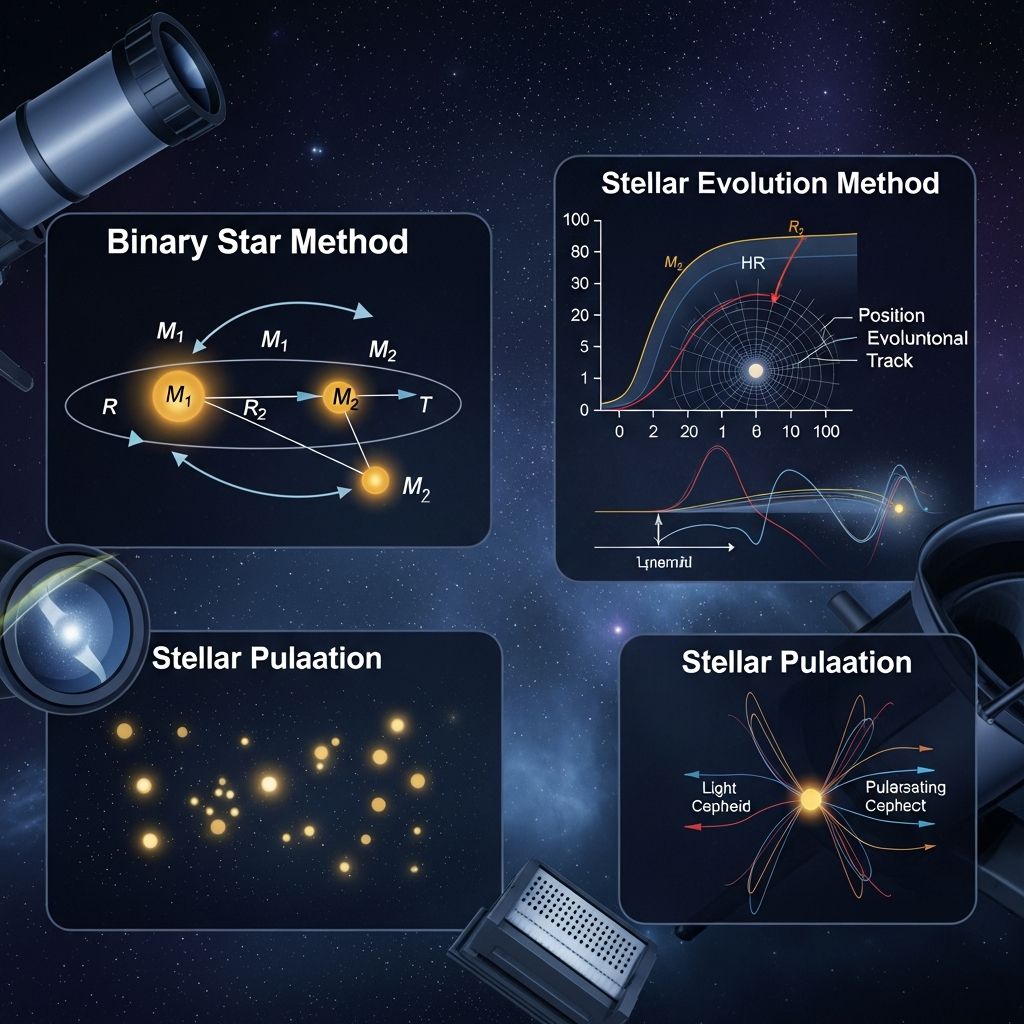
Determining the mass of a star is fundamental to understanding its life cycle, evolution, and role in the universe. Unlike size or temperature, which can be observed directly through light, mass requires indirect measurements based on gravitational interactions. Astronomers rely on systems where stars influence each other or orbiting companions, applying laws of physics like gravity and orbital mechanics.
Why Stellar Mass Matters in Astrophysics
The mass of a star dictates nearly every aspect of its behavior. More massive stars burn fuel faster, live shorter lives, and explode as supernovae, while lower-mass stars like red dwarfs endure for trillions of years. Mass influences luminosity, radius, and even the types of elements forged in a star’s core. Without accurate mass estimates, models of star formation, galactic dynamics, and cosmology would falter.
Binary Star Systems: The Gold Standard for Mass Measurement
Binary stars—two stars orbiting a common center of mass—provide the most reliable way to calculate individual stellar masses. These systems are abundant, making up about half of all stars in the Milky Way. By observing their orbital dance, astronomers extract precise mass values in solar units, where one solar mass equals 1.989 × 1030 kg.
In a binary system, the stars’ motion around the barycenter (center of mass) follows Newton’s law of gravitation. The key relationship is that the more massive star orbits closer to the barycenter. If star A has mass M1 and star B has M2, their distances from the center satisfy M1a1 = M2a2, where a1 and a2 are the semi-major axes of their orbits.
Applying Kepler’s Third Law to Binaries
Johannes Kepler’s third law, adapted for binaries, states that the total mass (M1 + M2) equals the cube of the semi-major axis (a in AU) divided by the square of the orbital period (P in years): (M1 + M2) = a3 / P2. This simplified form assumes solar units, making calculations straightforward.
For visual binaries, where both stars are resolvable, astronomers measure a and P directly. Spectroscopic binaries reveal radial velocities via Doppler shifts, allowing inference of orbital speeds and inclinations.
Example: Unraveling the Sirius Binary System
Consider Sirius, the brightest star in the night sky, and its white dwarf companion Sirius B. Their semi-major axis is 19.8 AU, and orbital period is 50.1 years. Plugging into Kepler’s law: total mass = (19.8)3 / (50.1)2 ≈ 7762 / 2510 ≈ 3.09 solar masses. Observations show Sirius B orbits twice as far from the barycenter as Sirius A, implying Sirius A is about twice as massive, roughly 2.06 solar masses, and Sirius B 1.03 solar masses.
| Parameter | Value | Unit |
|---|---|---|
| Semi-major axis (a) | 19.8 | AU |
| Orbital period (P) | 50.1 | years |
| Total mass | 3.09 | M⊙ |
| Sirius A mass | ~2.06 | M⊙ |
| Sirius B mass | ~1.03 | M⊙ |
Exoplanet Orbits: Probing Host Star Masses
When a star hosts detectable planets, their orbits offer another mass probe. Kepler’s third law for planetary systems is T2 / a3 = 4π2 / (G Ms), where T is the planet’s period, a its semi-major axis, and Ms the star’s mass. For a single planet, knowing T and a yields Ms directly, assuming the planet’s mass is negligible.
Multi-planet systems enhance accuracy. Plotting log(T2) vs. log(a3) gives a line with slope 4π2 / (G Ms). From the slope, solve Ms = 4π2 / (G × slope), converting units carefully (e.g., seconds and meters).
Step-by-Step Calculation from Planetary Data
- Step 1: Identify units for T (e.g., years to seconds) and a (e.g., AU to meters).
- Step 2: For multiple planets, fit a line to T2 vs. a3 data and find the slope.
- Step 3: Compute Ms = 4π2 / (G × slope), with G = 6.67 × 10⁻¹¹ m3 kg-1 s-2.
- Step 4: Verify with individual planet data for consistency.
Example: A planet with T = 4.13 × 10⁸ s and a = 1 million miles (converted to ~1.61 × 10¹² m) yields Ms ≈ 3.18 × 1030 kg or 1.6 solar masses.
Spectroscopic Binaries and Doppler Insights
Not all binaries are visually separable; many are detected via spectroscopy. Light from each star shifts due to orbital motion—blueshift approaching, redshift receding. The velocity semi-amplitude K relates to mass via M sin i = (P / 2π G) (K3 P)1/2, where i is inclination. For edge-on systems (i=90°), sin i =1, giving true masses.
Combined with visual data or light curves, these yield individual masses. Eclipsing binaries, where stars transit, provide i directly, boosting precision.
Alternative Approaches for Single Stars
For isolated stars, direct mass is elusive, but proxies help. The mass-luminosity relation for main-sequence stars links mass to brightness: L ∝ M3.5. Asteroseismology analyzes pulsations to infer internal density and mass. Interferometry measures diameters, and with temperature, yields radius for density estimates.
| Mass (M⊙) | Luminosity (L⊙) | Spectral Type |
|---|---|---|
| 0.1 | 0.0006 | M |
| 1.0 | 1 | G (Sun) |
| 15 | 10,000 | O |
Challenges and Precision in Modern Observations
Measuring stellar masses faces hurdles like distance uncertainties, orbital inclinations, and limb darkening in spectra. Space telescopes like Gaia provide parallaxes and positions, refining a and P. Radial velocity surveys (e.g., via HARPS) detect thousands of exoplanets, yielding host star masses statistically.
Recent advances include gravitational microlensing, where a star’s gravity lenses background light, revealing mass from Einstein radius timing.
Frequently Asked Questions
What is the most accurate way to measure a star’s mass?
Binary star systems, especially visual or eclipsing spectroscopic ones, offer the highest precision by directly applying Kepler’s laws to observed orbits.
Can we measure the mass of the Sun using these methods?
Yes, Earth’s orbit around the Sun gives its mass via Kepler’s law: 1 M⊙ = a3 / P2 with a=1 AU, P=1 year.
How do exoplanets help determine star masses?
Planetary orbital periods and semi-major axes follow Kepler’s third law, allowing isolation of the star’s mass when planet mass is negligible.
What units are used for stellar masses?
Solar masses (M⊙), where 1 M⊙ = 1.989 × 1030 kg, standardizing comparisons.
Are there limits to these mass measurement techniques?
Yes, isolated stars require indirect methods like mass-luminosity relations, which are less precise for evolved or non-main-sequence stars.
Future Directions in Stellar Mass Determination
Upcoming missions like PLATO and TESS will expand exoplanet catalogs, refining host masses. Gravitational wave detectors may reveal masses of merging neutron stars from progenitor stars. Machine learning on vast datasets promises automated, high-fidelity extractions from complex spectra and light curves.
These tools not only calibrate stellar evolution models but also inform exoplanet habitability—stars too massive sterilize worlds with radiation, too light fail to ignite fusion.
References
- Calculating the Mass of a Star from Experimental Data from its Planets’ Orbits — Study.com. 2023. https://study.com/skill/learn/calculating-the-mass-of-a-star-from-experimental-data-from-its-planets-orbits-explanation.html
- How do astronomers measure the size and mass of stars? — Sky at Night Magazine. 2023-05-12. https://www.skyatnightmagazine.com/space-science/how-measure-size-mass-stars
- How To Calculate The Mass Of A Star — YouTube (Astronomy video). 2022. https://www.youtube.com/watch?v=YrTmSHy9AyE
- The mass of a star is determined from binary star systems — EarthSky. 2023-10-15. https://earthsky.org/space/how-astronomers-learn-the-masses-of-double-stars/
- Lecture 10: How Massive is a Star? — Ohio State University Astronomy. 2023. https://www.astronomy.ohio-state.edu/ryden.1/ast162_2/notes10.html
- Measuring Stellar Masses — Lumen Learning (SUNY Astronomy). 2024-01-20. https://courses.lumenlearning.com/suny-astronomy/chapter/measuring-stellar-masses/

- Integrated M.A. in Applied Linguistics, University of Hyderabad
- 5+ years in editorial, instructional, SEO, and research-based writing
Sneha is a relationships and lifestyle writer with a strong foundation in applied linguistics and certified training in relationship coaching. She brings over five years of writing experience to theskillvault, crafting thoughtful, research-driven content that empowers readers to build healthier relationships, boost emotional well-being, and embrace holistic living. Her writing and insights reflect the belief that beauty, happiness, and wellness…