
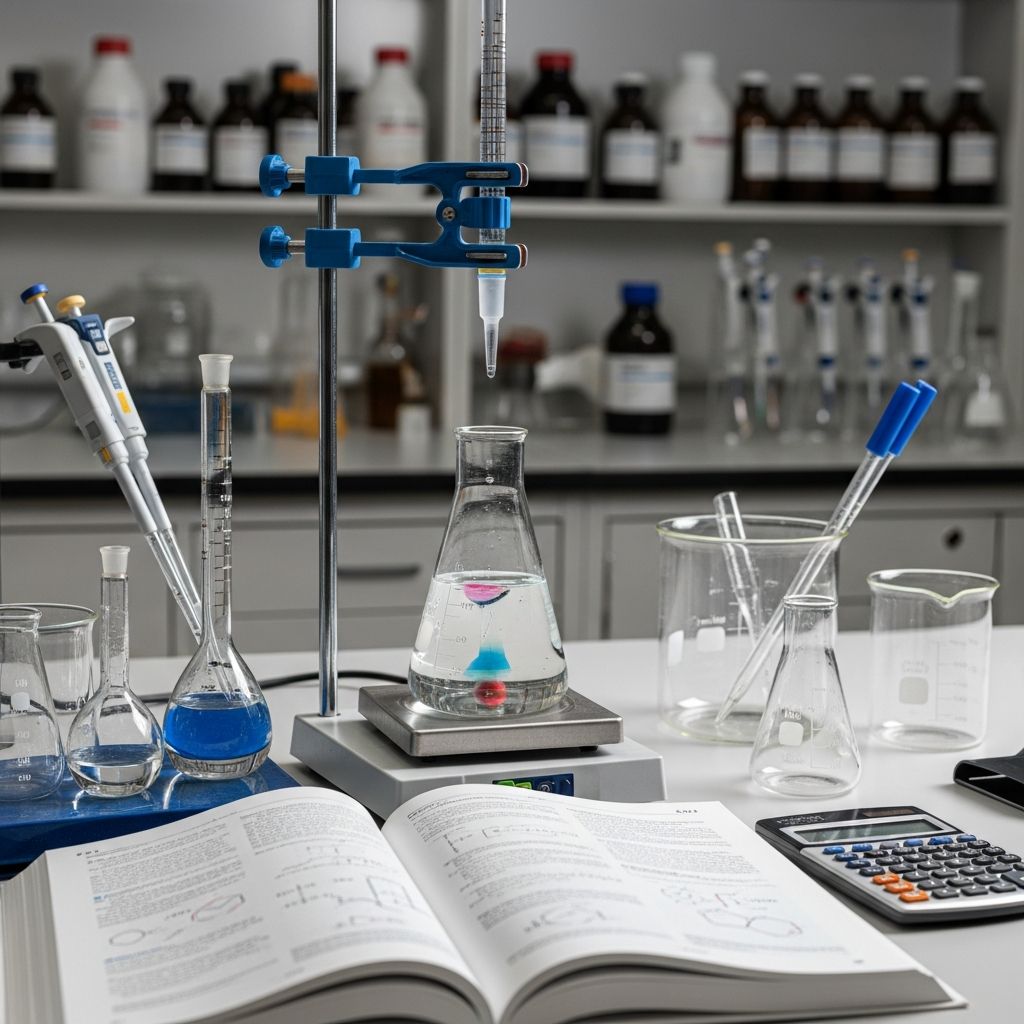
Normality stands as a fundamental measure of solution concentration in chemistry, particularly useful in reactions involving acids, bases, and redox processes. Unlike molarity, which counts moles per liter, normality quantifies equivalents per liter, making it ideal for stoichiometric balancing in titrations.
Understanding Concentration Measures: From Molarity to Normality
In chemical analysis, expressing a solution’s strength accurately is crucial. Molarity (M) defines moles of solute per liter of solution, but it doesn’t directly reflect reactive capacity. Normality (N), on the other hand, accounts for the number of reactive units, or equivalents, per liter. An equivalent represents the amount of substance that supplies or accepts one mole of electrons, protons, or hydroxide ions, depending on the reaction type.
This distinction arises because many compounds, like sulfuric acid (H₂SO₄), donate multiple protons. A 1 M H₂SO₄ solution is 2 N because each molecule provides two H⁺ ions. Normality simplifies calculations in analytical procedures where reaction stoichiometry matters most.
The Core Formula for Normality
The basic equation for normality is straightforward: N = (number of equivalents of solute) / (volume of solution in liters). Equivalents are calculated as mass of solute divided by its equivalent weight (EW).
Equivalent weight depends on the substance and reaction:
- Acids: EW = molecular weight (MW) / number of H⁺ ions donated (basicity).
- Bases: EW = MW / number of OH⁻ ions or H⁺ accepted (acidity).
- Salts: EW = MW / total positive charge of cations.
- Redox agents: EW = MW / number of electrons transferred (n-factor).
Thus, the full formula becomes N = (mass / EW) / volume (L), or equivalently, N = (molarity × n-factor), where n-factor is equivalents per mole.
Step-by-Step Guide to Compute Normality
Follow these steps to determine normality reliably:
- Identify the solute and reaction type to find the n-factor (e.g., H₂SO₄ → 2 for complete neutralization).
- Calculate equivalent weight: EW = MW / n-factor. Use periodic table values for atomic masses.
- Measure mass of solute in grams.
- Determine solution volume in liters (convert mL by dividing by 1000).
- Apply the formula: Equivalents = mass / EW; N = equivalents / volume.
For quick checks, online tools like normality calculators automate this, inputting mass, EW, and volume.
Practical Examples Across Chemical Types
Let’s apply these concepts with diverse worked problems.
Acid Normality: Sulfuric Acid Solution
Calculate normality for 4 g of H₂SO₄ in 500 mL water. MW of H₂SO₄ = 98 g/mol; n-factor = 2 (two H⁺).
EW = 98 / 2 = 49 g/eq.
Equivalents = 4 / 49 ≈ 0.0816 eq.
Volume = 0.5 L.
N = 0.0816 / 0.5 = 0.163 N.
Base Normality: Calcium Hydroxide
For 10 g Ca(OH)₂ in 300 mL water. MW = 74 g/mol; n-factor = 2 (two OH⁻).
EW = 74 / 2 = 37 g/eq.
Equivalents = 10 / 37 ≈ 0.270 eq.
Volume = 0.3 L.
N = 0.270 / 0.3 ≈ 0.90 N.
From Molarity to Normality
A 1 M HNO₃ solution (n-factor=1) is 1 N. For 70 wt% HNO₃ (density 1.413 g/mL, MW=63.01), molarity ≈15.7 M, normality=15.7 N.
| Solute | Mass (g) | Volume (L) | n-factor | Normality (N) |
|---|---|---|---|---|
| H₂SO₄ | 4 | 0.5 | 2 | 0.163 |
| Ca(OH)₂ | 10 | 0.3 | 2 | 0.90 |
| NaHCO₃ | 1 | 3 | 1 | 0.0063 |
Normality in Redox Reactions
In oxidation-reduction titrations, normality hinges on electron transfer. For KMnO₄ in acidic medium, n-factor=5 (Mn⁷⁺ to Mn²⁺). EW = 158 / 5 = 31.6 g/eq.
Example: 3.16 g KMnO₄ in 1 L solution yields N=1 (since 3.16/31.6=0.1 eq/L? Wait, correct: 3.16 g / 31.6 g/eq = 0.1 eq in 1 L → 0.1 N). This precision ensures balanced redox equations.
Applications in Laboratory Titration
Normality shines in acid-base titrations. The equation N₁V₁ = N₂V₂ equates equivalents, simplifying unknown concentrations. For instance, titrating 25 mL of unknown HCl (N₁) with 0.1 N NaOH (30 mL), N₁ = (0.1 × 30) / 25 = 0.12 N.
It’s also vital for preparing standard solutions, like 0.1 N HCl for chloride determination, where exact equivalents guarantee reproducible results.
Comparing Normality with Other Concentrations
| Unit | Definition | Best For | Formula Relation |
|---|---|---|---|
| Molarity (M) | Moles/L | General stoichiometry | N = M × n |
| Molality (m) | Moles/kg solvent | Temp-independent | No direct link |
| Normality (N) | Eq/L | Titrations, reactions | Eq = mass/EW |
| Percent (%) | g solute/100g soln | Stock solutions | Convert via density |
While molarity suits modern labs, normality persists in classical analytical chemistry for its reaction-focused insight.
Common Pitfalls and Pro Tips
- Volume consistency: Always use liters; 500 mL = 0.5 L.
- n-factor errors: Verify for partial reactions (e.g., H₂SO₄ first proton n=1, full n=2).
- Units mismatch: Mass in g, MW in g/mol.
- Tip: For dilute solutions, approximate N ≈ M if n=1.
Double-check EW calculations using reliable MW tables from sources like NIST.
Advanced Uses: Normality in Industrial Contexts
Beyond academia, normality standardizes battery electrolytes (e.g., 1.25 N H₂SO₄) and water treatment chemicals. In pharmaceuticals, it ensures precise API dosing in formulations.
Modern software integrates normality for automated titrators, enhancing efficiency in quality control.
Frequently Asked Questions (FAQs)
What is the difference between normality and molarity?
Normality measures equivalents per liter, while molarity measures moles per liter. N = M × n-factor.
How do I find the equivalent weight of a compound?
Divide molecular weight by the number of reactive units (H⁺, OH⁻, or e⁻) in the specific reaction.
Can normality be used for all solutions?
No, it’s reaction-specific; best for titrations. Molarity is more universal.
Is normality still relevant today?
Yes, especially in analytical and industrial chemistry for stoichiometric accuracy.
How to convert wt% to normality?
Use density and MW: M = [(% × d) / MW] × 10, then N = M × n.
Conclusion: Empower Your Chemical Calculations
Mastering normality equips chemists with a powerful tool for precise quantitative analysis. Practice with varied examples to build confidence in lab and research settings.
References
- Normality Calculator — Omni Calculator. 2023. https://www.omnicalculator.com/chemistry/normality
- How to calculate normality in chemistry? — YouTube (Khan Academy style). 2022-04-15. https://www.youtube.com/watch?v=4QTv-aM7vGo
- How To Calculate the Normality of a Solution — YouTube (The Organic Chemistry Tutor). 2021-10-20. https://www.youtube.com/watch?v=3BUG_EVrPVc
- Acid & Base Normality and Molarity Calculator — Sigma-Aldrich. 2024-01-10. https://www.sigmaaldrich.com/US/en/support/calculators-and-apps/molarity-calculator
- Normality in Chemistry | Definition, Formula & Examples — Study.com. 2023-08-05. https://study.com/academy/lesson/normality-formula-importance-examples-chemistry.html
- 16.1: Normality — Chemistry LibreTexts (Harvey Analytical Chemistry). 2022-09-12. https://chem.libretexts.org/Bookshelves/Analytical_Chemistry/Analytical_Chemistry_2.1_(Harvey)/16:_Appendix/16.01:_Normality
- Normality and Other Units of Concentration — LabXchange (Harvard). 2023-11-28. https://www.labxchange.org/library/items/lb:LabXchange:29cb234b:html:1

Medha Deb is an editor with a master's degree in Applied Linguistics from the University of Hyderabad. She believes that her qualification has helped her develop a deep understanding of language and its application in various contexts. Medha specializes in the areas of beauty, health, sports, and wellness and is committed to ensuring that the content on the website is…