
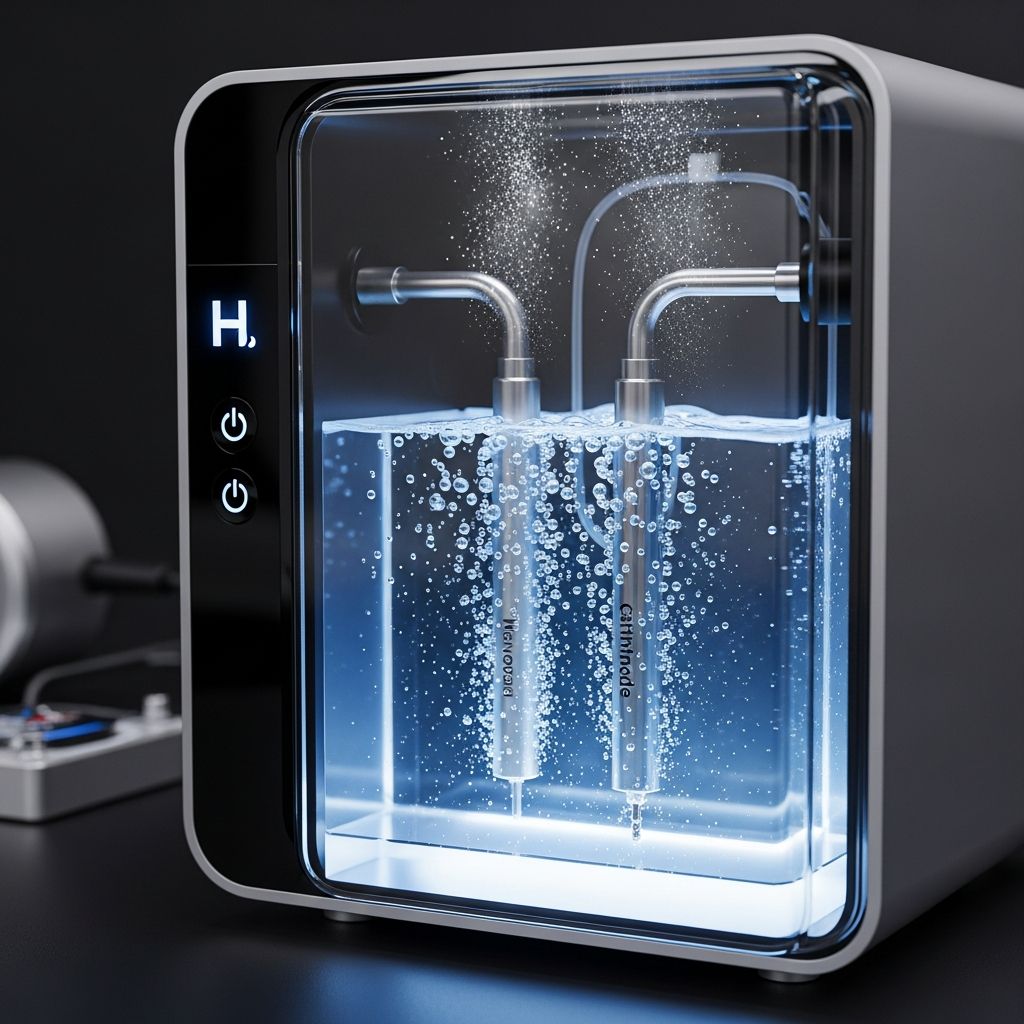
Hydrogen gas, the lightest element in the periodic table, can be generated in a home setting using basic materials and straightforward processes. This article details reliable techniques inspired by proven educational experiments, emphasizing safety and educational value.
Understanding Hydrogen Gas and Its Importance
Hydrogen (H2) is a colorless, odorless gas that burns cleanly with oxygen to produce water. It powers fuel cells in modern vehicles and serves as a reducing agent in industrial metallurgy. In home experiments, producing hydrogen demonstrates key chemistry principles like displacement reactions and electrolysis.
Generating hydrogen at home fosters scientific curiosity but requires caution due to its flammability. Always work in well-ventilated areas, avoid open flames, and use protective gear.
Core Principles Behind Hydrogen Production
Hydrogen generation typically involves breaking water (H2O) into H2 and O2 or reacting metals with acids. These methods rely on redox reactions where electrons transfer, liberating hydrogen bubbles.
- Electrolysis: Applies electrical current to split water molecules.
- Metal Displacement: Active metals react with acids or bases to release H2.
These approaches use household items, making them accessible for students and hobbyists.
Method 1: Electrolysis with Batteries and Salt Water
Electrolysis decomposes water using direct current. A simple setup uses a battery, electrodes, and electrolyte-enhanced water.
Required Materials
- 9-volt battery or similar DC power source.
- Two metal electrodes (e.g., paperclips, thumbtacks, or stainless steel washers).
- Container with water and salt or baking soda (electrolyte).
- Test tubes or balloons for gas collection.
- Wires with alligator clips.
Step-by-Step Instructions
- Prepare electrodes: Strip insulation if needed and position them without touching.
- Mix electrolyte: Add 1 teaspoon salt or baking soda per cup of water to improve conductivity.
- Submerge electrodes in the solution, connecting positive (anode) to one and negative (cathode) to the other.
- Observe bubbles: Hydrogen forms at the cathode (more vigorously), oxygen at the anode.
- Collect gas: Invert a test tube over the cathode to capture pure hydrogen.
This method produces small quantities slowly but is safe and visualizes gas evolution clearly.
Method 2: Aluminum and Base Reaction
Aluminum reacts with sodium hydroxide (from drain cleaner) in water, producing hydrogen via: 2Al + 2NaOH + 6H2O → 2Na[Al(OH)4] + 3H2.
Gathering Supplies
| Item | Purpose |
|---|---|
| Aluminum foil (1 meter) | Reactant metal |
| Sodium hydroxide crystals (2 tbsp) | Catalyst/base |
| Glass bottle (e.g., soda bottle) | Reaction vessel |
| Water | Medium |
| Balloon | Gas storage |
Execution Guide
- In a ventilated outdoor space, add NaOH to the bottle.
- Roll foil into a loose ball and insert without full submersion.
- Pour in water (1/3 bottle volume) to initiate reaction.
- Quickly fit balloon over mouth; hydrogen inflates it as reaction heats up.
- Monitor temperature; cool with water bath if overheating produces steam.
The exothermic reaction generates significant gas; balloons become buoyant.
Method 3: Acid-Metal Combination
Using hydrochloric acid (from toilet cleaner) with aluminum yields hydrogen: 2Al + 6HCl → 2AlCl3 + 3H2.
Materials List
- Aluminum foil pieces.
- Hydrochloric acid solution (toilet bowl cleaner).
- Plastic bottle.
- Balloon and water for dilution.
Procedure
- Add acid to bottle, followed by foil scraps.
- Dilute with equal water volume to control vigor.
- Seal with balloon; wait for inflation (hours for visible volume).
This is slower but uses common cleaners; efficiency improves with purer acid.
Advanced Home Setup: Washer-Based Electrolyzer
Stack stainless steel washers as electrodes in a bottle for continuous production. Alternate washers connect to battery terminals, separated by plastic spacers. Electrolyte water fills gaps, generating HHO mix (hydrogen-oxygen). Ideal for observing sustained electrolysis.
Safety Protocols for All Methods
Hydrogen is explosive in air (4-75% concentration). Key rules:
- Ventilation: Outdoors or fume hood.
- No Sparks: Ground yourself; avoid static.
- Quantities: Small-scale only (<1L gas).
- PPE: Gloves, goggles; neutralize wastes.
- Storage: Temporary in balloons; release excess promptly.
Test purity by igniting small amounts at distance with long fuse.
Testing and Verifying Your Hydrogen
Burn Test: Clean-burning ‘pop’ sound confirms H2. Sooty flame indicates impurities.
Density Check: Filled balloons rise, proving low density (0.0899 g/L).
Use inverted tube over candle for safe demo.
Practical Applications and Experiments
- Balloons/Rockets: Ignite for propulsion demos.
- Fuel Cells: Power small LEDs.
- Reductions: Reduce copper oxide to metal.
These tie into green energy education, mirroring industrial H2 production.
Scaling Up Responsibly
For more gas, use larger batteries or purer electrolytes like KOH. Commercial generators employ PEM electrolysis for purity, powered by solar. Home scaling demands engineering for safety.
Environmental and Future Considerations
Home H2 production highlights renewable potential. Paired with solar, it enables off-grid energy storage, reducing fossil fuel reliance.
Frequently Asked Questions (FAQs)
Is home hydrogen production dangerous?
Yes, but manageable with precautions. Limit scale and ventilate well.
What is the purest method?
Electrolysis at cathode yields nearly pure H2.
Can I store hydrogen long-term?
Not recommended at home; use immediately or professional cylinders.
How much gas from one reaction?
Al-NaOH in 2L bottle: ~1-2L H2.
Legal restrictions?
Educational use fine; large-scale needs permits.
References
- Homemade Hydrogen — Theodore Gray. Accessed 2026. https://theodoregray.com/periodictable/Stories/001.1/index.html
- How to make HYDROGEN gas at home easily — YouTube. 2023. https://www.youtube.com/watch?v=ung-xKZaeQA
- How to Make Hydrogen — Instructables. Accessed 2026. https://www.instructables.com/How-to-make-Hydrogen/
- Make hydrogen gas at home with a 9 volt battery — YouTube (Rhett Allain). 2023. https://www.youtube.com/watch?v=9j8gE4oZ9FQ
- Hydrogen Generator — Hydroride.eu. Accessed 2026. https://hydroride.eu/hydrogen-generator/
- Making a Simple Hydrogen Generator from Washers — YouTube (Maciej Nowak Projects). 2023. https://www.youtube.com/watch?v=RY08xO-_11w

Medha Deb is an editor with a master's degree in Applied Linguistics from the University of Hyderabad. She believes that her qualification has helped her develop a deep understanding of language and its application in various contexts. Medha specializes in the areas of beauty, health, sports, and wellness and is committed to ensuring that the content on the website is…