
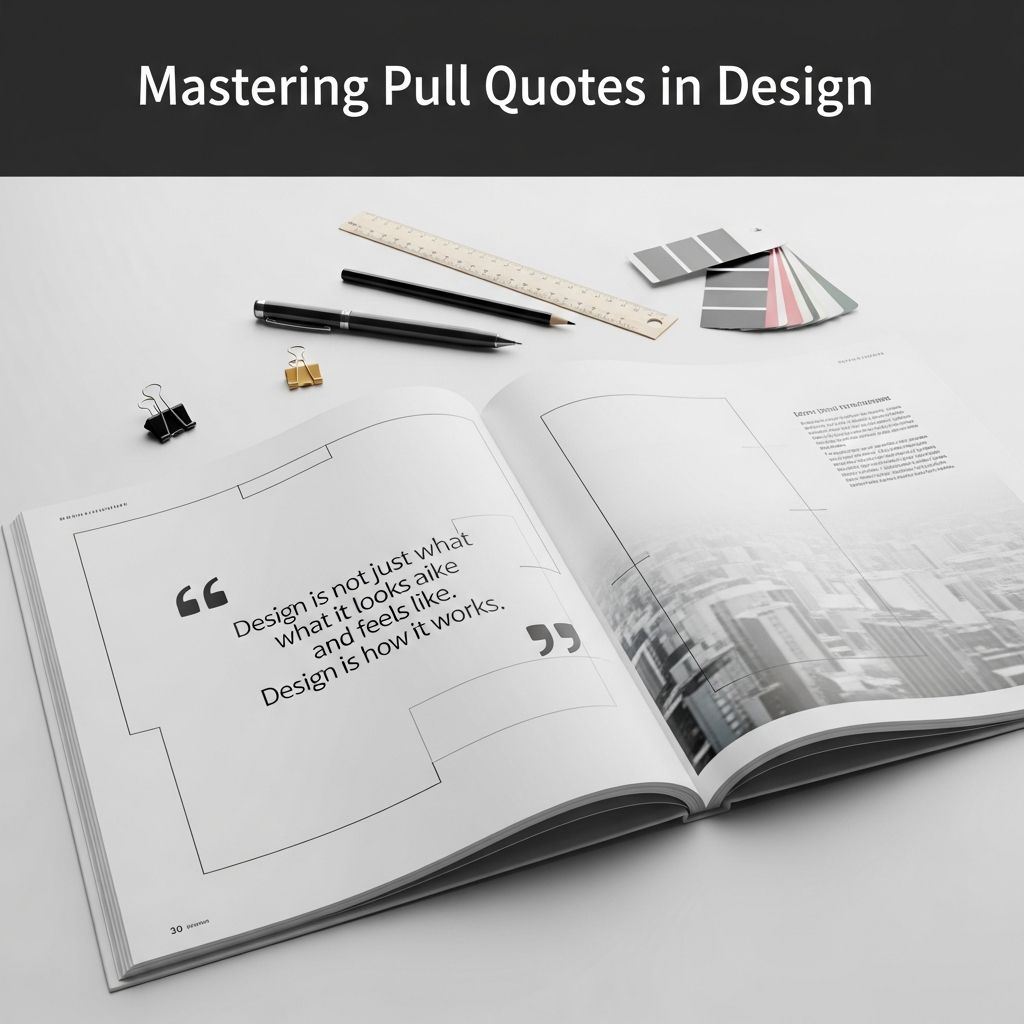
Pull quotes serve as powerful visual anchors in any layout, drawing the eye to essential ideas while breaking up dense text. These highlighted excerpts not only reinforce core messages but also guide readers through complex content with elegance and impact.
Understanding the Role of Pull Quotes
In graphic design and publishing, pull quotes function as strategic highlights that extract compelling phrases from the main body. Unlike standard block quotes, which often cite external sources, pull quotes typically feature the author’s own words to emphasize themes or provoke curiosity. They create breathing room on the page, making long-form content more approachable and memorable.
Designers use them to establish rhythm in layouts. By pulling out a single sentence or short paragraph, these elements act like signposts, signaling importance without disrupting narrative flow. In nonfiction books or articles, they underscore arguments, while in magazines, they tease intriguing insights.
- Attention grabbers: Positioned prominently, they lure skimmers into deeper reading.
- Thematic reinforcers: They echo the piece’s central thesis.
- Visual breaks: They prevent text-heavy pages from feeling overwhelming.
Selecting the Perfect Text for Impact
Choosing text for a pull quote demands precision. Scan your content for phrases that stand alone with power—surprising statistics, bold declarations, or evocative questions. Avoid excerpts that require heavy context, as they risk confusing readers.
Ideal candidates include:
- Provocative statements that challenge assumptions.
- Concise summaries of complex sections.
- Memorable metaphors or vivid descriptions.
Author or editor input often identifies these gems first, but designers should verify they align with the overall tone. Test by reading aloud: does it hook instantly? In journalistic work, original interview snippets shine, but self-quotes dominate most nonfiction. Aim for brevity—under 50 words—to maintain punch.
Strategic Placement Techniques
Placement determines a pull quote’s effectiveness. “Preview” positioning places it before the source text, teasing content to build anticipation. This risky tactic works best with standalone zingers that spark curiosity without spoilers. Conversely, “review” placement follows the original, reinforcing points post-exposure for emphasis.
Key guidelines include:
| Placement Type | Best For | Risks |
|---|---|---|
| Preview (Early) | Grabbing attention, long articles | Spoilers, context loss |
| Review (Later) | Reinforcing arguments, summaries | Redundancy if overused |
| Neighbor (Side) | Magazines, sidebars | Flow disruption |
Never position directly adjacent to the source text; space them apart to avoid redundancy. In multi-column layouts, opt for vertical spans between columns, ensuring they don’t squeeze margins too narrowly.
Design Principles for Visual Appeal
Typography and styling transform simple text into standout features. Larger fonts, italics, or contrasting weights draw the eye. Enclose with oversized quotation marks for instant recognition, often placed left-aligned for familiarity.
Balance these dos and don’ts:
- Do: Optically align edges, especially with hanging punctuation.
- Do: Use ample whitespace or rules for separation.
- Don’t: Hyphenate mid-word or split names.
- Don’t: Over-center; left or right justification often reads cleaner.
Experiment with orientation: vertical stacks suit narrow spaces, while horizontal blocks fit wide pages. In digital formats, ensure responsiveness across devices—eBooks reflow unpredictably, so prioritize semantic HTML.
Distinguishing Pull Quotes from Similar Elements
Confusion arises between pull quotes, block quotes, and display quotes. Block quotes indent long external citations within flow; pull quotes repeat internal text prominently aside. Epigraphs open chapters with external wisdom, while display quotes might bold key lines inline.
Pull quotes uniquely “pull” from your content, demanding self-referential power. Misusing external quotes as pulls dilutes authenticity unless original to the piece.
Best Practices Across Formats
Print offers control: rules, boxes, or bleeds enhance drama. Digital demands subtlety—CSS floats or grids prevent overlap on mobiles. Nonfiction books benefit from chapter-start pulls, providing skimmable overviews.
Frequency matters: one or two per article suffice; more litters the page, diminishing impact. In dense sections, they offer respite; sparse ones need none.
Avoiding Common Pitfalls
Overuse breeds pompousness, turning emphasis into shouting. Poor choices—weak text or spoilers—frustrate. Technical slips like ragged edges or device glitches undermine professionalism.
Pro tip: Prototype in context. Print proofs or browser-test to confirm harmony.
Frequently Asked Questions
What makes a pull quote different from a blockquote?
Pull quotes highlight internal text prominently outside the flow; blockquotes indent external citations within it.
How many pull quotes per page?
Limit to 1-2 for short pieces, scaling sparingly for longer ones to avoid clutter.
Can pull quotes use external sources?
Prefer internal excerpts; external only if original to your content.
Do pull quotes work in eBooks?
Yes, but use responsive CSS; test across devices for reflow.
What’s the ideal length?
Short: 1-2 sentences max for maximum punch.
Advanced Styling Ideas
Beyond basics, integrate icons, gradients, or animations for web. In print, colored backgrounds or drop shadows add depth. Pair with infographics for data-heavy pieces, pulling stats visually.
Case study: Magazines like those from Columbia University stress brevity and boldness—”keep it short, be bold”. Adapt to audience: corporate reports favor subtlety; lifestyle mags embrace flair.
Tools like Adobe InDesign automate pulls via scripts, while CSS frameworks (e.g., Tailwind) simplify web implementation. Always prioritize readability over novelty.
References
- TypeTalk: How to Attract Attention With Pull Quotes — CreativePro. 2023-05-15. https://creativepro.com/how-to-attract-attention-pull-quotes/
- Block Quotes and Pull Quotes — J.M. Elliott, Substack. 2024-02-10. https://jmelliott.substack.com/p/block-quotes-and-pull-quotes
- Pull Quotes: Best Practices for Nonfiction Books — The Book Designer. 2023-11-20. https://www.thebookdesigner.com/pull-quotes-in-nonfiction-books/
- Block Quotes and Pull Quotes: Examples and Good Practices — Smashing Magazine. 2008-06-12. https://www.smashingmagazine.com/2008/06/block-quotes-and-pull-quotes-examples-and-good-practices/
- Using Pull Quotes, Display Quotes, Block Quotes, and Epigraphs — Jessi Hoffman, Book Editor. 2022-08-05. https://bookeditor-jessihoffman.com/using-pull-quotes-display-quotes-block-quotes-and-epigraphs-in-your-writing/

- Integrated M.A. in Applied Linguistics, University of Hyderabad
- 5+ years in editorial, instructional, SEO, and research-based writing
Sneha is a relationships and lifestyle writer with a strong foundation in applied linguistics and certified training in relationship coaching. She brings over five years of writing experience to theskillvault, crafting thoughtful, research-driven content that empowers readers to build healthier relationships, boost emotional well-being, and embrace holistic living. Her writing and insights reflect the belief that beauty, happiness, and wellness…