
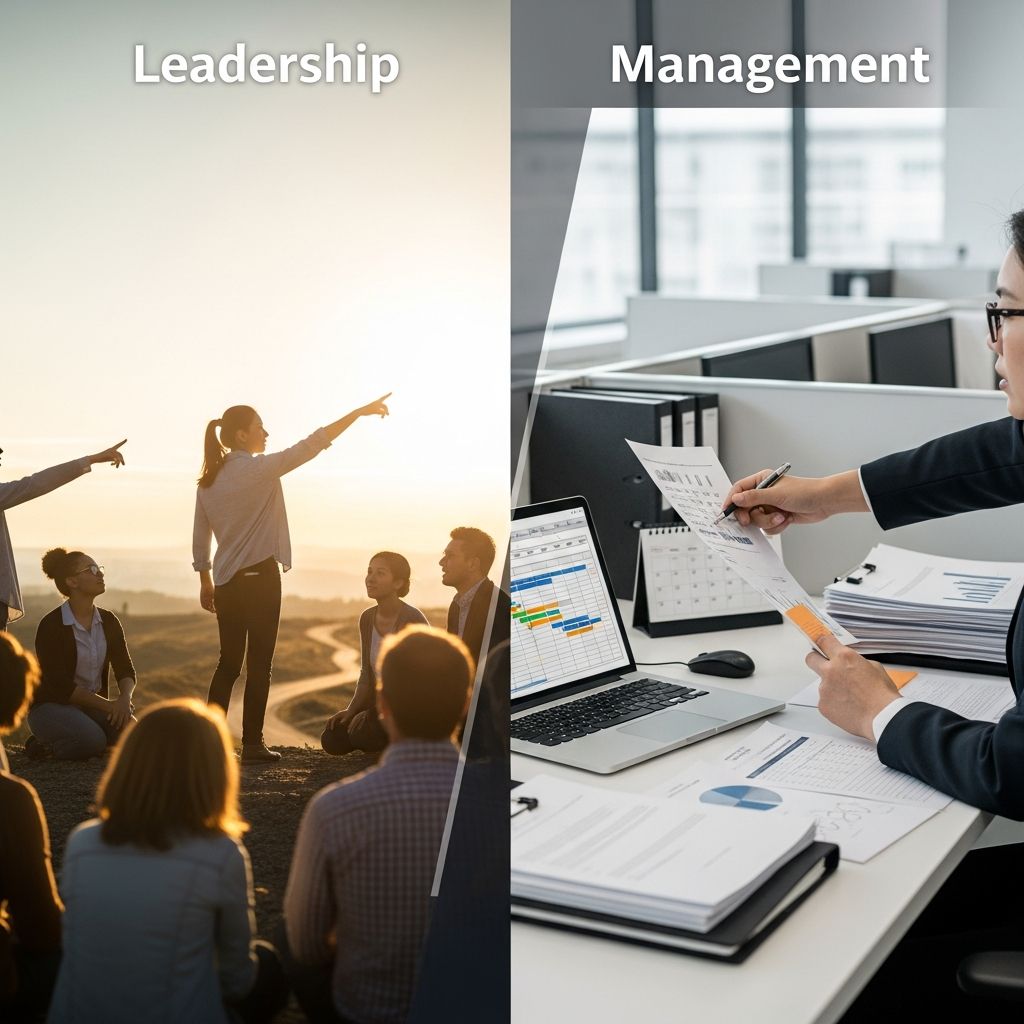
Understanding the nuances between **leadership** and **management** is crucial for anyone aiming to thrive in professional environments. While both roles are vital for organizational success, they serve distinct purposes. Leadership drives transformation through inspiration and foresight, whereas management ensures stability through structure and execution. This article delves into these differences, drawing from established frameworks to help you recognize and cultivate both skill sets.
Defining the Foundations: What Sets Them Apart
At their core, leadership and management address different aspects of organizational dynamics. Leaders focus on the overarching purpose and direction, answering the pivotal questions of “why” and “what.” They craft compelling visions that rally teams toward ambitious futures. Managers, conversely, concentrate on the “how,” translating those visions into practical steps, timelines, and resource allocations.
This foundational divergence shapes every decision and interaction. For instance, a leader might champion a bold market expansion to capture emerging opportunities, while a manager would orchestrate the logistics, budgeting, and team assignments to make it feasible. Recognizing this interplay allows professionals to blend both approaches effectively, avoiding the pitfalls of overemphasizing one at the expense of the other.
Strategic Vision Versus Operational Execution
**Leaders** excel in strategic visioning, painting a picture of long-term potential that motivates beyond immediate tasks. They scan horizons for trends, disruptions, and growth avenues, positioning their organizations for sustained relevance. This forward-looking mindset encourages adaptability in volatile markets.
**Managers**, by contrast, prioritize operational execution. They break down complex strategies into manageable tasks, monitor progress against benchmarks, and optimize workflows for peak efficiency. Their efforts ensure that daily operations align seamlessly with broader objectives, minimizing disruptions and maximizing output.
| Aspect | Leadership | Management |
|---|---|---|
| Primary Focus | Future-oriented vision and strategy | Present-day operations and tasks |
| Key Question | What and why? | How and when? |
| Outcome | Innovation and growth | Efficiency and consistency |
This table illustrates how these roles complement each other, with leadership providing direction and management delivering results.
Embracing Change: Innovation Drivers vs Stability Guardians
Leaders are natural agents of change, thriving in ambiguity and championing innovation. They challenge conventions, foster creative problem-solving, and propel organizations through transformative shifts. Comfortable with calculated risks, they view uncertainty as a gateway to breakthroughs, inspiring teams to experiment and adapt.
Managers safeguard stability, refining processes to deliver predictable outcomes. They mitigate risks by adhering to proven methodologies, conducting thorough analyses, and implementing controls that prevent errors. This approach is indispensable during routine operations or when scaling established practices.
- Leadership in Action: Launching a pioneering product line amid industry upheaval.
- Management in Action: Streamlining supply chains to reduce costs by 20%.
Balancing these ensures organizations innovate without chaos.
People-Centric Inspiration vs Process-Driven Coordination
**True leadership** revolves around people, building emotional connections that unlock potential. Leaders motivate through charisma, empathy, and empowerment, cultivating trust and loyalty. They invest in development, recognizing individual strengths to foster high-performing teams oriented toward shared goals.
**Management** emphasizes processes, designing systems for accountability and productivity. Managers allocate roles, set expectations, and track performance metrics, ensuring alignment with organizational standards. Their structured oversight keeps teams cohesive and objectives on course.
In practice, leaders might host vision-sharing workshops to ignite passion, while managers conduct performance reviews to refine skills and address gaps. Both are essential, but leadership amplifies human capital, while management harnesses it systematically.
Decision-Making Styles: Bold Risks vs Calculated Caution
Leaders approach decisions with boldness, weighing high-reward possibilities against uncertainties. They empower decentralized choices, encouraging agility and ownership across levels. This risk-tolerant stance fuels breakthroughs but demands resilience against setbacks.
Managers employ caution, relying on data, protocols, and contingency plans to minimize downsides. Their decisions prioritize reliability, often through hierarchical approvals and iterative testing. This method excels in regulated environments or high-stakes operations.
| Decision Style | Leadership Approach | Management Approach |
|---|---|---|
| Risk Attitude | Embraces uncertainty for growth | Mitigates risks for stability |
| Method | Intuitive, visionary insights | Data-driven, analytical |
| Example | Pivoting to new tech amid trends | Auditing processes for compliance |
Time Horizons: Long-Term Legacy vs Short-Term Wins
Leaders operate on extended timelines, strategizing years ahead to build enduring legacies. They anticipate macroeconomic shifts, talent pipelines, and cultural evolutions, investing in initiatives with deferred payoffs.
Managers target short-term milestones, delivering quarterly results and resolving immediate bottlenecks. Their focus on now ensures momentum, providing the tangible progress that sustains long-term endeavors.
Organizations flourish when leaders set the 5-year roadmap and managers navigate the quarterly sprints.
Cultivating Both: Pathways to Organizational Excellence
Great professionals integrate leadership and management. Aspiring leaders can hone vision by studying market forecasts and practicing storytelling. Managers aiming to lead should embrace feedback loops and delegate boldly.
Training programs from institutions like Harvard Business School emphasize hybrid skills, blending strategic thinking with tactical prowess. Self-assessment tools help identify strengths:
- Do you inspire or instruct?
- Prioritize people or procedures?
- Chase horizons or hit targets?
Organizations benefit from dual-role development, promoting managers into leadership tracks via mentorship and rotations.
Real-World Applications Across Industries
In tech giants like those analyzed by Asana, leaders like visionary CEOs disrupt markets, while managers orchestrate dev teams for flawless releases. Healthcare leaders pioneer telemedicine visions; managers ensure HIPAA-compliant implementations.
Non-profits see leaders rallying donors for missions, managers budgeting campaigns. Retail leaders spot e-commerce trends; managers optimize inventory turns. These examples underscore universal relevance.
Frequently Asked Questions (FAQs)
Can someone be both a leader and a manager?
Yes, effective professionals balance both. Leaders must manage execution, and managers lead teams. Kotter notes overlaps in planning and motivation.
Is leadership always superior to management?
No, both are indispensable. Without management, visions falter; without leadership, stagnation sets in.
How can I develop leadership skills if I’m a manager?
Seek feedback, mentor others, pursue strategic projects, and study cases from HBS Online.
Do leaders take more risks than managers?
Typically, yes—leaders drive innovation via bold moves, managers stabilize via caution.
What’s the impact of poor leadership vs poor management?
Poor leadership causes aimlessness; poor management breeds chaos. Balanced development mitigates both.
Conclusion: Harmonizing Roles for Peak Performance
Distinguishing leadership from management empowers individuals and organizations to harness their synergies. By fostering visionary leaders and meticulous managers, teams achieve transformative results. Embrace these distinctions to unlock your potential.
References
- Management vs. Leadership: What’s the Difference? — Our Lady of the Lake University. 2023-05-15. https://www.ollusa.edu/blog/management-vs-leadership.html
- Management vs. Leadership: Similarities and Differences — Wilson College Online. 2024-02-10. https://online.wilson.edu/resources/management-vs-leadership/
- Leadership vs Management: 7 Core Differences to Know — Crummer Rollins. 2023-11-20. https://crummer.rollins.edu/resources/leadership-vs-management/
- Leaders vs Managers – Key Differences and Commonalities — Fisher College of Business, OSU. 2022-08-05. https://fisher.osu.edu/blogs/leadreadtoday/leaders-vs-managers-key-differences-and-commonalities
- Leading vs. Managing: What’s the Difference? — Harvard PON. 2024-03-12. https://www.pon.harvard.edu/daily/leadership-skills-daily/leading-vs-managing-whats-the-difference/
- Leadership vs. Management: What’s the Difference? — Harvard Business School Online. 2025-01-08. https://online.hbs.edu/blog/post/leadership-vs-management
- Leadership vs. Management: What’s the Difference? [2026] — Asana. 2026-01-01. https://asana.com/resources/leadership-vs-management

- Integrated M.A. in Applied Linguistics, University of Hyderabad
- 5+ years in editorial, instructional, SEO, and research-based writing
Sneha is a relationships and lifestyle writer with a strong foundation in applied linguistics and certified training in relationship coaching. She brings over five years of writing experience to theskillvault, crafting thoughtful, research-driven content that empowers readers to build healthier relationships, boost emotional well-being, and embrace holistic living. Her writing and insights reflect the belief that beauty, happiness, and wellness…