
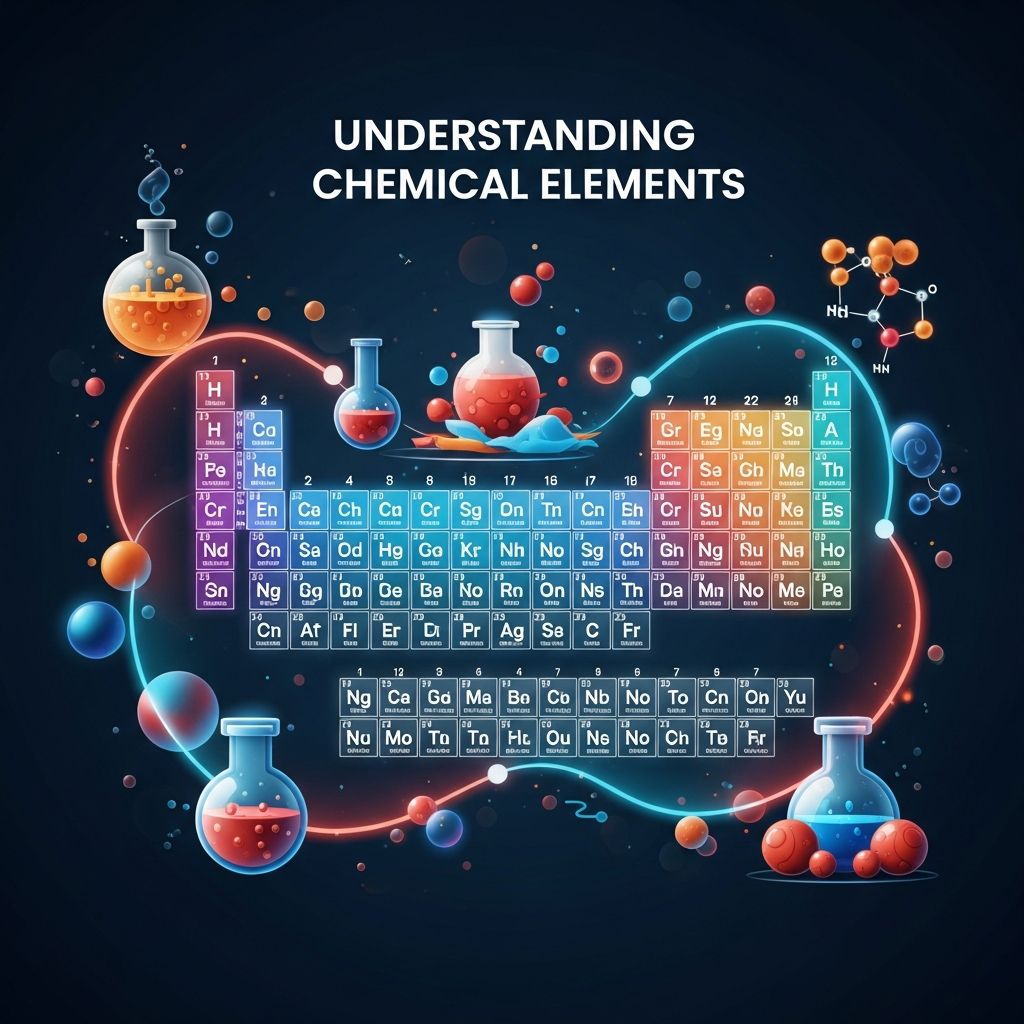
Chemical elements form the basic units of all matter in the universe, each uniquely identified by the number of protons in its atomic nucleus. These fundamental substances cannot be broken down further by chemical means and serve as the building blocks for every compound and material around us.
Defining the Essence of a Chemical Element
At its core, a chemical element is a type of atom characterized solely by its atomic number, which equals the count of protons in the nucleus. For instance, all oxygen atoms possess exactly eight protons, distinguishing them from other elements regardless of other atomic variations. This proton count dictates the element’s chemical behavior and position in the periodic table.
Elements exist as pure substances made entirely of one type of atom, such as the oxygen gas we breathe or the iron in steel. Unlike compounds like water, which combines hydrogen and oxygen, elements resist decomposition through standard chemical reactions. Nuclear processes, however, can alter an element’s identity by changing its proton number, as seen in stellar fusion or particle accelerators.
In practical chemistry, a pure element consists of atoms with identical atomic numbers, though nuclear physicists may require a single isotope for purity. This distinction highlights how context—chemical versus nuclear—affects definitions.
Atomic Structure: Protons, Electrons, and Neutrons
Every atom of an element features a nucleus containing protons and neutrons, orbited by electrons equal in number to protons in a neutral state. The simplest element, hydrogen, typically has one proton and one electron, with no neutrons in its most common form.
Protons carry a positive charge, defining the atomic number (Z), while neutrons add mass without charge. Electrons, negatively charged, occupy electron shells that determine reactivity. Variations in neutron count create isotopes, like hydrogen’s deuterium with one extra neutron, sharing the same chemical properties but differing in mass and stability.
| Particle | Charge | Location | Role in Element Definition |
|---|---|---|---|
| Proton | Positive (+1) | Nucleus | Defines atomic number and element identity |
| Neutron | Neutral (0) | Nucleus | Contributes to atomic mass; varies in isotopes |
| Electron | Negative (-1) | Electron cloud | Balances charge; influences chemical bonding |
This table summarizes atomic particles, underscoring protons’ primacy in element classification.
Historical Evolution of Element Discovery
Human recognition of elements dates to antiquity, with early civilizations identifying substances like gold, silver, copper, iron, tin, lead, mercury, sulfur, carbon, and phosphorus that resisted breakdown. These were not understood atomically but empirically as irreducible materials.
The modern era began in the 18th and 19th centuries with systematic isolation. Antoine Lavoisier formalized the concept in the 1780s, listing 33 elements. Dmitri Mendeleev’s 1869 periodic table organized known elements by atomic weight, predicting undiscovered ones like gallium and germanium.
Twentieth-century advancements via nuclear synthesis expanded the list. Glenn Seaborg’s team created berkelium (Bk, Z=97) in 1949 at Berkeley using americium bombarded with helium nuclei: 241Am(4He, 2n)243Bk. Today, 118 elements are recognized, from hydrogen (Z=1) to oganesson (Z=118), many superheavy ones lab-made with fleeting existences.
- Ancient elements: Gold (Au), used in jewelry for millennia.
- Medieval additions: Phosphorus, discovered glowing in urine extracts.
- Modern synthetics: Elements beyond uranium (Z=92), unstable and radioactive.
This timeline reflects humanity’s deepening grasp of matter’s composition.
The Periodic Table: Organizing Principles
The periodic table arranges elements by increasing atomic number into rows (periods) and columns (groups), revealing patterns in properties. Elements in the same group, like alkali metals (Group 1), share valence electrons, yielding similar reactivities.
Blocks categorize by outermost electron orbitals: s-block (Groups 1-2, helium), p-block (Groups 13-18), d-block (transition metals), f-block (lanthanides, actinides). Trends include atomic radius decreasing across periods and increasing down groups, ionization energy rising across periods.
Naturally occurring elements dominate (up to uranium), while transuranic ones require accelerators. Cosmic abundances peak at hydrogen (74% by atoms), helium (24%), then traces of others from Big Bang nucleosynthesis and stellar processes.
Isotopes: Variations Within Elements
Isotopes are atoms of the same element with differing neutron numbers, thus different mass numbers. Carbon-12 (6 protons, 6 neutrons) is stable; carbon-14 (6 protons, 8 neutrons) is radioactive, used in dating.
Most elements have multiple isotopes; hydrogen has three: protium (^1H), deuterium (^2H), tritium (^3H). Stable isotopes inform geochemistry; unstable ones fuel nuclear power or medicine.
- Applications: Uranium-235 for fission, iodine-131 for thyroid treatment.
- Detection: Mass spectrometry separates by mass-to-charge ratio.
Isotopic purity matters in nuclear contexts, contrasting chemical uniformity.
Cosmic Origins and Universal Distribution
Elements trace to the universe’s birth. Big Bang produced hydrogen, helium, lithium; heavier ones forged in stars via fusion—helium to carbon in red giants, up to iron in supernovae explosions dispersing them.
Neutron star mergers synthesize rare r-process elements like gold. Earth’s crust skews toward oxygen (46%), silicon (28%), unlike cosmic hydrogen dominance. Abundances follow the Oddo-Harkins rule: even-Z elements more common.
Nearly all visible matter comprises elements, except exotic states like neutronium in neutron stars.
Chemical Symbols and Nomenclature
Elements bear one- or two-letter symbols, often from Latin roots: H for hydrogen, Fe for ferrum (iron), Na for natrium (sodium). Capitalized first letter, lowercase second if present.
Symbols aid formulas: H2O for water, CO2 for carbon dioxide. IUPAC standardizes names, recently nihonium (Nh) for element 113.
Practical Roles in Everyday Life and Science
Elements underpin technology and biology. Silicon enables chips; lithium powers batteries; iron strengthens steel. In life, carbon, hydrogen, oxygen, nitrogen form biomolecules; trace elements like zinc catalyze enzymes.
Understanding elements drives innovation: rare earths in magnets, helium in cryogenics. Challenges include sourcing scarce ones ethically amid green transitions.
Frequently Asked Questions (FAQs)
What distinguishes one chemical element from another?
The number of protons in the nucleus, or atomic number, uniquely identifies each element.
Can elements be created or destroyed?
Yes, via nuclear reactions like fusion or fission, but not by chemical means.
How many chemical elements exist?
118 confirmed elements, with ongoing research into superheavy ones.
What are isotopes, and why do they matter?
Isotopes have the same protons but different neutrons, affecting stability and applications like medical imaging.
Where do heavy elements like gold come from?
Primarily from supernova explosions and neutron star collisions.
References
- Chemical element – Wikipedia — Wikipedia contributors. 2023-10-01. https://en.wikipedia.org/wiki/Chemical_element
- Chemical element | Definition, Origins, Distribution, & Facts — Encyclopædia Britannica. 2024-01-15. https://www.britannica.com/science/chemical-element
- History of the Origin of the Chemical Elements and Their Discoverers — National Nuclear Data Center, Brookhaven National Laboratory. 2023-05-20. https://www.nndc.bnl.gov/content/elements.html
- What are Chemical Elements? – YouTube — Educational video. 2022-06-10. https://www.youtube.com/watch?v=kWa_zTldnhw
- Elements and atomic number (video) — Khan Academy. 2023-11-05. https://www.khanacademy.org/science/hs-chemistry/x2613d8165d88df5e:atoms-isotopes-and-ions/x2613d8165d88df5e:atomic-structure/v/elements-and-atomic-number

Medha Deb is an editor with a master's degree in Applied Linguistics from the University of Hyderabad. She believes that her qualification has helped her develop a deep understanding of language and its application in various contexts. Medha specializes in the areas of beauty, health, sports, and wellness and is committed to ensuring that the content on the website is…