
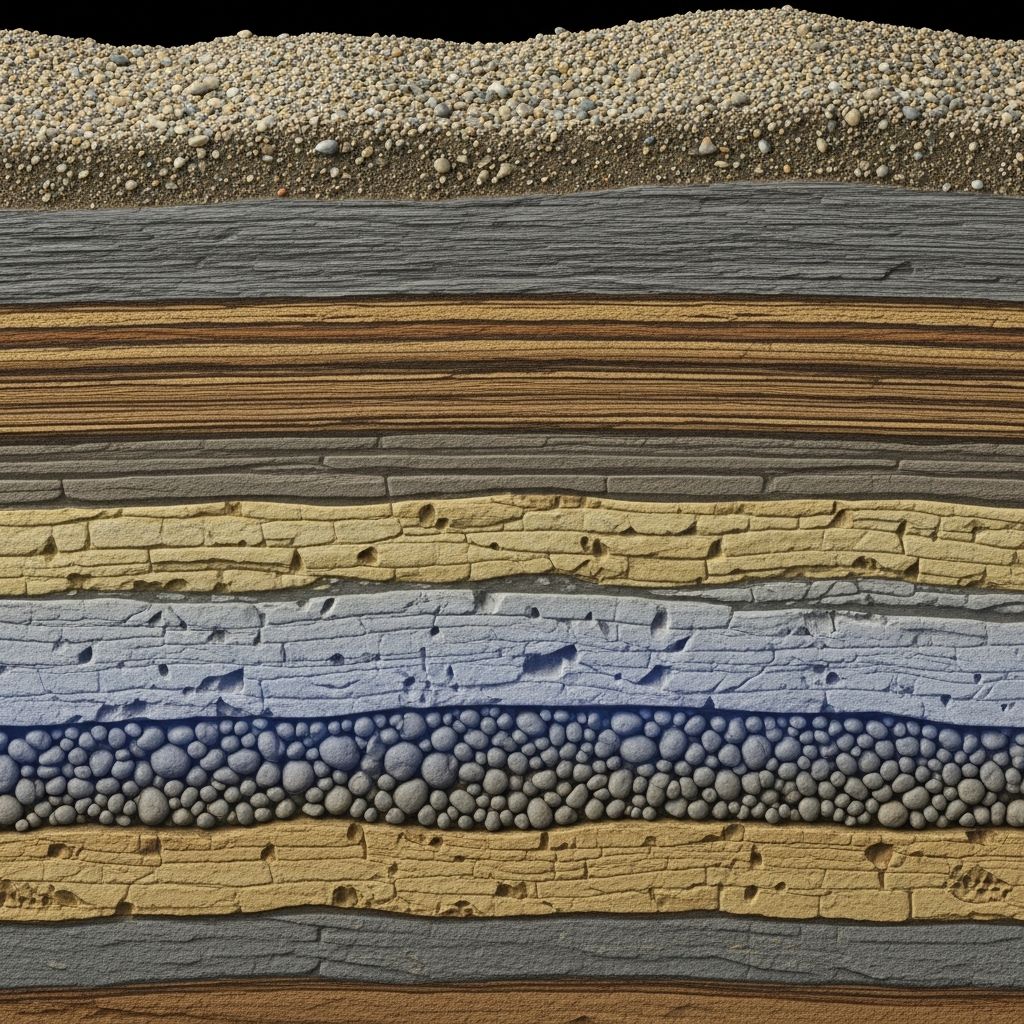
Sedimentary rocks form through the accumulation, compaction, and cementation of sediments derived from pre-existing rocks, organic materials, or chemical precipitates. They cover about 75% of Earth’s surface and preserve vital records of ancient environments, climates, and life forms.
Origins of Sedimentary Rocks
Sedimentary rocks originate from three primary processes: mechanical weathering producing clastic sediments, biological activity creating organic remains, and chemical precipitation from water solutions. These materials deposit in layers on land, lakes, rivers, or oceans, then undergo lithification—compaction under burial pressure and cementation by minerals like silica, calcite, or iron oxides.
Unlike igneous rocks formed from magma or metamorphic rocks altered by heat and pressure, sedimentary rocks characteristically exhibit bedding or stratification, reflecting episodic deposition. Fossils abound in many types, offering snapshots of past ecosystems.
Main Categories of Sedimentary Rocks
Sedimentary rocks divide into clastic (detrital), chemical, biochemical (biogenic), and other specialized types based on composition and formation mechanisms.
Clastic Sedimentary Rocks
Clastic rocks consist of fragments (clasts) from eroded bedrock, sorted by grain size during transport by water, wind, or ice. Classification follows the Udden-Wentworth scale: gravel (>2 mm), sand (0.0625-2 mm), silt (0.004-0.0625 mm), and clay (<0.004 mm).
- Conglomerates and Breccias: Gravel-dominated; conglomerates feature rounded pebbles cemented in matrix, forming in high-energy rivers; breccias have angular clasts from nearby sources like fault zones.
- Sandstones: Sand grains (mostly quartz) compacted; subtypes include quartz sandstone (pure quartz), arkose (feldspar-rich, from rapid erosion), and graywacke (lithic fragments, volcanic origins).
- Mudrocks: Finest grains; shale (fissile, splits into sheets), mudstone (blocky), siltstone (silt-dominant), claystone (clay-rich).
| Grain Size | Rock Type | Typical Environment |
|---|---|---|
| >2 mm (Gravel) | Conglomerate/Breccia | Rivers, beaches |
| 0.0625-2 mm (Sand) | Sandstone | Dunes, deltas |
| 0.004-0.0625 mm (Silt) | Siltstone | Floodplains |
| <0.004 mm (Clay) | Shale/Claystone | Deep sea, lakes |
Chemical Sedimentary Rocks
These precipitate directly from supersaturated water without biological mediation, often in evaporating basins or supersaturated seas. Common minerals include calcite, halite, and gypsum.
- Limestone (non-biogenic): Calcite from evaporated seawater; microcrystalline micrite forms slowly.
- Evaporites: Rock salt (halite), gypsum, anhydrite from sequential evaporation in restricted basins like the Dead Sea.
- Chert: Silica (SiO2) nodules or beds from groundwater precipitation.
Biochemical and Organic Sedimentary Rocks
Formed from accumulated biological remains, compressed over time. They record life’s influence on geology.
- Biochemical Limestone: Shells, coral, foraminifera compacted into chalk (microfossils) or coquina (shell fragments).
- Coal: Plant debris in swamps, evolving from peat through ranks: lignite, bituminous, anthracite.
- Other: Phosphorites (bone beds), ironstones, oil shales rich in organic carbon (>3%).
Key Formation Processes
Sediment production begins with weathering: physical (frost, abrasion) breaks rocks into clasts; chemical dissolves minerals. Erosion transports via rivers (bedload/suspended), wind (dunes), glaciers (tillites).
Deposition occurs where energy drops: deltas, beaches, abyssal plains. Diagenesis follows: compaction expels water, cementation binds grains. Early stages include bioturbation by organisms; late-stage forms concretions.
Environments dictate type: alluvial fans yield conglomerates; reefs build limestone; anoxic basins preserve black shales.
Recognizing Sedimentary Rocks in Nature
Distinct features include:
- Bedding planes: Horizontal layers from calm deposition.
- Graded bedding: Finer grains atop coarser in turbidites.
- Cross-bedding: Angled layers in dunes or rivers.
- Fossils: Plants, animals, traces.
- Color: Red (iron oxides), gray (anoxic), white (pure carbonates).
Significance in Earth Science
Sedimentary rocks host 99% of fossils, revealing evolution and extinctions. They trap hydrocarbons (porous sandstones, organic shales), ores (evaporites for potash), and aquifers. Stratigraphy dates events via index fossils and isotopes.
In national parks like Grand Canyon, layered sandstones, shales, limestones chronicle 1.8 billion years.
Common Examples and Locations
| Rock Type | Description | Notable Sites |
|---|---|---|
| Sandstone | Cemented quartz sands | Navajo Sandstone, Zion NP |
| Shale | Fissile mudrock | Burgess Shale, Canada |
| Limestone | CaCO3-rich | White Cliffs of Dover |
| Conglomerate | Rounded pebbles | Black Canyon, Gunnison NP |
Frequently Asked Questions
What percentage of Earth’s surface do sedimentary rocks cover?
Approximately 75%, mainly in low-lying basins and platforms.
How do clastic rocks differ from chemical ones?
Clastic are fragmented pre-existing rocks; chemical precipitate minerals from solution.
Can sedimentary rocks form quickly?
Some, like volcanic ash deposits, lithify in years; others take millions.
Why are fossils mostly in sedimentary rocks?
Burial preserves organics rapidly, unlike igneous/metamorphic heat destroying them.
What cements clastic grains?
Calcite, silica, iron oxides precipitate from groundwater.
Advanced Classification Nuances
Beyond basics, siliciclastic rocks dominate continents; carbonates thrive in warm, shallow seas. Textures vary: matrix-supported (mud-rich) vs. grain-supported. Composition prefixes like ‘quartzose’ or ‘arkosic’ refine names.
Mudrocks, 65% of stratigraphic record, split as shale (fissile), mudstone (massive). Carbonates subclassify by allochems (grains) vs. orthocho (micrite).
Pyroclastic sediments from volcanoes blur lines but classify separately.
Environmental Indicators
Grain size signals energy: coarse=high (mountains), fine=low (deep ocean). Rounding increases with transport distance. Fossils pinpoint climates: reefs=tropical, tillites=glacial.
Today, studying modern analogs like Mississippi Delta refines ancient interpretations.
References
- Classification of sedimentary rocks — The Australian Museum. 2023. https://australian.museum/learn/minerals/shaping-earth/classification-of-sedimentary-rocks/
- Sedimentary rock — Wikipedia (drawing from geological standards). 2023-10-01. https://en.wikipedia.org/wiki/Sedimentary_rock
- 3 Types of Rock: Igneous, Sedimentary & Metamorphic — American Museum of Natural History. 2023. https://www.amnh.org/explore/ology/earth/if-rocks-could-talk2/three-types-of-rock
- Glad You Asked: Igneous, Sedimentary, & Metamorphic Rocks — Utah Geological Survey. 2022-05-11. https://geology.utah.gov/map-pub/survey-notes/glad-you-asked/igneous-sedimentary-metamorphic-rocks/
- Sedimentary Rocks — U.S. National Park Service. 2024-01-15. https://www.nps.gov/subjects/geology/sedimentary.htm
- 5.5: Classification of Sedimentary Rocks — Geosciences LibreTexts (California State University). 2023-08-20. https://geo.libretexts.org/Bookshelves/Geology/Historical_Geology_(Bentley_et_al.)/05:_Earth_Materials_-_Rocks/5.05:_Classification_of_Sedimentary_Rocks
- What are sedimentary rocks? — U.S. Geological Survey. 2023-11-28. https://www.usgs.gov/faqs/what-are-sedimentary-rocks

- Integrated M.A. in Applied Linguistics, University of Hyderabad
- 5+ years in editorial, instructional, SEO, and research-based writing
Sneha is a relationships and lifestyle writer with a strong foundation in applied linguistics and certified training in relationship coaching. She brings over five years of writing experience to theskillvault, crafting thoughtful, research-driven content that empowers readers to build healthier relationships, boost emotional well-being, and embrace holistic living. Her writing and insights reflect the belief that beauty, happiness, and wellness…