
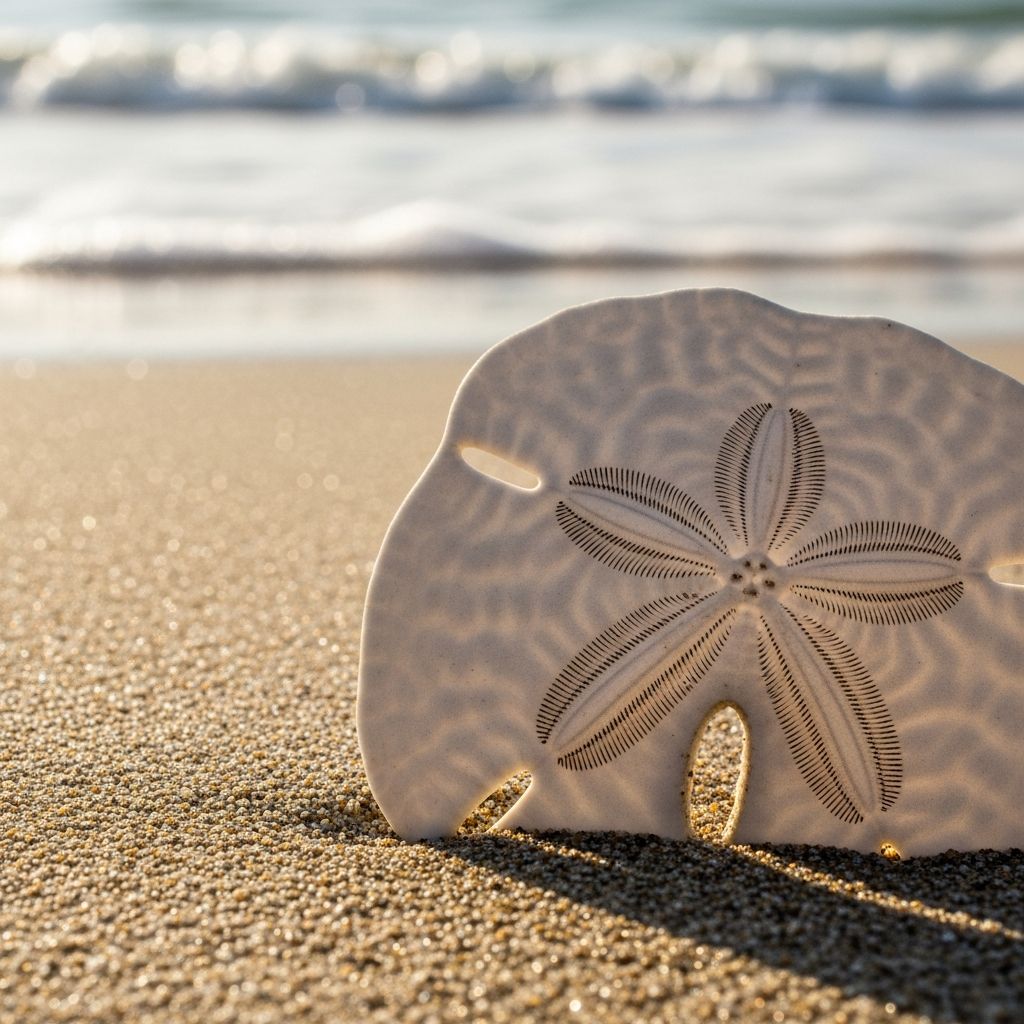
Sand dollars are captivating marine creatures whose bleached skeletons wash up on beaches worldwide, sparking curiosity among beachgoers. These flat, disk-shaped organisms belong to the order Clypeasteroida within the echinoderm phylum, closely related to sea urchins. Far from the smooth white discs we collect, living sand dollars are vibrant, spiny animals that burrow in sandy ocean floors, filtering food from the water column.
The Living Sand Dollar: A Spiny Survivor
Alive, a sand dollar bears little resemblance to its postmortem shell. Covered in thousands of tiny, movable spines called cilia or tube feet, it exhibits colors ranging from deep purple and reddish-brown to greenish hues, depending on the species. These spines, which give the creature a velvety, fuzzy appearance, serve multiple purposes: locomotion, respiration, and feeding.
The body, known as the test, is a rigid endoskeleton made of tightly fused calcium carbonate plates arranged in a distinctive fivefold radial symmetry. This structure provides protection while allowing flexibility for burrowing. On the aboral (upper) surface, five petal-like ambulacral areas—pores through which tube feet extend—form a star or flower pattern. These pores facilitate gas exchange and water circulation, essential for the animal’s survival in low-oxygen sediments.
- Spine Functions: Tiny hairs on spines move in coordinated waves to propel the sand dollar across the seabed or push sediment toward its mouth.
- Color Variations: Purple dominates in many Atlantic species, while Pacific ones may appear blue-violet.
- Size Range: Typically 80-100 mm in diameter, though some reach up to 150 mm.
Sand dollars thrive in shallow coastal waters, from intertidal zones to depths of 130 meters, preferring sandy or muddy bottoms where currents deliver plankton. They can live up to 10 years, enduring waves by standing on edge in calm conditions or flattening and burying themselves during storms.
Internal Anatomy: Beyond the Shell
Crack open a dried sand dollar, and you’ll discover more than empty space. The interior houses a complex apparatus adapted for survival in a harsh environment. Central to this is the Aristotle’s lantern, a jaw-like structure with five tooth-like elements, supported by 50 calcified skeletal rods and operated by 60 muscles. This grinding mechanism processes microscopic food particles.
Surrounding the lantern are the digestive tract, nerve ring for sensory coordination, and gonads for reproduction. Water vascular system vessels branch throughout, powering tube feet. When the animal dies, soft tissues decay, leaving the lantern as a loose, rattling “bird”-shaped relic inside the test—often interpreted symbolically as a dove of peace.
| Component | Description | Function |
|---|---|---|
| Aristotle’s Lantern | Jaw with 5 teeth, 50 elements, 60 muscles | Grinds plankton and detritus |
| Test | Calcium carbonate plates | Protection and symmetry |
| Tube Feet & Spines | Cilia-covered appendages | Movement, feeding, respiration |
| Lunules (in some species) | Slits in test | Stability against currents |
The mouth, centered on the oral (bottom) surface amid the petaloid pattern, leads to a simple stomach where enzymes break down algae, diatoms, and organic matter captured by spines and pedicellariae—pincer-like organs that seize prey. Reproductive organs release gametes into the water during spawning seasons, contributing to vast larval clouds that drift before settling.
Evolutionary Ties to Sea Urchins
Sand dollars evolved from irregular echinoids millions of years ago, flattening their globular ancestors into efficient sand-dwellers. This adaptation optimized them for infaunal life, burrowing just below the surface to avoid predators like sharks, rays, and whelks. Their test’s petal patterns evolved from ambulacra used in urchins for locomotion, now specialized for filter-feeding.
Fossil records show Clypeasteroida dating back 55 million years, with modern diversity peaking in the Miocene. Today, over 100 species inhabit temperate and tropical seas, from the common Echinarachnius parma of the North Atlantic to the keyhole sand dollar Mellita tenuis with its distinctive notches.
Ecological Importance in Coastal Ecosystems
As detritivores, sand dollars recycle nutrients by ingesting sediment and excreting cleaner sand, promoting biodiversity. High densities can stabilize seabed communities, while their burrowing aerates sediment, benefiting infauna like clams and worms. They serve as prey for fish, crabs, and seabirds, forming a trophic link.
Climate change poses threats: ocean acidification dissolves calcium carbonate tests, and warming waters shift plankton distributions, starving populations. Conservation focuses on habitat protection in estuaries and bays.
Beachcombing Ethics: Live vs. Dead
Spotting sand dollars near the high-tide line? Check for life signs before collecting. Live ones move spines when touched, retain color (purple/brown), and may emit a foul odor if moribund. White, smooth tests are dead and legal in most areas, but regulations vary—e.g., Florida bans live harvesting.
- Identification Tips:
- Velvety texture or moving spines: Alive—return to water.
- Bleached white, lightweight, no smell: Safe to keep.
- Five symmetric petaloids and anal slit: Intact specimen.
Clean finds by soaking in bleach-water (1:3), then rinsing and drying. Avoid boiling to prevent fragility.
Cultural and Symbolic Significance
Resembling silver coins, sand dollars inspired names like “sea cookies” or “snapper biscuits.” Christian lore sees the five petals as wounds of Christ, the central hole as the spear wound, and internal “doves” as flying peace symbols—popular in Easter crafts. Indigenous coastal cultures viewed them as omens of calm seas.
In aquariums, they demonstrate echinoderm biology; at home, polished tests adorn shelves, reminding us of ocean mysteries.
Frequently Asked Questions (FAQs)
What do sand dollars eat?
They consume plankton, detritus, and microalgae, ground by their internal teeth and filtered via spines.
Can sand dollars regenerate?
Yes, like other echinoderms, they regrow lost spines and tube feet, though test damage is harder to repair.
Are sand dollars endangered?
Most species are stable, but habitat loss and acidification threaten populations; none are currently IUCN-listed.
How do sand dollars reproduce?
Separate sexes broadcast eggs and sperm into water; planktonic larvae metamorphose after weeks.
Why do dead sand dollars rattle?
The dried Aristotle’s lantern loosens inside the test, creating the sound when shaken.
Observing Sand Dollars in the Wild
Dive in calm shallows at low tide, scanning for subtle mounds in sand. Snorkeling reveals their slow, purposeful scuttling. Respect ecosystems by not disturbing beds—photograph live ones instead.
Sand dollars embody marine resilience, their internals a testament to evolutionary ingenuity. Next beach walk, ponder the spiny life behind that white disc.
References
- Everything You Need to Know About the Sand Dollar — Sand Dollar Shelling. 2023. https://sanddollarshelling.com/seashells/everything-you-need-to-know-about-the-sand-dollar/
- Sand Dollar — Wikipedia (citing primary echinoderm sources). 2024-01-15. https://en.wikipedia.org/wiki/Sand_dollar
- What’s Inside a Sand Dollar? — YouTube (educational video). 2020. https://www.youtube.com/watch?v=dFSa9_GEMdA
- Sand Dollars Discovery Card — Seaside Aquarium. Accessed 2026. https://www.seasideaquarium.com/sandDollars_page2.php
- Sand Dollar — Monterey Bay Aquarium (official exhibit). 2025-03-10. https://www.montereybayaquarium.org/animals/animals-a-to-z/sand-dollar

Medha Deb is an editor with a master's degree in Applied Linguistics from the University of Hyderabad. She believes that her qualification has helped her develop a deep understanding of language and its application in various contexts. Medha specializes in the areas of beauty, health, sports, and wellness and is committed to ensuring that the content on the website is…