
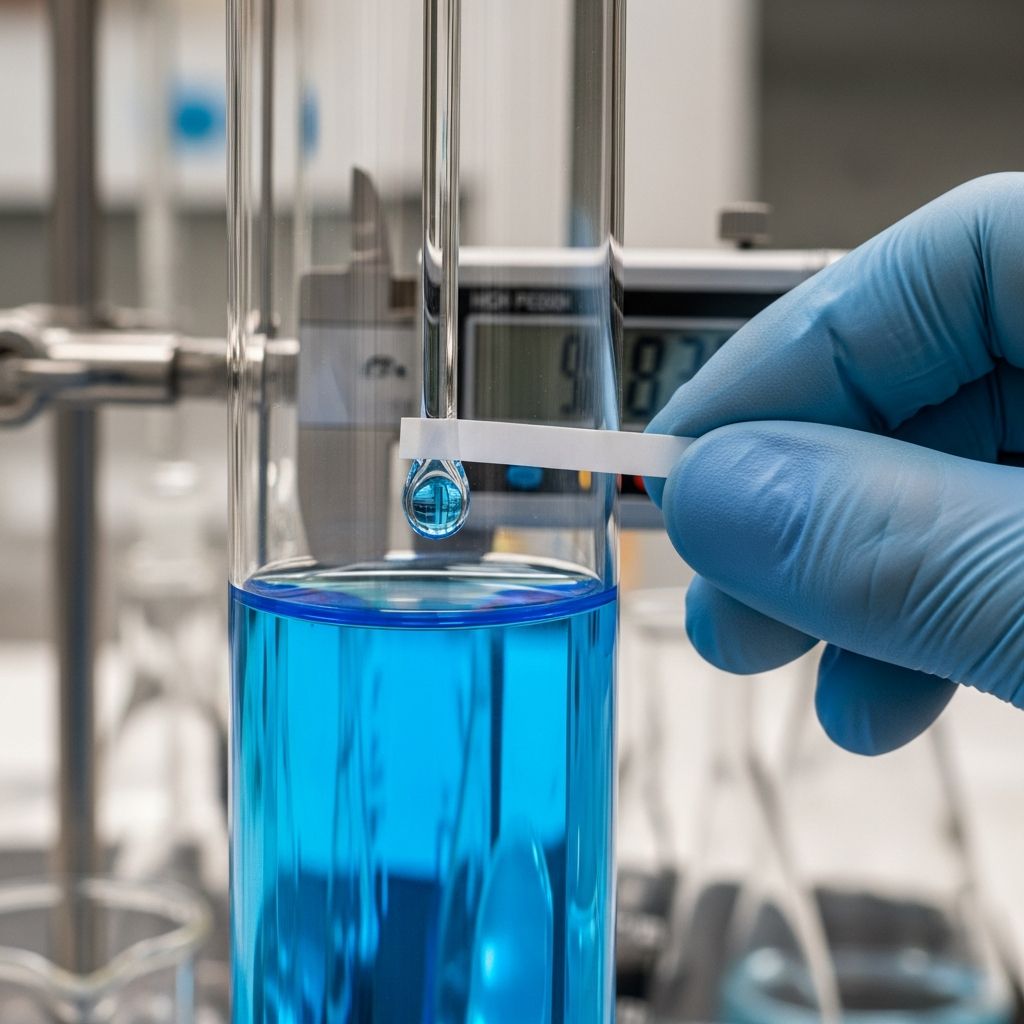
Accurate volume measurement forms the foundation of reliable experimental results in chemistry and related fields. The meniscus, that distinctive curve formed by liquids in narrow containers, plays a pivotal role in these readings. Understanding how to interpret it correctly prevents errors that could skew data and invalidate conclusions. This guide explores the science behind menisci, practical reading techniques, and advanced tools for precision.
Understanding the Meniscus Phenomenon
The meniscus arises from the interplay between liquid molecules and the container’s surface, driven by adhesive and cohesive forces. In glass or plastic tubes, water-based solutions typically exhibit a concave shape, dipping lowest in the center due to stronger adhesion to the walls than cohesion among molecules. This creates a U-shaped curve ideal for precise bottom-point readings.
Conversely, mercury forms a convex meniscus, bulging upward in the center because it does not wet glass surfaces well. Non-wetting liquids push away from walls, resulting in a dome-like appearance where the highest point marks the volume. Surface tension dictates curvature: tighter in narrower tubes, flattening in wider ones. Equilibrium must be confirmed by gentle tapping to ensure stability before recording.
Essential Tools for Volumetric Measurements
Graduated cylinders, pipettes, and burettes are staples for liquid handling. Cylinders suit rough estimates with markings every 1-10 mL, allowing readings to one decimal past the smallest division—e.g., 0.1 mL precision on 1 mL ticks. Burettes offer superior accuracy for titrations, with 0.01 mL graduations wrapping around the tube for parallax-free alignment.
- Graduated Cylinders: Broad base for stability; read bottom of concave meniscus.
- Burettes: Narrow, tall design; read top-down from zero at the top.
- Pipettes: Fixed or variable volumes; estimate to two decimals.
For flat menisci in certain plastics with water, read straight across the middle.
Step-by-Step Guide to Reading a Meniscus
Position yourself at eye level with the liquid surface to eliminate distortion. For portable glassware, lift to chest height; for fixed setups, adjust your stance. Align the front and rear graduation lines to form a single line, confirming perpendicular viewing.
- Approach the container squarely, avoiding angled sightlines that cause parallax shifts.
- Gently tap to settle the liquid into equilibrium.
- For concave: Focus on the lowest central point against the scale.
- For convex: Note the highest central point.
- Estimate beyond markings: One-fifth the smallest division for the next decimal.
In practice, a 2.7-2.8 mL reading on 0.1 mL ticks might refine to 2.74 mL by eyeing one-fifth intervals. Always include trailing zeros for precision, like 15.0 mL.
Overcoming Common Reading Challenges
Parallax error tops the list of pitfalls, where off-angle views make the meniscus appear shifted. Counter it by sighting slightly below the line until front and back markings align perfectly. Lighting matters: Backlight with a white card for concave visibility or black shading for convex profiles.
Narrow tubes amplify curvature, demanding sharper focus; wider ones near-flat require middle-line reads. Temperature affects viscosity and thus shape—calibrate accordingly. Dirty glassware distorts menisci; rinse thoroughly with the liquid first.
| Meniscus Type | Reading Point | Common Liquids | Visual Aid |
|---|---|---|---|
| Concave | Bottom center | Water, alcohols | White card behind |
| Convex | Top center | Mercury, non-wetting | Black screen below |
| Flat | Straight across | Water in some plastics | None needed |
Advanced Techniques and Calibration Methods
Professional calibrations employ standardized protocols. NIST guidelines specify Option A: Eye below the graduation plane, centering the meniscus in the ellipse formed by dual-sided lines. Option B uses a tangent line at the upper edge plane, minimizing offsets.
Meniscus readers enhance accuracy: Black/white cards sharpen edges, magnifying cross-hairs align sights, and rubber collars block stray light. For volumetric glassware certification, treat reading errors as triangular distributions, factoring meniscus thickness beyond lines. Volume calculations integrate radius and height for non-cylindrical shapes.
In titrations, burette readings descend from top zero, tracking dispensed volumes to two decimals. Video demonstrations confirm: Squat for eye-level, read bottom for most aqueous solutions.
Practical Applications Across Disciplines
Beyond chemistry labs, meniscus reading ensures precision in pharmaceuticals for dose prep, environmental testing for pollutant volumes, and food science for ingredient ratios. NIST videos train fuel dispensers on similar techniques. Even biology labs measure reagents accurately for protocols.
In education, mastering this skill builds foundational lab competency. Errors here propagate through calculations, like molarity (M = moles/volume), underscoring volume’s criticality.
Frequently Asked Questions
What is the correct eye position for reading volumes?
Align your eye directly level with the meniscus center, either by lifting glassware or bending down, to avoid parallax.
How do I read a burette versus a graduated cylinder?
Burettes read top-down from zero, to 0.01 mL; cylinders bottom-up to 0.1 mL typically. Both use meniscus bottom for concave.
Why does mercury have a different meniscus shape?
Its non-wetting property with glass causes convex bulging; read the top.
Can I read to more decimals than marked?
Yes, estimate one decimal past smallest ticks, or one-fifth for finer, including zeros.
What if the meniscus is flat?
Read straight across the middle, common with water in plastics.
Best Practices for Lab Precision
Combine techniques: Use aids, confirm equilibrium, record promptly. Practice with known volumes builds intuition. Cleanliness and consistent methods yield reproducible data, vital for scientific integrity.
(Word count: 1678)
References
- How to Read a Meniscus in Chemistry — Westlab. Accessed 2026. https://www.westlab.com/blog/how-to-read-a-meniscus-in-chemistry
- GMP 3 Reading a Meniscus — NIST. 2019-05-07. https://www.nist.gov/document/gmp-3-reading-meniscus-20190507pdf
- CHE111L How to Read a Meniscus — YouTube (Hughes’ Views). Accessed 2026. https://www.youtube.com/watch?v=fV5bp0GI2M4
- (Technique) Reading a meniscus — YouTube. Accessed 2026. https://www.youtube.com/watch?v=HqXCu271b-c
- Meniscus | Definition, Reading & Examples — Study.com. Accessed 2026. https://study.com/learn/lesson/meniscus-liquid-uses-examples-science.html
- Reading the Meniscus | NIST — NIST. 2014-09-10. https://www.nist.gov/video/reading-meniscus
- Volumetric and Graduated Glassware — Vanderbilt University. Accessed 2026. https://www.vanderbilt.edu/AnS/Chemistry/courses/chem104/experiment1/volumetric/volumetric2.htm

Medha Deb is an editor with a master's degree in Applied Linguistics from the University of Hyderabad. She believes that her qualification has helped her develop a deep understanding of language and its application in various contexts. Medha specializes in the areas of beauty, health, sports, and wellness and is committed to ensuring that the content on the website is…