
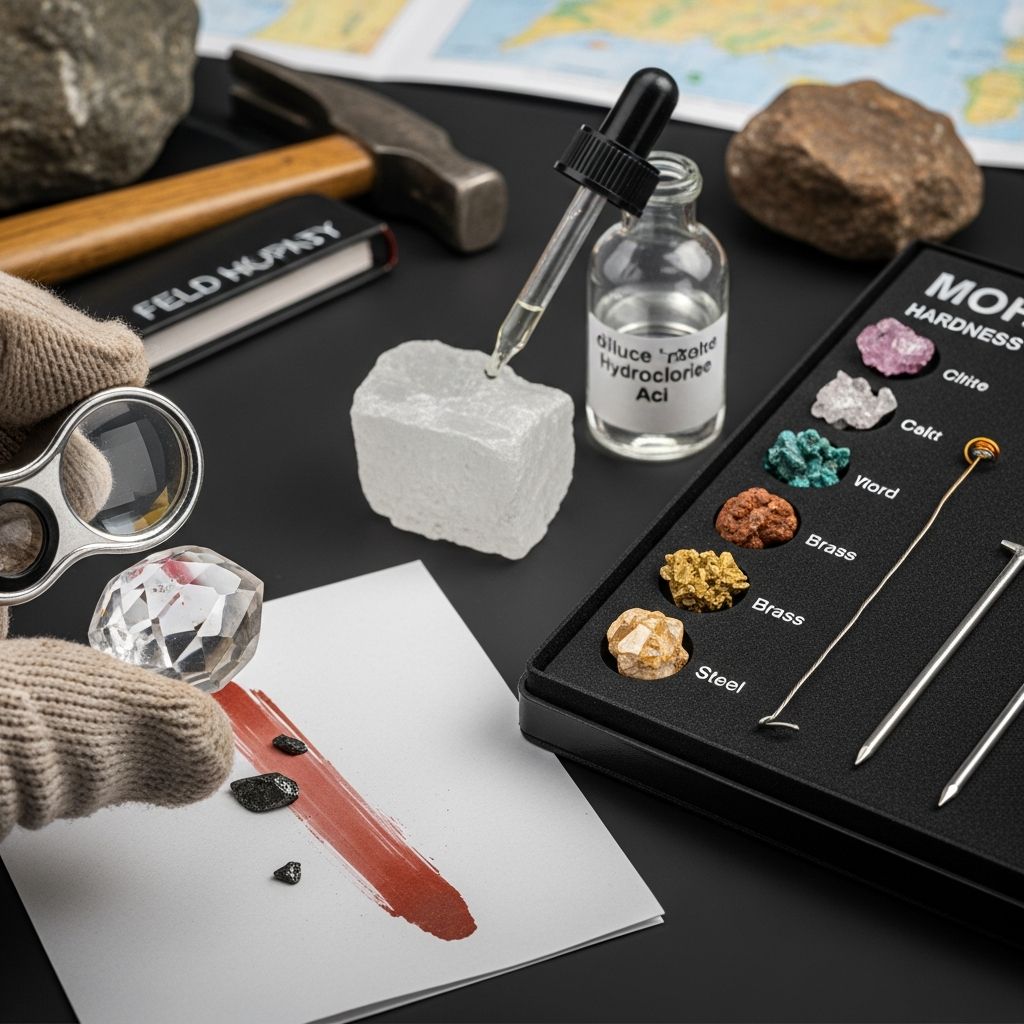
Minerals form the building blocks of rocks and hold vital clues about Earth’s history. Identifying them accurately requires systematic observation of physical traits tied to their atomic structure and chemistry. This guide equips beginners and experts with practical steps to distinguish over 4,000 known minerals using simple tools and tests.
Why Physical Properties Matter in Mineralogy
Every mineral’s unique combination of traits stems from its internal lattice and chemical bonds. Geologists prioritize observable features over complex lab analysis for fieldwork. Common properties include external shape, light interaction, scratch resistance, fracture patterns, and density. These diagnostics allow reliable classification without advanced equipment.
Start with the largest, cleanest sample available. Note all traits before consulting charts or keys. Consistency across multiple specimens confirms identity.
Evaluating Crystal Habits and Forms
The outward shape of a mineral, or crystal habit, reveals its internal order. Well-formed crystals display geometric faces reflecting atomic arrangements. Common habits include:
- Prismatic: Elongated like quartz columns.
- Bladed: Thin and flat, as in some feldspars.
- Massive: No distinct form, like chalky limestone.
- Tabular: Plate-like, seen in micas.
Examine under good light for twinning or striations—fine lines indicating composite growth. Crystal systems (cubic, hexagonal) further narrow options.
Assessing Luster: Light Reflection Clues
Luster describes how a mineral reflects light, ranging from dull to brilliant. Key types include:
- Metallic: Opaque shine like galena or pyrite.
- Vitreous: Glassy, typical of quartz.
- Pearly: Iridescent, as in talc.
- Greasy: Oily appearance in nephrite jade.
Test by tilting the sample; metallic lusters feel heavy and conduct heat. Non-metallic divide into sub-lusters like adamantine (diamond-like) or silky (fibrous asbestos).
Color: A Starting Point with Limitations
Color attracts attention first but deceives due to impurities. Idiochromatic minerals owe hue to composition—malachite’s green from copper, cinnabar’s red from sulfur. Allochromatic types vary widely; quartz appears in rose, smoky, or clear forms from trace elements.
Use color for initial grouping, but confirm with other tests. Azurite’s consistent blue aids quick recognition, while hematite shifts from metallic gray to earthy red.
Streak: The True Color Test
Streak reveals powder color by scraping on unglazed porcelain (hardness 6.5-7). It trumps hand-sample color for reliability. Pyrite’s golden sheen yields greenish-black streak, ruling out gold’s yellow one. Hematite’s red streak persists despite varied appearances.
| Mineral | Hand Color | Streak Color |
|---|---|---|
| Pyrite | Brassy yellow | Greenish-black |
| Hematite | Gray to red | Reddish-brown |
| Gold | Yellow | Golden yellow |
Colorless minerals like quartz leave no streak. Repeat on fresh surfaces for accuracy.
Hardness via Mohs Scale
Hardness measures scratch resistance, quantified by Mohs scale (1-10). Test with common objects or minerals:
| Hardness | Reference Mineral | Common Test |
|---|---|---|
| 1 | Talc | Fingernail |
| 2-2.5 | Gypsum | |
| 3 | Calcite | Copper penny |
| 4-5 | Fluorite/Apatite | Iron nail |
| 6 | Orthoclase | Glass plate |
| 7 | Quartz | Steel file |
| 8-10 | Topaz/Diamond |
Quartz (7) scratches apatite (5) but not topaz (8). Bidirectional scratching confirms equality. Avoid confusing with toughness—diamond scratches all but cleaves easily.
Cleavage, Fracture, and Break Patterns
Cleavage follows weak atomic planes, producing flat breaks. Count planes and angles:
- One direction: Basal like mica (perfect sheets).
- Three at 90°: Cubic like galena.
- Three not at 90°: Rhombohedral like calcite.
Fracture occurs without cleavage—conchoidal (shell-like, quartz), hackly (jagged, copper), or uneven. Both reveal structure.
Density and Specific Gravity Checks
Specific gravity (SG) compares mineral weight to water’s. Heft first: galena (SG 7.5) feels heavy. Calculate via water displacement for precision. Barite (4.5) sinks swiftly; talc (2.7) floats longer.
Special Traits for Definitive ID
Unique reactions seal identification:
- Magnetism: Magnetite attracts strongly; pyrrhotite weakly.
- Effervescence: Calcite fizzes in dilute HCl.
- Fluorescence: Scheelite glows blue under UV.
- Taste: Halite salty; never taste unknowns.
- Odor: Sulfur reeks when rubbed.
Radioactivity in uraninite requires Geiger counters—handle cautiously.
Step-by-Step Field Identification Workflow
- Observe habit and luster.
- Note color and perform streak.
- Test hardness progressively.
- Examine cleavage/fracture.
- Check heft and special traits.
- Consult keys or apps.
Practice on known samples like quartz or feldspar. Table rock-formers first.
Tools for Every Rockhound
Essential kit: streak plate, magnet, hardness set (fingernail to steel), loupe (10x), HCl dropper, UV light. Hand lens reveals microcrystals.
Common Pitfalls and Pro Tips
Avoid over-relying on color. Weathering alters surfaces—clean samples. Twins mimic multiple crystals. Log data systematically for complex IDs.
Frequently Asked Questions
What is the quickest mineral test?
Hardness via Mohs—use everyday items like pennies or nails for rapid sorting.
Why does streak differ from color?
Powder eliminates impurities and thin-film interference, showing true composition.
Can I identify minerals without tools?
Yes, via heft, cleavage, and luster, but accuracy improves with streak plate and magnet.
Is gold hard to mistake?
Pyrite fools many, but gold’s yellow streak, softness (2.5), and high SG distinguish it.
How accurate is field ID?
90% for common minerals; lab XRF confirms rares.
Advanced Identification Resources
Keys like Dana or online galleries match traits. Apps simulate tests. Join clubs for hands-on practice.
References
- Methods Used to Identify Minerals — Kentucky Geological Survey, University of Kentucky. N/A. https://www.uky.edu/KGS/rocksmineral/minerals_methods_used_to_identify.pdf
- How to Identify Minerals in 10 Steps — Geology In. 2014-11-01. https://www.geologyin.com/2014/11/how-to-identify-minerals-in-10-steps.html
- Glad You Asked: How Do Geologists Identify Minerals? — Utah Geological Survey (.gov). N/A. https://geology.utah.gov/map-pub/survey-notes/glad-you-asked/how-do-geologists-identify-minerals/
- Mineral Identification — Lumen Learning (based on SUNY Earth Science, .edu). N/A. https://courses.lumenlearning.com/suny-earthscience/chapter/mineral-identification/
- Mineral Identification — Geosciences LibreTexts (.edu). N/A. https://geo.libretexts.org/Bookshelves/Geology/Fundamentals_of_Geology_(Schulte)/02:_Rock_Forming_Minerals/2.03:_Mineral_Identification
- Identifying Minerals — Geoscience Australia via Google Arts & Culture (.gov.au). N/A. https://artsandculture.google.com/story/identifying-minerals-geoscience-australia/QgXh9pyyxhIYKQ?hl=en

Medha Deb is an editor with a master's degree in Applied Linguistics from the University of Hyderabad. She believes that her qualification has helped her develop a deep understanding of language and its application in various contexts. Medha specializes in the areas of beauty, health, sports, and wellness and is committed to ensuring that the content on the website is…