
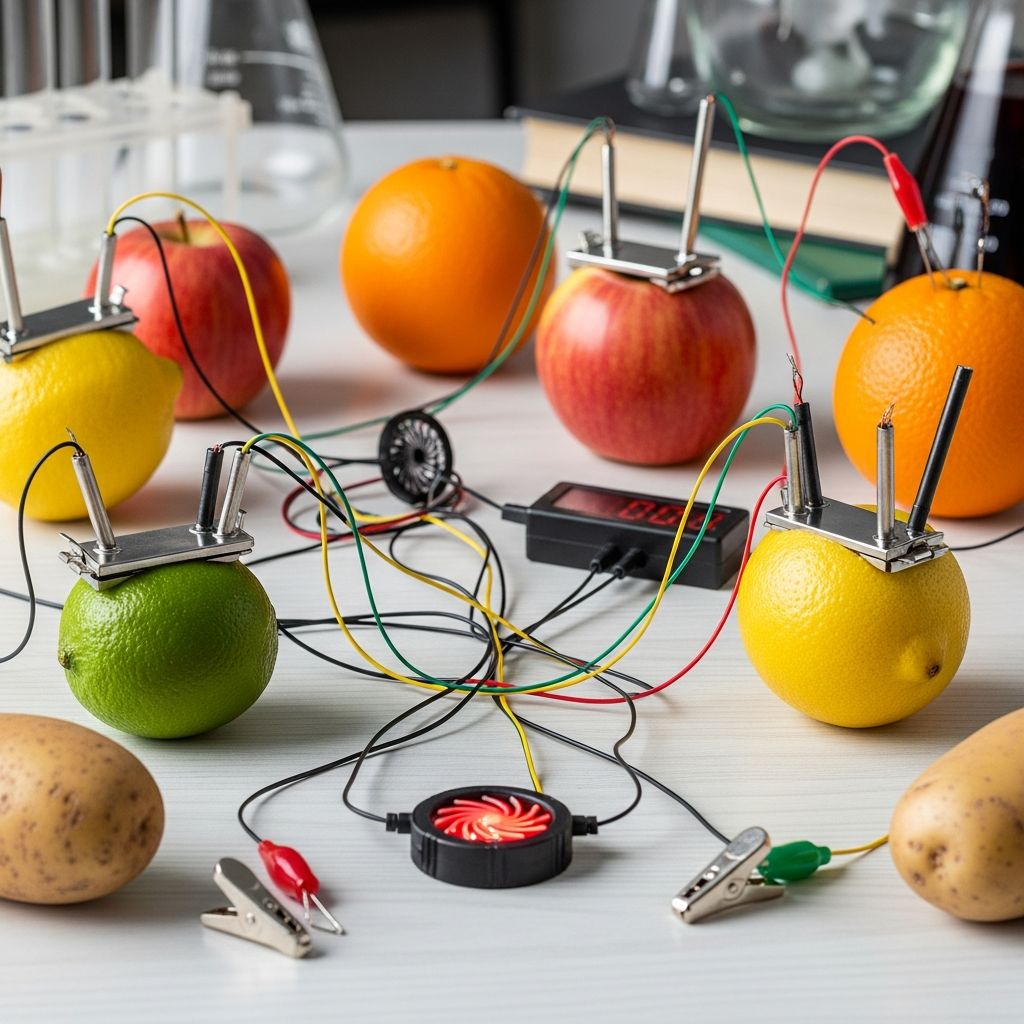
Transform ordinary kitchen staples into sources of electricity through the fascinating world of fruit batteries. This experiment reveals how acidic fruits and vegetables can generate power via simple chemical reactions, making it an ideal project for curious minds exploring electricity and chemistry at home or in the classroom.
Understanding the Science Behind Fruit-Powered Electricity
At its core, a fruit battery operates on principles of electrochemistry, where two dissimilar metals immersed in an electrolyte produce a voltage difference. Fruits like lemons contain citric acid, which serves as the electrolyte, facilitating ion movement between electrodes such as zinc and copper.
The zinc electrode (anode) oxidizes, releasing electrons that flow toward the copper electrode (cathode) through an external circuit. This electron flow constitutes electric current, capable of lighting small LEDs when multiple cells are connected in series. Each fruit cell typically generates 0.7 to 1 volt, depending on the fruit’s acidity and ripeness.
This setup mimics commercial batteries but uses biodegradable materials, highlighting sustainable energy concepts. The reaction is: Zn → Zn²⁺ + 2e⁻ at the anode, and 2H⁺ + 2e⁻ → H₂ at the cathode, though in practice, hydrogen evolution is minimal.
Gathering Your Materials for Success
To build effective fruit batteries, select items that maximize conductivity and voltage output. Here’s a comprehensive list:
- Fruits and Vegetables: Lemons, limes, oranges, grapefruits, tomatoes, apples, kiwis, or potatoes (boiled potatoes work best for higher output).
- Electrodes: Galvanized zinc nails (anode) and copper coins, pennies (pre-1982 for pure copper), or copper wire (cathode).
- Connectors: Alligator clips or insulated copper wire with stripped ends for linking cells.
- Testing Tools: Multimeter or voltmeter to measure voltage; small LEDs (red requires least voltage, blue the most).
- Safety Items: Cutting board, knife (adult supervision required), gloves optional.
Start with 4-10 fruits for sufficient voltage to light an LED, as single cells produce under 1V.
Step-by-Step Construction of Your Fruit Battery
Follow these precise steps to assemble a working fruit battery chain capable of powering an LED.
- Prepare the Produce: Roll each fruit firmly on a flat surface to rupture internal membranes and release juices, enhancing electrolyte availability. For potatoes, boil briefly (5 minutes) then cool completely.
- Insert Electrodes: Carefully slice fruits if needed for better access, but avoid full cuts. Insert zinc nail into one side and copper piece into the opposite side, ensuring 1-2 cm separation to prevent short-circuiting.
- Test Individual Cells: Use a multimeter to check voltage; lemons often yield ~0.9V, tomatoes slightly less.
- Connect in Series: Link cells by attaching an alligator clip from the zinc nail of one fruit to the copper of the next. Repeat for 4-7 cells.
- Attach the Load: Connect the free copper end (positive) to the LED’s longer leg and the free zinc end (negative) to the shorter leg. Polarity matters—reverse if it doesn’t light.
Your chain should now glow, demonstrating cumulative voltage (e.g., 4 lemons ≈ 3.6V for a green LED).
Comparing Produce: Which Makes the Best Battery?
Not all produce performs equally. Experiment to find top performers by measuring voltages.
| Produce | Average Voltage (V) | Notes |
|---|---|---|
| Lemon | 0.9-1.0 | High citric acid; reliable. |
| Potato (boiled) | 0.8-1.1 | Phosphoric acid; stable output. |
| Tomato | 0.7-0.9 | Juicy; good for beginners. |
| Apple | 0.5-0.7 | Lower acidity; needs more cells. |
| Grapefruit | 0.9-1.0 | Strong performer like lemon. |
Acidity correlates with voltage; pH testing confirms lemons (pH ~2) outperform apples (pH ~3.5). Boiled potatoes excel due to released starches forming better electrolytes.
Advanced Experiments to Boost Learning
Extend the project with these variations to deepen understanding:
- Ripeness Impact: Test green, ripe, and overripe fruits—riper ones often produce more juice but may corrode electrodes faster.
- Electrode Variations: Compare nail sizes or pure vs. coated pennies; larger surface area increases current.
- Hybrid Batteries: Mix fruits (e.g., lemon-potato chain) for optimized voltage.
- Power Measurement: Use multimeter for voltage and current; calculate power (P=IV) to see why LEDs (low mA) work best.
- Duration Test: Time how long the battery lasts—typically 30-60 minutes before electrodes degrade.
These tweaks reveal variables like electrolyte strength and electrode reactivity.
Troubleshooting Common Issues
Encounter problems? Address them systematically:
- No Light: Check connections, polarity, and add more cells for voltage.
- Dim Glow: Ensure electrodes don’t touch inside fruit; clean corrosion.
- Low Voltage: Use fresher, juicier produce; roll harder.
- LED Burns Out: Select low-voltage LEDs (1.5-3V); red first.
Safety first: Supervise cuts, avoid ingestion of corroded parts, and wash hands.
Frequently Asked Questions (FAQs)
Can any fruit work as a battery?
Most acidic fruits and some vegetables yes, but higher acidity yields better results. Neutral produce like bananas fails due to insufficient electrolytes.
How much voltage does one lemon produce?
Approximately 0.9 volts, enough for basic tests but not standalone LED lighting.
Why zinc and copper specifically?
Their electrochemical potential difference (zinc more reactive) drives electron flow; alternatives like magnesium work but corrode faster.
Is this a real battery?
Yes, a voltaic cell array, though low-power and non-rechargeable unlike alkaline batteries.
Can I power bigger devices?
Limited to micro-loads like LEDs; scale up with dozens of cells for clocks, but impractical.
Educational Value and Real-World Connections
Fruit batteries teach circuits, chemical reactions, and sustainability. They illustrate voltaic piles invented by Alessandro Volta in 1800, foundational to modern batteries. In classrooms, integrate with renewable energy discussions—bio-electrolytes inspire green tech.
Challenge students to graph voltages or hypothesize based on pH, fostering scientific method skills. This project aligns with NGSS standards on energy transfer.
Environmentally, it promotes waste reduction by repurposing produce, contrasting disposable batteries’ pollution. Explore extensions like microbial fuel cells using fruit waste for advanced bioenergy.
References
- Phizzi Practical – Fruity Batteries — The Ogden Trust. 2021-09. https://www.ogdentrust.com/wp-content/uploads/2021/09/Phizzi_Practical_Fruity_batteries.pdf
- Fruit Battery Science Experiment — Jennifer Findley. Accessed 2026. https://jenniferfindley.com/fruit-battery-science-experiment/
- Simple Lemon Battery — ResearchParent.com. Accessed 2026. https://researchparent.com/simple-lemon-battery/
- Build a Lemon Battery — American Chemical Society. Accessed 2026. https://www.acs.org/content/dam/acsorg/education/outreach/kidszone/kids-zone-build-a-lemon-battery.pdf
- Fruit Battery – Activity — Imperial College London. Accessed 2026. https://www.imperial.ac.uk/be-inspired/schools-outreach/secondary-schools/stem-in-action/energy-and-sustainability/fruit-battery–activity/

Medha Deb is an editor with a master's degree in Applied Linguistics from the University of Hyderabad. She believes that her qualification has helped her develop a deep understanding of language and its application in various contexts. Medha specializes in the areas of beauty, health, sports, and wellness and is committed to ensuring that the content on the website is…