
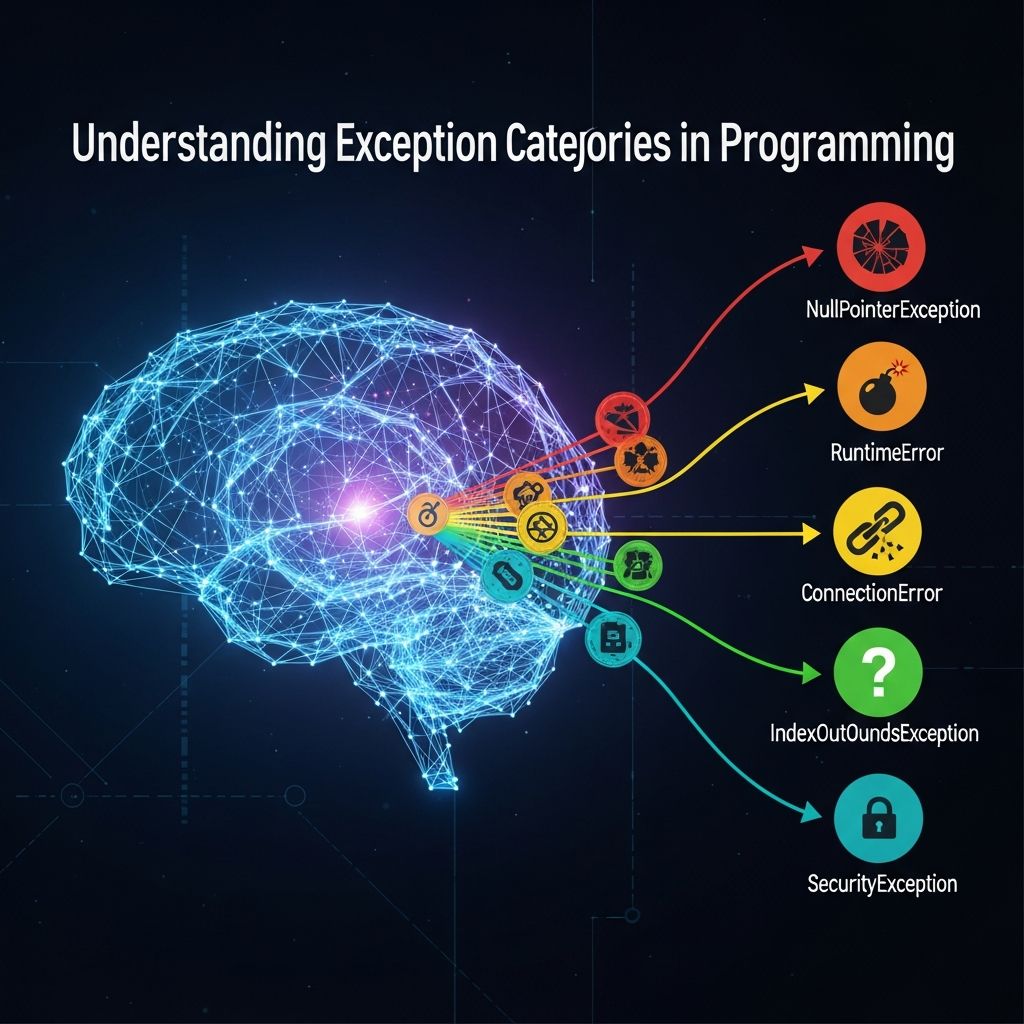
Exceptions represent unexpected events or errors that disrupt normal program execution, requiring structured handling to maintain application stability. Programming languages like Java, Python, and .NET classify these into distinct categories such as checked, unchecked, built-in, and custom-defined types, each serving specific error scenarios.
Core Framework of Exception Hierarchies
At the foundation, exceptions derive from base classes tailored to language designs. In Java, all exceptions inherit from java.lang.Throwable, branching into Exception for recoverable issues and Error for severe, unrecoverable system problems. Python uses a similar hierarchy with BaseException as the root, encompassing Exception and specialized errors like SystemExit. .NET employs System.Exception as the universal superclass, promoting standardized responses.
These hierarchies enable precise catch blocks, allowing developers to target specific error types while propagating others upward for broader handling. Understanding this structure prevents overgeneralized catches that mask critical issues.
Checked Exceptions: Compile-Time Safeguards
Checked exceptions enforce error anticipation at compile time, compelling developers to address potential failures explicitly. Java exemplifies this with types like IOException and ClassNotFoundException, where compilers reject code lacking try-catch or throws declarations.
This mechanism fosters defensive programming; for instance, file operations must handle FileNotFoundException to avoid runtime crashes. In contrast, Python and .NET largely omit checked exceptions, relying on runtime detection, though .NET guidelines recommend explicit throws for invalid arguments via ArgumentException.
| Language | Checked Examples | Handling Requirement |
|---|---|---|
| Java | SQLException, IOException | Compile-time enforced |
| Python | None (all runtime) | Optional |
| .NET | Limited (e.g., some IO) | Guideline-based |
Unchecked Exceptions: Runtime Discoveries
Unchecked exceptions, or runtime exceptions, evade compile-time checks, surfacing only during execution. Java’s RuntimeException subclasses like NullPointerException and ArrayIndexOutOfBoundsException typify these, often stemming from programming oversights.
A NullPointerException arises when accessing members of a null reference, while NumberFormatException occurs during invalid string-to-number conversions. Python mirrors this with TypeError for incompatible operations and IndexError for out-of-bounds access. These demand rigorous testing rather than mandatory handling.
- NullPointerException (Java): Attempting
nullObject.method(). - IndexError (Python):
myList[10]on a short list. - ArgumentOutOfRangeException (.NET): Invalid index or value passed.
Built-in Exceptions: Language-Specific Tools
Every language ships with predefined exceptions for common pitfalls. Java includes ArithmeticException for divide-by-zero and StringIndexOutOfBoundsException for invalid string accesses. Python offers ZeroDivisionError, KeyError for missing dictionary keys, and IndentationError for formatting issues.
In .NET, DivideByZeroException and FormatException cover numerical and parsing errors, with guidelines urging ArgumentNullException for null parameters. These built-ins reduce custom code needs, standardizing error responses across applications.
Common Built-in Exceptions Across Languages
| Error Type | Java | Python | .NET |
|---|---|---|---|
| Division by Zero | ArithmeticException | ZeroDivisionError | DivideByZeroException |
| Invalid Index | ArrayIndexOutOfBoundsException | IndexError | IndexOutOfRangeException |
| Null Reference | NullPointerException | AttributeError | NullReferenceException |
| Parse Failure | NumberFormatException | ValueError | FormatException |
Errors vs Exceptions: Severity Distinctions
Errors signal irrecoverable conditions beyond programmer control, like out-of-memory or link failures. Java’s OutOfMemoryError and StackOverflowError fall here, typically uncaught. Python’s MemoryError and RecursionError similarly indicate systemic failures.
Distinguishing errors from exceptions guides recovery strategies: exceptions invite handling, errors prompt application restarts or diagnostics.
Custom User-Defined Exceptions
When built-ins fall short, developers craft tailored exceptions. In Java, extend Exception or RuntimeException: public class InvalidUserInputException extends Exception { ... }. Python favors subclassing Exception: class CustomValidationError(Exception): pass.
.NET recommends deriving from ApplicationException for app-specific issues. Benefits include semantic clarity, as InsufficientFundsException conveys precise meaning over generic messages.
- Define class inheriting base exception.
- Add constructors mirroring parent (with/without message).
- Throw via
throw new CustomException("Reason"). - Catch specifically for targeted recovery.
Best Practices for Effective Exception Management
Robust handling minimizes crashes and aids debugging. Avoid catching Throwable broadly; target specifics. Log stack traces with context: Java’s getMessage() and getCause() provide details.
Prefer specific over general catches:
try { // risky code} catch (FileNotFoundException e) { // handle missing file} catch (IOException e) { // handle other IO issues}Python’s try-except-else-finally adds cleanup guarantees. Validate inputs preemptively to sidestep exceptions.
Real-World Handling Scenarios
Consider database access: Java wraps SQLException (checked), Python uses sqlite3.Error. Thread interruptions trigger InterruptedException in Java. API calls in .NET throw HttpRequestException for network woes.
These examples underscore language nuances while sharing principles: anticipate, isolate, recover.
Frequently Asked Questions (FAQs)
What distinguishes checked from unchecked exceptions?
Checked exceptions require compile-time handling in Java; unchecked occur at runtime without enforcement.
Should I catch all exceptions?
No—catch specifics to avoid masking bugs; let unhandled ones propagate for logging.
How do I create a custom exception in Python?
Subclass Exception: class MyError(Exception): pass, then raise MyError("msg").
Are Errors recoverable?
Rarely; they indicate severe issues like memory exhaustion, often requiring restarts.
What’s a NullPointerException equivalent in Python?
AttributeError when accessing attributes on None.
Conclusion: Building Resilient Applications
Mastering exception types empowers developers to craft fault-tolerant software. By leveraging language-specific tools and universal best practices, applications withstand real-world stresses, enhancing reliability and user trust.
References
- Types of Exception in Java with Examples — GeeksforGeeks. 2023-10-15. https://www.geeksforgeeks.org/java/types-of-exception-in-java-with-examples/
- Python Built-in Exceptions — W3Schools. 2024-01-20. https://www.w3schools.com/python/python_ref_exceptions.asp
- Types of Exceptions in Java — Stackify. 2022-05-12. https://stackify.com/types-of-exceptions-java/
- Using Standard Exception Types — Microsoft Learn (.gov equivalent for docs). 2024-03-08. https://learn.microsoft.com/en-us/dotnet/standard/design-guidelines/using-standard-exception-types
- Built-in Exceptions — Python Official Documentation. 2025-09-10. https://docs.python.org/3/library/exceptions.html

Medha Deb is an editor with a master's degree in Applied Linguistics from the University of Hyderabad. She believes that her qualification has helped her develop a deep understanding of language and its application in various contexts. Medha specializes in the areas of beauty, health, sports, and wellness and is committed to ensuring that the content on the website is…