
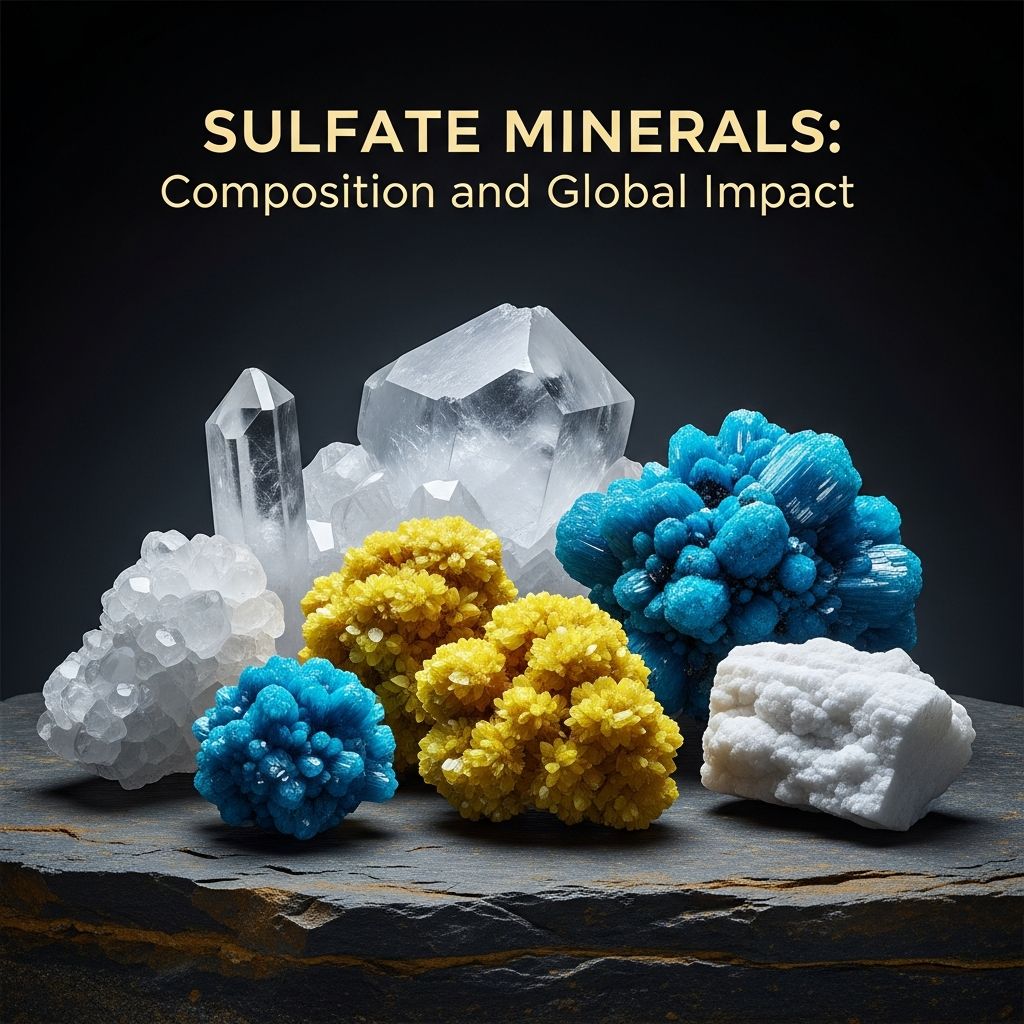
Sulfate minerals form a diverse class of naturally occurring compounds characterized by the presence of the sulfate ion (SO42-), which consists of a sulfur atom bonded to four oxygen atoms in a tetrahedral arrangement. These minerals are essential in geological processes, industrial applications, and environmental systems, with over 200 recognized varieties, though only a few are abundant and economically significant.
Fundamental Chemistry and Crystal Structures
The defining feature of sulfate minerals is the discrete SO42- tetrahedron, where sulfur occupies the center and oxygen atoms form the corners. Unlike silicates, which polymerize into complex frameworks, sulfate tetrahedra remain isolated, behaving as complex anions that pair with metal cations. This structure imparts distinct physical properties, such as moderate hardness and varied solubility.
Sulfate minerals divide into anhydrous (water-free) and hydrous (water-containing) categories. Anhydrous sulfates, like barite (BaSO4) and anhydrite (CaSO4), feature cations such as barium, strontium, or calcium alternating with sulfate groups. Hydrous sulfates incorporate water molecules, as in gypsum (CaSO4·2H2O).
| Mineral | Formula | Type | Key Property |
|---|---|---|---|
| Gypsum | CaSO4·2H2O | Hydrous | Soft, cleavable |
| Anhydrite | CaSO4 | Anhydrous | Harder than gypsum |
| Barite | BaSO4 | Anhydrous | High density |
| Celestite | SrSO4 | Anhydrous | Bluish crystals |
This table highlights common examples, illustrating substitution of cations like Ca2+, Ba2+, and Sr2+ in similar structures.
Geological Origins and Formation Environments
Sulfate minerals precipitate in multiple settings. Primary evaporite deposits arise when seawater or saline lake waters evaporate, sequentially depositing sulfates after halides. Common sequences begin with gypsum, transitioning to anhydrite under hotter, drier conditions.
- Evaporite Basins: Thick layers of gypsum and anhydrite form in restricted marine basins, often interbedded with halite and carbonates.
- Oxidation Zones: In sulfide ore deposits, weathering produces secondary sulfates like anglesite (PbSO4) from galena oxidation.
- Hydrothermal Veins: Hot fluids deposit sulfates like barite in veins associated with metallic ores.
- Volcanic and Hot Spring Areas: Gases and waters yield minerals such as alunite in advanced argillic alteration zones.
These environments underscore sulfates’ role as indicators of past climatic and tectonic conditions.
Prominent Sulfate Minerals and Their Traits
Gypsum: The Ubiquitous Hydrated Sulfate
Gypsum, or hydrated calcium sulfate, is the most widespread sulfate mineral, occurring in massive, fibrous, or crystalline forms. Varieties include selenite (transparent crystals), satin spar (silky fibers), and alabaster (fine-grained, ornamental stone). Its softness (Mohs 2) allows perfect cleavage into flexible sheets, and it dehydrates to anhydrite upon heating.
Gypsum deposits span global evaporite sequences, from the White Sands of New Mexico to Permian basins in Europe.
Anhydrite: The Dehydrated Counterpart
Anhydrite forms when gypsum loses water, typically in deeper, hotter burial settings. Bluish-gray and blocky, it lacks gypsum’s cleavage and is denser. It rehydrates to gypsum near the surface, explaining transitional occurrences.
Barite and Celestite: Heavyweights of the Group
Barite (barium sulfate) stands out for its extreme density (4.5 g/cm³), earning its name from the Greek for “heavy.” Used in drilling muds, it forms tabular crystals in hydrothermal veins and sediments. Celestite (strontium sulfate) shares a similar structure, often appearing sky-blue and sourced from evaporites.
Less common hydrous sulfates like epsomite (MgSO4·7H2O) and chalcanthite (CuSO4·5H2O) form in arid or mine environments, prized by collectors for vibrant colors.
Industrial Extraction and Economic Value
Sulfate minerals drive key industries. Gypsum mines produce billions of tons annually for plaster, drywall, and cement, with pure alabaster for sculptures. Barite supplies 90% of global drilling mud for oil and gas, stabilizing boreholes due to its weight.
- Plaster of Paris: Calcined gypsum used in construction and medical casts.
- Fertilizers: Thenardite and others provide sulfur for agriculture.
- Ceramics and Glass: Celestite yields strontium compounds.
Major producers include the US, China, and Mexico for gypsum; India and China for barite.
Environmental Roles and Challenges
Sulfates influence ecosystems profoundly. In acid mine drainage, jarosite and other sulfates store heavy metals, releasing them during wet-dry cycles, complicating remediation. Volcanic sulfates like alunite signal hydrothermal activity and potential hazards.
Conversely, evaporite sulfates preserve paleoclimate data, revealing ancient arid periods. Their solubility aids groundwater sulfate levels, impacting water quality.
Identification Techniques for Sulfate Minerals
Field identification relies on luster (pearly for gypsum, vitreous for barite), cleavage, and density. Lab tests include flame colors (strontium imparts crimson) and solubility in HCl for carbonates versus sulfates.
Spectroscopy and X-ray diffraction confirm tetrahedral SO4 signatures, vital for rare species.
Frequently Asked Questions
What distinguishes sulfate minerals from other groups?
Sulfates feature isolated SO42- tetrahedra, unlike polymerizing silicates, and form mainly via evaporation or oxidation.
Is gypsum safe for everyday use?
Yes, purified gypsum is non-toxic and widely used in food (as calcium sulfate) and building materials.
Why is barite crucial in oil exploration?
Its high specific gravity increases mud density, preventing blowouts during drilling.
Can sulfate minerals indicate mineral deposits?
Yes, supergene sulfates like anglesite guide prospectors to primary sulfides.
How do hydrous and anhydrous sulfates differ in stability?
Hydrous forms like gypsum hydrate easily; anhydrous like anhydrite require higher temperatures for formation.
Future Prospects in Sulfate Mineral Research
Advancing studies focus on sulfates’ geochemical cycling, especially in climate change contexts where evaporites may expand. Nanotechnology explores barite for pollution control, adsorbing heavy metals. Remote sensing maps acid-sulfate alterations for geothermal energy.
In summary, sulfate minerals bridge geology, industry, and environment, with ongoing research unlocking new applications while addressing sustainability.
References
- Sulfate mineral – Wikipedia — Wikipedia contributors. 2023-10-01. https://en.wikipedia.org/wiki/Sulfate_mineral
- Sulfate mineral | Types, Properties & Uses – Britannica — Encyclopædia Britannica. 2024-01-15. https://www.britannica.com/science/sulfate-mineral
- 7.4.4: Sulfate Minerals – Geosciences LibreTexts — Geosciences LibreTexts. 2022-08-20. https://geo.libretexts.org/Bookshelves/Geology/Mineralogy_(Perkins_et_al.)/07:_Sedimentary_Minerals_and_Sedimentary_Rocks/7.04:_Sedimentary_Minerals/7.4.04:_Sulfate_Minerals
- 14.9 Sulfate Minerals – Mineralogy — University of Tennessee Chattanooga Pressbooks. 2023-05-10. https://utc.pressbooks.pub/mineralogy/chapter/sulfate-minerals/
- Sulfate Minerals: Crystallography, Geochemistry, and Environmental Significance — Mineralogical Society of America. 2000-01-01. http://www.minsocam.org/msa/rim/rim40.html
- Origin of secondary sulfate minerals on active andesitic stratovolcanoes — U.S. Geological Survey. 2000-07-28. https://www.usgs.gov/publications/origin-secondary-sulfate-minerals-active-andesitic-stratovolcanoes

Medha Deb is an editor with a master's degree in Applied Linguistics from the University of Hyderabad. She believes that her qualification has helped her develop a deep understanding of language and its application in various contexts. Medha specializes in the areas of beauty, health, sports, and wellness and is committed to ensuring that the content on the website is…