
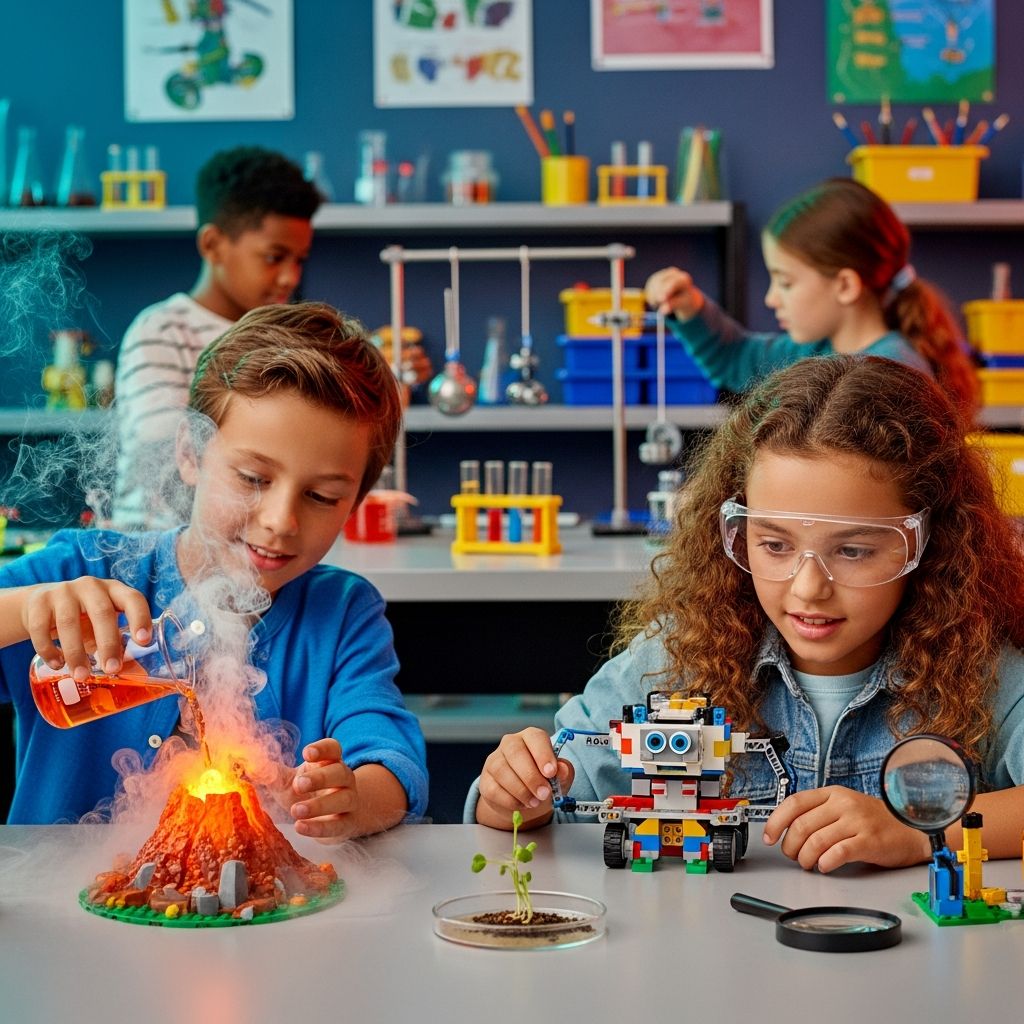
LEGO bricks transform ordinary playtime into extraordinary learning adventures. These interlocking toys provide the perfect medium for exploring scientific principles through construction and experimentation. From understanding gravity to modeling chemical reactions, LEGO enables children to grasp complex ideas intuitively. This guide presents over 40 original project ideas, organized by scientific discipline, to inspire educators, parents, and young inventors.
Mastering Motion and Forces
Forces and motion form the foundation of physics, and LEGO offers tangible ways to demonstrate these concepts. Children can build vehicles and structures to test how pushes, pulls, and inclines affect speed and direction.
- Balloon Propulsion Vehicles: Construct a lightweight car chassis with axles and wheels. Attach a balloon to the top, inflate it, and release. Observe how air escapes, propelling the car forward, illustrating Newton’s third law of motion—action and reaction.
- Rubber Band Launchers: Assemble a simple catapult using plates and beams. Wind a rubber band around the axle and launch small objects. Measure distances to compare tension levels, exploring elastic potential energy conversion to kinetic energy.
- Incline Speed Tests: Build adjustable ramps with varying slopes. Roll marble-sized LEGO balls down them and time the descents. Discuss how gravity accelerates objects on steeper angles, introducing concepts of friction and acceleration.
These activities encourage prediction and measurement, key scientific skills. Variations include adding weights to vehicles for mass impact studies.
Exploring Buoyancy and Density
Density determines whether objects sink or float, a principle easily tested with LEGO in water and other liquids.
- Brick Density Challenge: Select bricks of different sizes and place them in water, oil, and saltwater. Note which float or sink. Larger, air-filled structures buoy better, teaching Archimedes’ principle.
- Boat Load Tests: Design flat-bottomed boats from plates. Gradually add pennies or small bricks until they submerge. Calculate maximum loads to compare designs, fostering engineering optimization.
- Layered Liquid Towers: Stack immiscible liquids like oil, water, and syrup in a clear container. Drop LEGO pieces to see where they settle based on density, visualizing stratification.
| Liquid | Density (g/cm³) | LEGO Brick Behavior |
|---|---|---|
| Oil | 0.9 | Most bricks float |
| Water | 1.0 | Dense bricks sink |
| Syrup | 1.3 | All bricks sink |
This table summarizes observations, helping kids quantify results.
Chemical Reactions and Earth Science Models
LEGO excels at simulating geological and chemical processes without mess.
- Erupting Mountain Builds: Shape a volcano cone around a central chamber. Add baking soda and vinegar for a fizzy eruption. Discuss acid-base reactions producing carbon dioxide gas.
- Soil Profile Cross-Sections: Stack bricks in layers: brown for topsoil, red for subsoil, black for bedrock. Bury ‘artifacts’ and excavate, mimicking archaeology while learning sediment layers.
- Atom Bonding Demonstrations: Use colored bricks as atoms. Connect same-color for elements, different for compounds. Rearrange to show reactions like H2 + O2 → 2H2O.
These models make abstract chemistry concrete, aligning with MIT’s educational approaches.
Simple Machines and Mechanical Systems
Introduce levers, pulleys, and gears through functional LEGO assemblies.
- Pulley Lift Systems: Rig a block and tackle with string over wheels. Lift heavy loads with minimal effort, demonstrating mechanical advantage.
- Gear Train Mechanisms: Link gears of varying sizes. Turn one and observe speed/torque changes, explaining gear ratios.
- Balance Scale Contraptions: Build a seesaw with a central pivot. Compare weights on each side, exploring equilibrium.
Light, Magnetism, and Electricity Basics
LEGO facilitates experiments with invisible forces like magnetism and light.
- Magnetic Path Mazes: Construct walls with a base plate. Guide a magnetic ball under the board using an external magnet, navigating turns.
- Shadow Projection Art: Erect tall towers outdoors. Trace evolving shadows with chalk as the sun moves, charting solar angles.
- Color Filter Lenses: Stack translucent bricks over a flashlight. Mix primary colors to create secondaries, delving into additive light mixing.
Environmental and Life Science Simulations
Model ecosystems and natural cycles with seasonal builds.
- Seasonal Landscape Dioramas: Create four scenes: snowy winter trees, blooming spring meadows, leafy autumn forests, sunny summer beaches. Rotate a light source to simulate Earth’s tilt.
- Water Cycle Wheels: Build a rotating model showing evaporation, condensation, precipitation. Use cotton for clouds and blue plates for oceans.
- Plant Growth Timelines: Construct vertical stages from seed to flower, hidden roots encouraging underground process imagination.
Advanced Engineering Challenges
For older kids, tackle complex builds integrating multiple concepts.
- Wind Turbine Generators: Fashion blades on a central axle. Blow fans to spin them, measuring voltage with a multimeter if available.
- Hydraulic Arms: Use syringes filled with water connected by tubes to mimic pistons, lifting LEGO loads.
- Zipline Transports: String fishing line between chairs. Attach wheeled carriers and race weighted payloads, testing friction minimization.
These projects build resilience through iterative design, much like LEGO Education’s force investigations.
Group and Competitive STEM Challenges
Turn learning social with team contests.
- Bridge Strength Tests: Teams build spans holding maximum books before collapse.
- Maze Design Derbies: Create 3D labyrinths for marble runs; fastest completion wins.
- Water Wheel Races: Channel flow to turn wheels; most rotations in 30 seconds triumphs.
Frequently Asked Questions (FAQs)
What age group suits these LEGO science projects?
Most activities work for ages 5-12, with simpler builds for younger kids and complex engineering for tweens. Adapt by providing pre-built bases.
Do I need specific LEGO sets?
Basic bricks, plates, wheels, and axles suffice. DUPLO suits toddlers; standard bricks for school-age.
How to incorporate measurements?
Use rulers, timers, and balances. Record data in notebooks for graphing trends.
Are these safe for classrooms?
Yes, with supervision. Avoid small parts for under-3s; use food-safe reactions.
Can these align with curriculum standards?
Absolutely. They cover NGSS topics like PS2.A (forces), PS1.A (matter), and ETS1 (engineering design).
Extending Learning with Technology
Incorporate apps like LEGO Builder for digital prototyping before physical builds. Pair with sensors from LEGO Education SPIKE kits for data logging.
Parental tips: Discuss failures as learning opportunities. Photograph iterations to create portfolios showcasing progress.
Educators benefit from these as low-prep, high-engagement lessons. Rotate stations for whole-class involvement.
References
- Hands-on Science Solutions for K-8 — LEGO Education. 2023. https://education.lego.com/en-us/lego-education-science/
- STEM & STEAM Lesson Plans & Activities — LEGO Education. 2024. https://education.lego.com/en-us/lessons/
- Winning with Science – BricQ Motion — LEGO Education. 2023. https://education.lego.com/en-us/lessons/bricq-motion-winning-with-science/
- Next Generation Science Standards (NGSS) — National Research Council. 2013 (authoritative core document). https://www.nextgenscience.org/
- Using Legos to Model Science Concepts — Science Lessons That Rock. 2022. https://sciencelessonsthatrock.com/using-legos-to-model-science-concepts-html/
- LEGO STEM Activities — The STEM Laboratory. 2023. https://thestemlaboratory.com/lego-stem-activities/

Medha Deb is an editor with a master's degree in Applied Linguistics from the University of Hyderabad. She believes that her qualification has helped her develop a deep understanding of language and its application in various contexts. Medha specializes in the areas of beauty, health, sports, and wellness and is committed to ensuring that the content on the website is…