
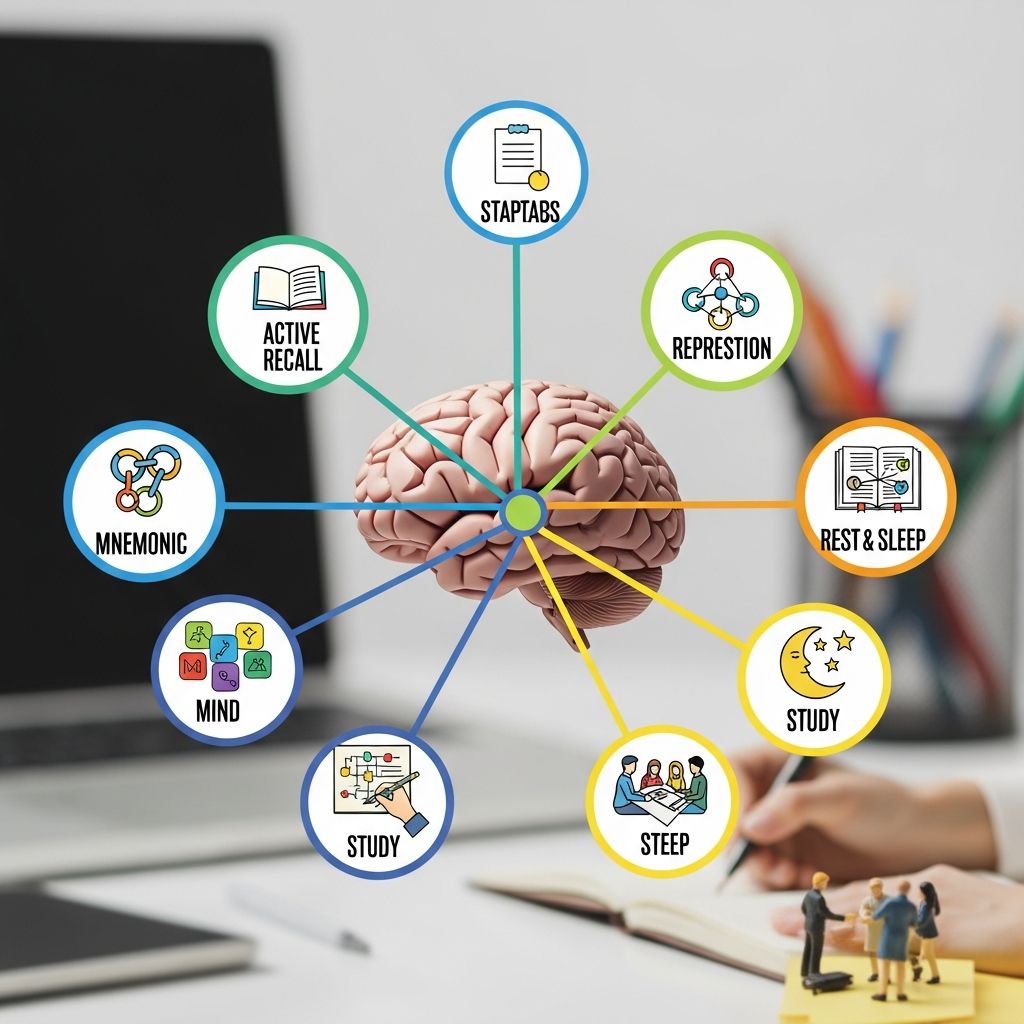
Effective memorization is essential for academic achievement, yet many students rely on inefficient cramming that leads to quick forgetting. Science reveals targeted strategies that strengthen long-term retention by leveraging how the brain processes and stores information. This article explores seven powerful, research-validated approaches to transform your study routine and excel in exams.
Harness the Power of Sleep for Memory Consolidation
Sleep is a cornerstone of memory formation, as it allows the brain to consolidate newly acquired knowledge into lasting neural pathways. During deep sleep stages, the hippocampus replays daytime learning experiences, transferring them to the neocortex for permanent storage. Studies demonstrate that students who prioritize sleep after studying outperform those who pull all-nighters, with retention rates improving by up to 40%.
To integrate this strategy, aim for 7-9 hours of quality sleep nightly, especially following intensive review sessions. Avoid screens an hour before bed to enhance melatonin production. Combine sleep with brief pre-sleep reviews: spend 10-15 minutes recapping key concepts. This timing maximizes consolidation, as the brain processes this material during subsequent rest cycles. Research from MIT underscores that sleep quality accounts for about 25% of performance variance in assessments, making it indispensable for high-stakes exams.
- Establish a consistent sleep schedule aligned with your study peaks.
- Use low-light environments for evening reviews to signal rest readiness.
- Track sleep with apps to correlate rest patterns with recall accuracy.
Neglecting sleep disrupts attention and impairs working memory, which affects one in ten students significantly. By treating sleep as active study time, you create a natural booster for exam readiness.
Implement Spaced Repetition for Lasting Retention
Spaced repetition involves reviewing material at strategically increasing intervals, countering the brain’s natural forgetting curve. Pioneered by psychologist Hermann Ebbinghaus, this method shows that distributed practice strengthens memory traces far better than massed rehearsal. For instance, revisiting vocabulary daily for a week, then weekly, embeds it deeply.
Start by dividing content into small units and scheduling reviews: immediately after learning, then after 1 day, 3 days, 1 week, and monthly. Digital tools like Anki automate this via algorithms that predict forgetting and prompt timely refreshers. A key benefit is efficiency—spaced sessions take less total time yet yield superior long-term recall, ideal for covering vast syllabi.
| Review Interval | Purpose | Example Timeline |
|---|---|---|
| Day 0 | Initial Exposure | Learn new chapter |
| Day 1 | Strengthen Trace | Quick quiz |
| Day 3-7 | Build Durability | Flashcard review |
| Week 2+ | Long-term Lock | Full recall test |
Evidence from educational psychology confirms spaced repetition boosts retention by 200% over cramming, particularly for subjects like languages or sciences requiring cumulative knowledge.
Build Mental Palaces to Visualize Complex Information
The method of loci, or memory palace, exploits the brain’s superior spatial memory by associating facts with familiar locations. Ancient orators used this to deliver hour-long speeches flawlessly; modern students apply it to lists, formulas, or processes. Imagine your home: place a giant apple on the doorstep for ‘photosynthesis,’ a dancing electron in the hallway for ‘ionic bonds.’
To construct yours, select a vivid mental route—your commute or bedroom—and populate loci with exaggerated, multisensory images. The weirder, the better, as novelty aids encoding. Retrieval involves ‘walking’ the path, triggering instant recall. Studies show this technique doubles retention for ordered information compared to rote listing.
- Choose 10-20 loci in a logical sequence.
- Link items with absurd, emotional stories for stickiness.
- Practice navigation daily to solidify associations.
This visual-spatial hack is especially potent for visual learners and high-volume data like historical timelines or anatomical structures.
Master Active Recall Through Rigorous Self-Testing
Active recall trumps passive reading by forcing retrieval from memory, mimicking exam conditions and forging robust pathways. Instead of re-reading notes, close the book and write or verbalize everything you remember. This ‘desirable difficulty’ enhances encoding, as shown in experiments where pre-testing groups outperformed study-only peers by 50% after delays.
Implement with flashcards: question on front, answer hidden. Quiz randomly, rating confidence to guide spaced reviews. Techniques like the Feynman method—explaining concepts simply as if teaching a child—reveal gaps and deepen understanding. Army resilience training emphasizes self-testing as a top hack for resilient memory under pressure.
Daily 20-minute sessions yield compounding gains; track progress to stay motivated. This method shines for problem-solving subjects like math or law.
Chunk Information into Manageable Patterns
Chunking groups data into meaningful units, easing cognitive load. The brain holds 5-9 items in working memory; by organizing phone numbers as 123-456-7890 or acronyms like PEMDAS (order of operations), recall becomes effortless.
Apply to studies: break a biology chapter into ‘cell structure,’ ‘functions,’ ‘processes.’ Use hierarchies—main ideas with sub-bullets. Patterns emerge naturally: group dates by eras, theorems by proofs. Research indicates chunking accelerates mastery by creating higher-level schemas.
- Identify natural categories in material.
- Limit chunks to 4-7 elements.
- Rehearse chunks progressively larger.
Employ Mnemonics and Narrative Weaving
Mnemonics encode info via acronyms, rhymes, or stories, leveraging the brain’s affinity for patterns and narratives. ‘My Very Educated Mother Just Served Us Noodles’ recalls planets; craft yours for lists or sequences.
Storytelling elevates this: weave facts into absurd tales. For history, imagine kings battling with props symbolizing events. Vivid, humorous narratives stick 400% better than dry lists, per visual learning studies. Practice by converting notes into 1-minute stories, retelling aloud.
Interleave Topics for Adaptive Mastery
Interleaving mixes subjects or problem types, unlike blocked practice, training discrimination and application. A math study switching algebra, geometry boosts problem-solving by 40%.
Schedule mixed reviews: 25 minutes history, switch to physics. This builds flexible recall, crucial for mixed exams. Combine with prior techniques for synergy.
Frequently Asked Questions (FAQs)
How long before an exam should I start spaced repetition?
Begin 4-6 weeks out, with daily short sessions ramping to weekly for core material.
Can memory palaces work for abstract concepts like economics?
Yes—symbolize ‘supply’ with overflowing crates, ‘demand’ with crowds; exaggeration aids abstraction.
What’s the ideal sleep duration for students?
7-9 hours nightly, prioritizing consistency over extra weekend catch-up.
Do digital apps outperform paper flashcards?
Apps excel in spacing algorithms; paper suits tactile learners—use what boosts engagement.
How does active recall differ from summarizing notes?
Recall generates from scratch without cues, strengthening retrieval far more than prompted summary.
References
- Top 7 Proven Memory Techniques for Students in 2025 — UNIMA eCampus. 2024-12-15. https://unima.ecampus.ac.mw/top-7-proven-memory-techniques-for-students-in-2025-to-remember-more-in-less-time/
- 7 Proven Hacks to Boost Your Memory & Smartup Your Study Time — Army Resilience Directorate. 2023-08-10. https://www.armyresilience.army.mil/ard/r2/study-memory-hacks.html
- 7 Memorisation Methods to Remember 3x More — YouTube (Educational Channel). 2024-11-20. https://www.youtube.com/watch?v=Fd1Zf9qCTtQ
- 7 Memory Techniques For Students To Boost Learning And Recall — NDTV Education. 2024-09-05. https://www.ndtv.com/education/7-memory-techniques-for-students-to-boost-learning-and-recall-9405381
- 101 Series: 7 Science-Based Tips for Learning and Improving Memory — Amplifire. 2023-05-12. https://amplifire.com/resource/101-series-7-science-based-tips-for-learning-and-improving-memory/

- Integrated M.A. in Applied Linguistics, University of Hyderabad
- 5+ years in editorial, instructional, SEO, and research-based writing
Sneha is a relationships and lifestyle writer with a strong foundation in applied linguistics and certified training in relationship coaching. She brings over five years of writing experience to theskillvault, crafting thoughtful, research-driven content that empowers readers to build healthier relationships, boost emotional well-being, and embrace holistic living. Her writing and insights reflect the belief that beauty, happiness, and wellness…