
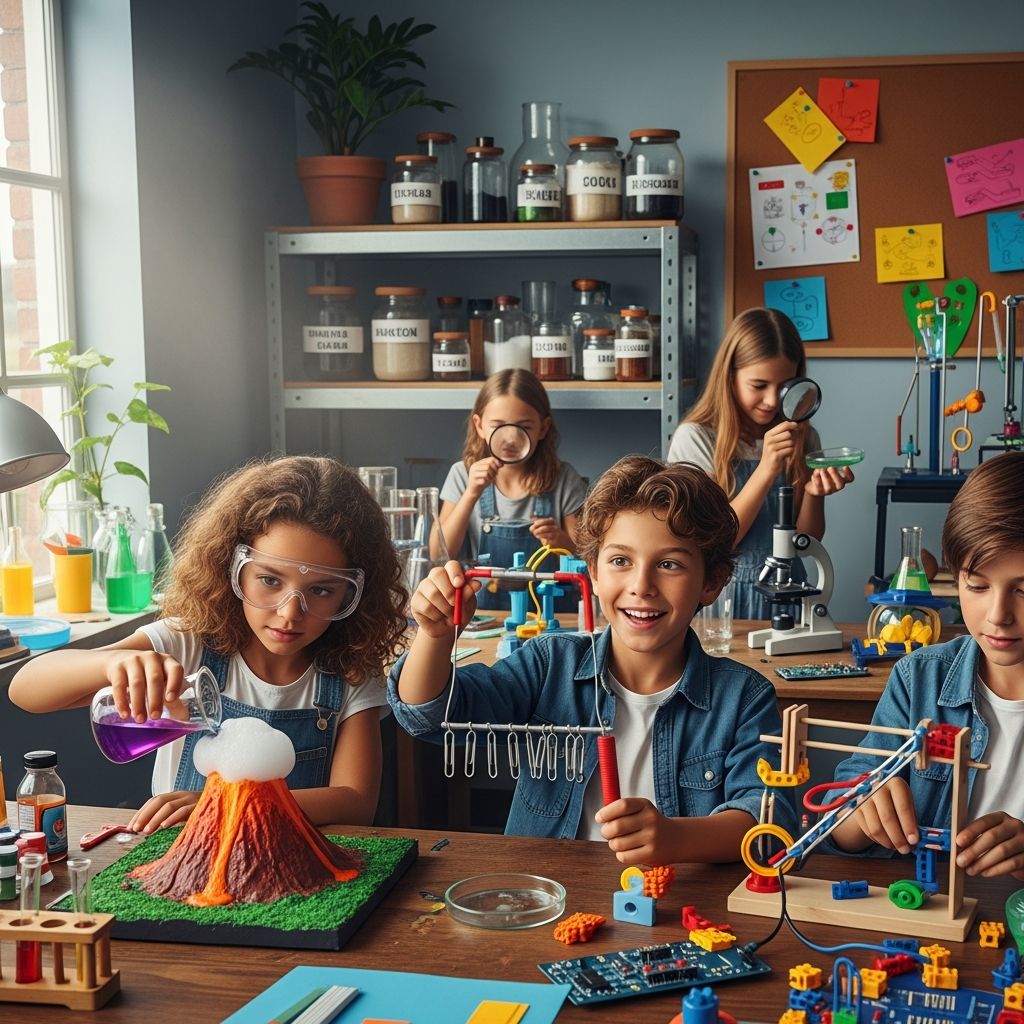
Introducing children to science through hands-on activities builds lasting interest in discovery. These projects use common household items to demonstrate principles like density, chemical reactions, and physical properties, fostering critical thinking and creativity in young learners.
Why Hands-On Science Matters for Children
Interactive experiments help kids grasp abstract concepts by observing real-world effects. They encourage questioning, prediction, and experimentation, aligning with educational standards from early years through primary school. Research from the National Science Teaching Association emphasizes that such activities improve retention of STEM concepts by up to 75% compared to passive learning.
1. Dancing Bubbles: Oil and Water Spectacle
This mesmerizing display reveals how immiscible liquids behave due to density differences and gas production.
Materials Needed
- Clear glass or jar
- Water
- Vegetable oil
- Food coloring
- Effervescent tablets or baking soda and vinegar
Step-by-Step Instructions
- Fill the jar one-quarter with water and add several drops of food coloring.
- Pour oil to nearly fill the jar, creating a distinct layer on top.
- Drop in pieces of effervescent tablet; watch colored bubbles rise and fall.
The oil floats on water because it is less dense. Gas from the reaction carries colored water upward, releasing it at the top to sink again, mimicking a lava lamp.
2. Edible Crystal Gardens
Grow sparkling sugar crystals to explore supersaturation and crystallization processes.
Materials Needed
- Granulated sugar
- Water
- Glass jar
- String or pipe cleaner
- Food coloring and edible glitter (optional)
Step-by-Step Instructions
- Boil 2 cups water and dissolve 4 cups sugar slowly, stirring until clear.
- Add coloring and glitter, then pour into jar.
- Suspend string in solution and let sit undisturbed for 1-2 weeks in a cool place.
As the solution cools, excess sugar molecules bond into crystals. This demonstrates how minerals form geodes in nature.
3. Explosive Chemical Eruptions
A timeless reaction showcasing acid-base chemistry and carbon dioxide production.
Materials Needed
- Modeling clay or playdough
- Small container
- Baking soda
- Vinegar
- Food coloring (optional)
Step-by-Step Instructions
- Mold clay into a volcano shape around the container.
- Add baking soda and coloring to the crater.
- Pour in vinegar quickly and step back.
Baking soda (base) reacts with vinegar (acid) to produce CO2 gas, causing foam to erupt. This models volcanic activity safely.
4. Color Migration Marvel
Observe capillary action and diffusion as colors ‘walk’ between containers.
Materials Needed
- 6 clear glasses
- Water
- Food coloring (red, blue, yellow)
- Paper towels
Step-by-Step Instructions
- Fill glasses 1, 3, 5 with water; add red to 1, blue to 3, yellow to 5.
- Leave 2, 4, 6 empty.
- Connect adjacent glasses with twisted paper towel bridges; wait hours for mixing.
Water travels via absorption in paper fibers, blending into secondary colors, teaching liquid movement in plants.
5. Egg Protection Challenge
Engineer protective devices to explore impact forces, gravity, and materials science.
Materials Needed
- Raw eggs
- Household recyclables (straws, tape, cotton, etc.)
- High surface for dropping
Rules and Tips
Teams build contraptions to prevent egg breakage from 2-meter drops. Test designs iteratively.
| Material | Strength | Shock Absorption |
|---|---|---|
| Straw Frames | High | Medium |
| Cotton Padding | Low | High |
| Tape Layers | Medium | Low |
Success relies on distributing force away from the egg, akin to real engineering like car crash safety.
6. Non-Newtonian Mystery Substance
Create Oobleck to investigate states of matter and shear-thickening fluids.
Materials Needed
- Cornstarch
- Water
- Food coloring (optional)
Step-by-Step Instructions
- Mix 2 cups cornstarch with 1 cup water gradually.
- Add coloring; knead to form dough-like consistency.
- Test: punches solidify it, slow pressure flows.
Oobleck behaves as solid under stress but liquid otherwise, illustrating non-Newtonian properties used in bulletproof vests.
7. Rainbow Density Tower
Layer liquids by density to form a stable, colorful column.
Materials Needed
- Honey, dish soap, water, oil, rubbing alcohol
- Food coloring
- Tall glass
Step-by-Step Instructions
- Color each liquid distinctly.
- Pour slowly: honey bottom, then soap, water, oil, alcohol top.
Denser liquids sink below lighter ones; molecules’ mass and spacing determine position, explaining ocean layering.
8. Dissolving Candy Diffusion
Watch colors spread in water to learn about solubility and molecular movement.
Materials Needed
- Plate
- Skittles or similar candies
- Warm water
Step-by-Step Instructions
- Arrange candies in circle on plate edge.
- Pour central water gently; observe color trails.
Sugar coating dissolves, dyes diffuse outward randomly until even, demonstrating entropy in solutions.
Safety Guidelines for All Experiments
- Supervise children at all times.
- Use eye protection for eruptions.
- Avoid ingestion unless specified edible.
- Clean spills immediately to prevent slips.
Frequently Asked Questions
What ages are these experiments suitable for?
Most suit ages 5-12; simplify for younger kids by reducing steps or heights.
Can I adapt these for classrooms?
Yes, scale materials for groups and discuss observations collectively.
What if an experiment fails?
Failures teach troubleshooting; discuss variables like temperature or ratios.
Are these aligned with school curricula?
They cover key topics in physics, chemistry, and engineering per NGSS standards.
Extending the Learning
After each project, prompt questions: ‘Why did that happen?’ Journal predictions vs. results. Connect to nature, like crystals in caves or density in oceans. Repeat with variations for deeper understanding.
These activities not only entertain but cultivate lifelong scientific inquiry. Stock your home lab today and watch curiosity flourish.
References
- National Science Teaching Association Standards — NSTA. 2013. https://www.nextgenscience.org/
- Simple Science Experiments for Elementary Classrooms — U.S. Department of Education. 2022-10-15. https://www.ed.gov/sites/default/files/documents/stem/STEM-Activities-for-Home.pdf
- Hands-On STEM Learning Guide — National Institutes of Health. 2024-03-01. https://www.nigms.nih.gov/education/fact-sheets/Pages/stem-learning.aspx
- Physics Demonstrations for K-12 — American Association of Physics Teachers. 2023-06-12. https://www.aapt.org/resources/demonstrations/
- Chemical Reactions in Education — American Chemical Society. 2025-01-20. https://www.acs.org/education/resources/k-8.html

Medha Deb is an editor with a master's degree in Applied Linguistics from the University of Hyderabad. She believes that her qualification has helped her develop a deep understanding of language and its application in various contexts. Medha specializes in the areas of beauty, health, sports, and wellness and is committed to ensuring that the content on the website is…